Namibia is the only country in the world to have suffered a downgrade by the World Bank Group’s latest classification. The global financial institution has now officially labelled Namibia a lower-middle-income country from the previous classification as an upper-middle-income country. The World Bank bases this classification on Gross National Income (GNI) per capita expressed in...
Author: Edgar Brandt (Edgar Brandt )
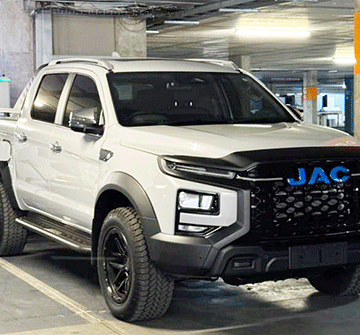
LDV’s T60 Max delivers more power …as the two-litre bi-turbo diesel engine turns heads
When you put your foot down on the accelerator of the LDV’s T60 Max double cab, it is quite evident why Namibian consumers are steadily migrating to Chinese automotive brands. You feel an immediate exhilaration as adrenalin rushes through your body in response to the superb performance oozing from the T60 Max’s 2 litre bi-turbo...
Economy grows for 16th consecutive quarter
Namibia’s real GDP growth for the first quarter of 2025 dipped to 2.7% year-on-year (y/y) from 4.8% in the corresponding quarter of last year. While this is a notable slowdown in growth, it still marks the 16th consecutive quarter of domestic economic growth. Local analysts pointed out that the latest figures, released this week by...
NIPDB realignment part of efforts to drive trade
The Namibia Investment Promotion and Development Board (NIPDB) has welcomed the strategic alignment by President Netumbo Nandi-Ndaitwah for it to resort under the Ministry of International Relations and Trade. NIPDB’s chief executive officer Nangula Uaandja, said the move is part of a broader effort to streamline government’s economic development agenda and to enhance coordination across...
July fuel prices remain unchanged
Despite extreme volatility of international oil prices coupled with under-recoveries in the domestic market, local fuel prices will remain unchanged for July 2025. This is as the Ministry of Industries, Mines and Energy provides relief to consumers by keeping fuel prices for all products unchanged until the next review. Other factors that impacted the international...
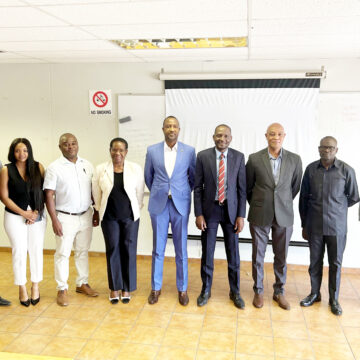
SanlamAllianz Namibia embarks on new era …brings together industry leaders with shared African vision
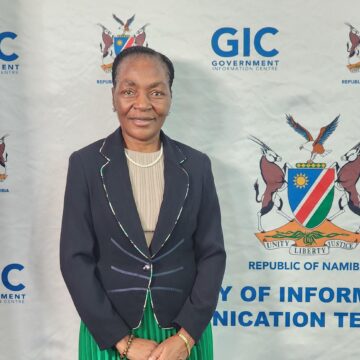
In a bid to access a large untapped African market and to provide appropriate and accessible financial solutions that reach across all levels of society, Sanlam this week officially rebranded as SanlamAllianz Namibia. This landmark development for Namibia’s financial sector was officially announced and unveiled by information and communication technology minister Emma Theofelus on Tuesday...
FIC to address 13 deficiencies by May 2026
An action plan by Namibia’s Financial Intelligence Centre (FIC) addressed 13 strategic deficiencies related to the ineffectiveness of the country’s antimoney laundering (AML), counterterrorism financing frameworks (CFT) and Countering Proliferation Financing (CPF). These deficiencies have to be remedied within various set timelines, which expire in May 2026. This is according to Bryan Eiseb, director of...
Europe designates Namibia as high-risk
The European Commission (EC) last week designated Namibia as a high-risk jurisdiction for antimoney laundering (AML) and counterterrorism financing frameworks (CFT). The EC updated the European Union (EU) list of high-risk jurisdictions and placed Namibia in high-risk jurisdictions such as Algeria, Angola, Côte d’Ivoire, Kenya, Laos, Lebanon, Monaco, Nepal and Venezuela. The EC’s decision is...
‘Namibia loses opportunities in delaying nuclear power’
Not capitalising on its abundant uranium resources to generate nuclear power sooner than later will deprive Namibia of a reliable energy source which will result in missed economic and job creation opportunities. This is according to Set-son Shifidi, a Namibian energy engineer. He said taking early action will help Namibia meet its future energy needs,...
On the spot with Edgar Brandt – Reducing debt and ensuring sustainable growth
Government, through the finance ministry, is actively reducing the country’s reliance on external borrowing in favour of prioritising the domestic financial market. Currently, government’s borrowing plan involves financing debt with 80% from domestic sources and borrowing and 20% from external sources. Also, most of Namibia’s external debt is denominated in South African Rand to avoid...