

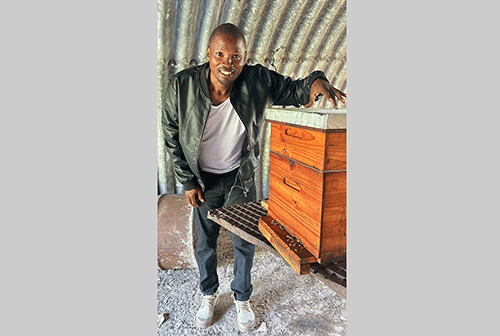

OMEGA 1 – A beekeeper from Omega 1 within the Bwabwata National Park in Kavango East, David Mushavanga, has branded his honey as ‘Bushman honey’, and called on government to protect these crucial bee species.
This, he stressed, will be done through investing in beekeeping projects.
Mushavanga said bees are vital for any ecosystem to ensure food and fruit production through plant pollination.
Behaviours that threaten the existence of bees, such as burning of forests, must be condemned. Beekeeping, also known as apiculture, is the practice of keeping honeybee colonies (bees) in beehives to collect honey and other bee products. It is a significant source of pollination for crops and provides valuable bee products, he elucidated.
“Why is Namibia not doing more research to advance beekeeping as an industry so that these bees can be protected? The burning of forests and cutting of trees must be controlled, and a law must be made so that these bees can be protected. Awareness must be made throughout our communities. Just like how wild animals are protected, bees need to be protected, as our vegetation depends on them,” the beekeeper stated.
Research has shown that if the numbers of bees decline or go extinct, it would cause a catastrophic disruption to global ecosystems and food production, as they are vital pollinators for many plant species, including those which provide a significant portion of human food sources. Without bees, many plant species would struggle to reproduce, leading to a decline in food availability for both humans and other animals, and leading to the loss of vegetation in the long run.
Conservation
Apart from contributing to biodiversity, ecosystem health and even forest conservation through their pollination efforts, bees are crucial to the ecosystem, largely due to their character as pollinators, which is essential for plant reproduction and food production.
New Era recently visited Mushavanga to see how his beekeeping and producing project is doing.
“I have the skills to produce more, but I also need to increase my bees because what I have is few; at the moment I have 5 beehives,” he noted.
Mushavanga is a beneficiary of a government project through the prime minister’s office which aims to empower members of the San community.
“There’s a programme which came through the prime minister’s office years back, led by Dr Libertina Amadhila as the prime minister at that time. It was aimed at empowering the San community, and when she came to our area, she asked for different project ideas that can uplift the livelihoods of the San people,” he said.
“She was initiating a lot of projects, like mushroom projects, brick-making projects, gardening, poultry and many more. I was thinking of this project because even before she visited our area, one day I picked up a newspaper article from Kenya, and I read about a beekeeping project which was published in that paper. I read about the importance of it, and then it challenged me and inspired me. When she visited, I thuis informed her about my aspirations of becoming a beekeeper,” he narrated.
Mushavanga said during the time that she visited their village, he had just finished his grade 12, and was the one translating for her.
He took advantage of that, and he introduced the beekeeping project idea to her, and told her that since it wasn’t done widely in Namibia at that time, he wanted to be supported to start.
“And she took my idea, and went to consult to see the viability of it all. After that, she brought me a response, and said she would not only support me to do it as an individual, but collectively with all San communities, including me. She invited two participants per region, hired a trainer from Kenya, another one from Italy and one from South Africa. We were trained at Neudamm Agricultural College in 2006 for a special short course on bee-keeping. We did a lot of theory and practical activities, including equipment assembly and more,” he added.
After training, they were funded with starting capital; each participant also got honey-extracting machines for processing the honey, a bee suit (protective clothes) and two hives. “And when I came back, I engaged the traditional authority who gave me the land, and asked people to assist me. At the beginning it took time, and in 2009 I officially started the project. I got my first honey from the bees in 2011; that’s when people started to believe me, and I made my first sales,” he beamed.
Struggle
The first years were a struggle, but in the third year he managed to get things moving. He was also interviewed on television that put him on the spot, and environmental-related organisations popped in to offer their support, which brought him to the level he is at now.
The project is a valuable one, but expensive. “Apart from honey, we are supposed to harvest beeswax, which is used to make candles and some lubricants. I can harvest bee pollen used to make some medicines, toothpastes, lotion and other things. There’s also propolis that some pills are made from, and so far, I’m not producing the above because of financial constraints and lack of capacity. If capacitated, I can do all that, as they are quite technical and need certain equipment investments and are costly to produce. But at the moment my focus is still on honey, and I’m planning on moving to producing wax products later.
“Apart from keeping bees to have honey, sometimes farmers with bigger farms hire my bees for pollination. I thus take my beehives there for a certain period, and make an income. For me to move from just making honey into other bee products is to expand my capacity by having more beehives for me to produce more, and be able to do other products. I also need certain advanced skills; I need an expert to redirect me. “Bees are valuable insects. If they are endangered, we won’t have a beautiful environment because there won’t be pollination going on, and trees won’t bear fruit. They are important,” he stressed.
-jmuyamba@nepc.com.na