

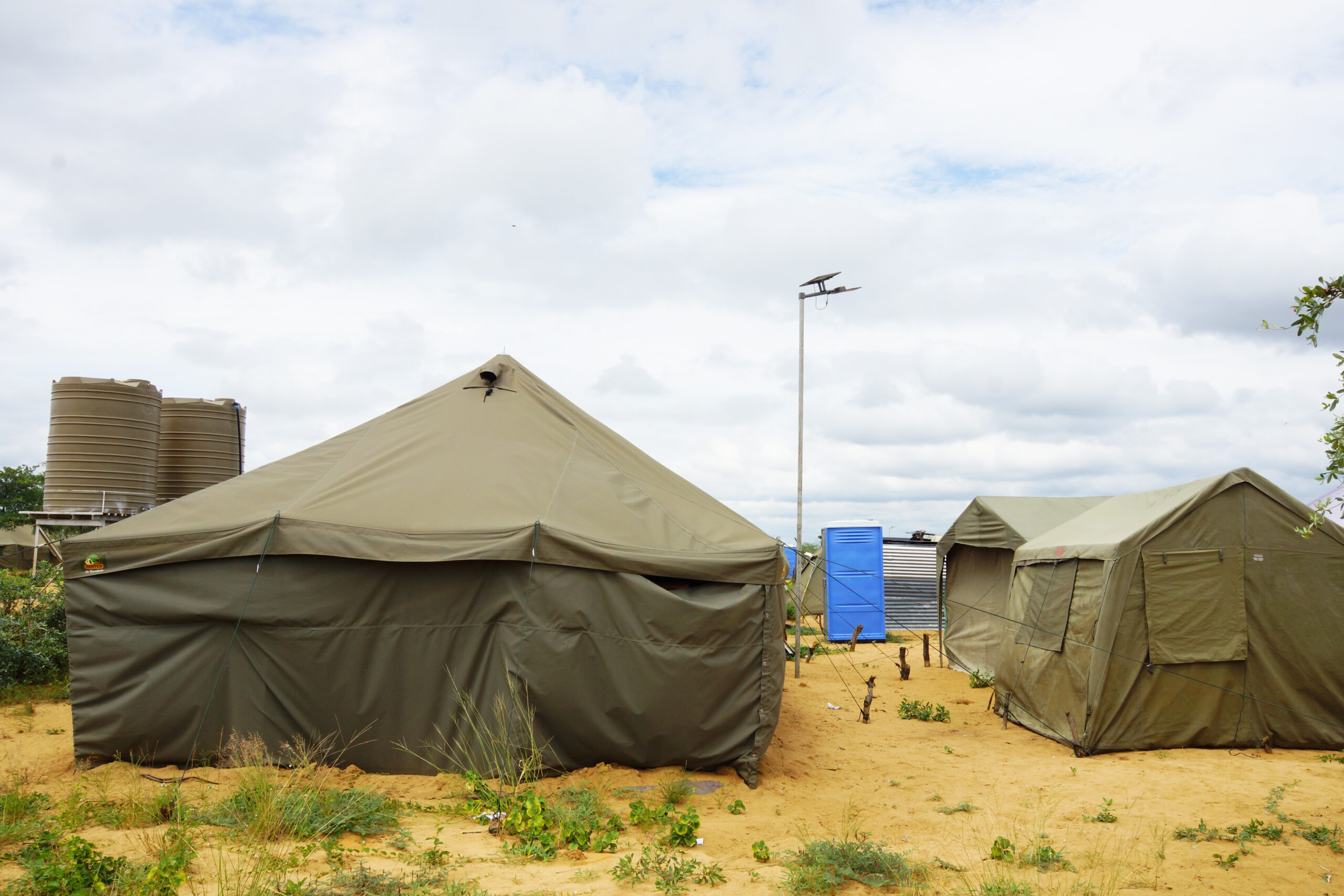

Hundreds of Botswana returnees of Namibian descent, currently housed at a reception area in the Gam settlement, will finally have places of their own to call home. This follows government’s announcement that some will receive resettlement units at farms across the Otjozondjupa region, while others will be resettled at Otjipaheua village in the Gam area.
Land reform minister Inge Zaamwani yesterday paid a personal visit to the families at the reception area on the outskirts of Gam, where she announced that government has commenced with the allocation of farming units to the returnees.
To date, the Namibian government has invested over N$60 million in the purchasing of six farms measuring a combined 23 000 hectares to resettle the returnees.
Three of those farms are in the Otjozondjupa region, while the remaining ones are in the Hardap and Omaheke regions.
An additional N$115 million has been spent on the establishment and maintenance of the reception at Gam, which includes the monthly supply of food items, potable water and access to general health care and safety for the hundreds of families.
All the returnees currently at the reception area have been issued with Namibian IDs and passports, and the elderly have already been enrolled to receive old-age grants and other social benefits from the Namibian government.
In Namibia, the old-age pension grant is N$1 600 for all citizens above the age of 60, while in Botswana, the government’s old-age pension grant is P1400, and citizens only qualify from the age of 65.
Zaamwani yesterday said eight families from the group will be relocated to the purchased farms in the Otjozondjupa region, where they will receive farming units that will enable them to commence with commercial farming activities and other economic undertakings.
The remaining group of families will be relocated to Otjipaheua village within the vicinity of Gam, which is a large track of virgin land where government has drilled boreholes, erected state-of-the-art cattle auction pans and access roads.
Transport to relocate the families and all their belongings to the new locations will be provided for by government, including the necessary post-resettlement support for farmers.
Zaamwani yesterday assured the returnees that President Netumbo Nandi-Ndaitwah remains unwaveringly committed to the full integration of the returning Batswana of Namibian descent into Namibian society.
As part of its ongoing efforts to resettle, integrate and create economic opportunities for them, the minister said government will continue to work hand in hand with all relevant offices, agencies and traditional authorities to ensure seamless incorporation.
“As we speak, some of the trucks are parked outside this hall waiting for you to start the relocation process. Let’s remember that this will not be a one-day process, so teamwork and cooperation will be very important in getting us all to where we want to be. Government will provide all the necessary support to ensure that families become productive citizens of this country, just like all other Namibians,” she said.
In 2023, Cabinet directed the international relations ministry, the home affairs ministry, the ministries of gender equality, and of land reform, to spearhead the repatriation process and ensure the smooth issuing of all required documents.
Cabinet also directed the gender equality ministry to provide social grants to the returnees within three months of their date of entry, and for the health ministry to fully capacitate the Gam clinic to cater for the projected growing number of this community.
Context
The hundreds of returnees at Gam are primarily the descendants of the Ovaherero and Ovambanderu who fought and perished in the war of resistance against German colonial troops between 1904 and 1908.
The few survivors of that gruesome genocidal war ended up in Botswana, and today, their descendants continue to show growing willingness to return in their hundreds to their motherland, Namibia.
Presently, thousands of these descendants are found in various villages and settlements across Botswana, particularly in the Ghanzi, Tsau, Maun, Semboyo, Komana and Chanoga areas, many of whom are subsistence farmers rearing thousands of cattle, sheep, goats and others.
Many others are also found in Botswana’s vast Ngamiland district at places such as Charleshill, Kareng, Bothatogo, Toteng, Sehithwa, Bodibeng and Makakung.
The first group of Batswana of Namibian ancestry were repatriated from that country in April 1993, and that number has since immensely grown over the years, and continues to grow.
– ohembapu@nepc.com.na