

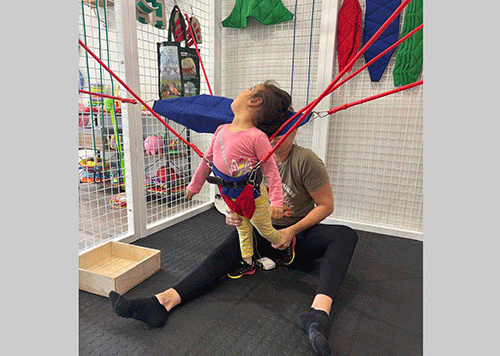

WALVIS BAY – Two coastal mothers have teamed up to establish a centre offering child-centred therapy services for children with developmental and neurological challenges.
Instead of travelling abroad, as is usually required for their children to access world-class treatment, the families opted to channel those funds into establishing a centre.
The centre will not only enable their own children to receive care locally but also assist other parents who do not have the means to travel abroad to access such services.
The initiative, ‘Beyond Barriers Paediatric Therapy’ in Swakopmund, was co-founded by Anthea Kostin and Manuela van Schalkwyk.
It was developed from their personal experiences as parents navigating intensive therapy systems for their own children outside Namibia.
The neurodevelopmental centre provides intensive, evidence-based therapy for neurodiverse children, offering specialised services to enhance independence.
The centre aims to address a shortage of specialised neurodevelopmental services in Namibia and reduce the financial and emotional burden on families who are often forced to seek treatment abroad.
Kostin said her journey began after the birth of her premature baby at 28 weeks, an experience she described as traumatic.
She said the immediate separation from her child after delivery was particularly distressing. “I woke up in the hospital after she was born, and my baby was not there. I was not allowed to see her until the next day. It is very intimidating, seeing machines and wires while her face was covered with plasters and tubes,” she said.
She said being discharged without her baby and returning daily while still recovering was one of the most difficult periods of her life. “What nobody prepares you for is walking out of the hospital without your child, and then having to come back every single day for two months while you’re still physically and emotionally recovering,” she said.
Kostin said her daughter was later diagnosed with bacterial meningitis, which resulted in a severe brain injury and hearing loss. She said this changed her expectations of motherhood and development.
“There is grief in that – real grief. Having a child with a brain injury changes how you see progress. What others might overlook becomes everything,” she said.
She said the family initially travelled abroad for therapy, but the financial and emotional strain became unsustainable.
“We were travelling, trying everything, and carrying both the financial and mental strain as a family,” she said.
They decided to redirect funds set aside for overseas treatment into establishing services locally, ensuring children in Namibia can access consistent care.
Van Schalkwyk said her daughter was diagnosed with a brain injury following a prolonged birth in 2015.
She said the family only noticed developmental concerns at nine months, after which they were referred to a paediatric neurologist in Cape Town. “Since then, this has been our life for the past 11 years,” she said.
She said the lack of specialised services in Namibia forced the family to travel to Cape Town every three months for neurological physiotherapy and occupational therapy. “We used to travel to Cape Town every three months for the first three years. Namibia simply does not have these services, and every special needs child desperately needs them,” she said.
Van Schalkwyk said her daughter later underwent stem cell treatments in India at the age of four, followed by additional therapies in the United States last year. After these interventions, her daughter began speaking and later took her first steps using a walking frame.
She said each milestone remains significant for families living with developmental challenges. Van Schalkwyk said the repeated international travel and high costs led her and Kostin to establish ‘Beyond Barriers Paediatric Therapy’ in Swakopmund.
The centre now provides structured, evidence-based therapy locally and also brings internationally qualified therapists to Namibia to expand access to specialised care.
“Through research, we realised many children in Namibia need specialised care. Some families cannot afford to travel, yet their children have the potential to lead fuller lives,” she said.
The journey has been emotionally and financially difficult, but it has also given their experience purpose, she added.
“We believe we were meant to go through this, not only to experience it, but to use it to help other children and families,” she said.