

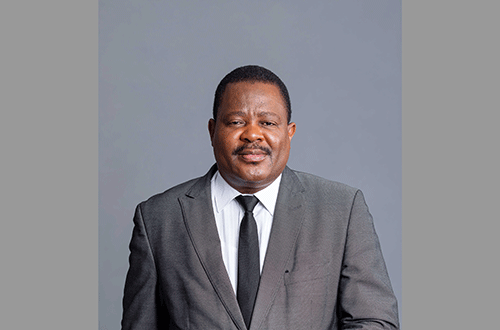

Chief Executive Officer of the Electricity Control Board (ECB), Robert Kahimise, on Friday said NamPower is owed a total of N$912 million by various entities across the country. Kahimise made the announcement during a media briefing, where he outlined the growing debt owed to the national power utility.
According to the ECB, local authorities and State-owned enterprises (SOEs) that are in breach of repayment agreements account for N$557 million of the total debt as of 25 November 2025. Mariental Municipality owes the largest amount at N$233.29 million. This is followed by Gobabis Municipality with N$70.2 million, Karasburg Municipality with N$59 million, Aranos Town Council with N$58 million, Maltahöhe Village Council with N$34 million, Gibeon Village Council with N$24 million, and Bethanie Village Council with N$21 million.
Kahimise said local authorities under bulk prepayment arrangements collectively owe N$210 million. He highlighted the Rehoboth Town Council, which has been on the bulk prepayment system since May 2024. However, as of 25 November 2025, its account showed a negative balance of N$12 million.
“This situation can lead to an immediate disruption of electricity supply,” Kahimise said. He added that local authorities, regional councils, government offices, regional electricity distributors (REDs), and SOEs without repayment arrangements owe a combined N$72 million. Among the highest debtors in this category are Lüderitz Town Council with N$22 million, Keetmanshoop Municipality with N$20 million, and the //Kharas Regional Council with N$10 million.
NamPower is also owed N$70 million by Angola’s utility company, RNT Angolan Utility Company.
Kahimise announced that the ECB board has approved NamPower’s Integrated Strategic Business Plan (ISBP) for the period 2026 to 2031. The new plan will take effect after the current ISBP ends on 31 March 2026.
He said the plan sets out a strategic roadmap to strengthen Namibia’s electricity sector and prepare the ECB for its transition into the Namibia Energy Regulatory Authority (NERA).
Kahimise said the electricity sector continues to face major challenges, including rising demand, dependence on imported power, affordability concerns, and increasing expectations for reliable and high-quality service. “The ISBP shows how a modern, data-driven and incentive-based regulatory environment can improve performance and resilience in the sector over the next five years,” he said.
He noted that for more than 20 years, the ECB has provided regulatory stability, transparency, and consumer protection, while supporting investor confidence and orderly development of the sector.
The transition to NERA, he said, reflects the ECB’s focus on strengthening current regulation while preparing for a wider energy mandate. The launch of the new ISBP is expected to take place in March 2026.
Kahimise said, electricity can be a deadly commodity as it can cause burns, electric shocks or even death if not handled properly, especially now that we are in a rainy season.
“We urge the public to handle appliances and power cords cautiously. Avoid fallen or low hanging electricity lines/poles and damaged electrical wires, and report them to your nearest electricity distribution company. Don’t climb on electricity poles or trees next to electricity lines. Never throw objects onto electricity lines or remove objects stuck on electricity lines,” he said.
The ECB reaffirmed its commitment to safeguarding Namibia’s electricity sector by ensuring affordability, reliability, and security of supply, while promoting sustained industry performance and economic growth through prudent and balanced regulatory decisions.