

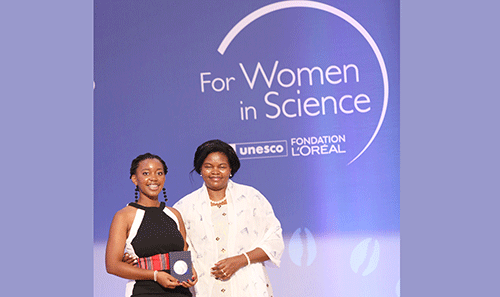

Namibia’s Doctor of Philosophy student at the University of Cape Town, Hilja Eelu, scooped an award at the 2024 L’Oréal-UNESCO For Women in Science (FWIS) sub-Saharan Africa Young Talents Awards recently.
She is among 30 researchers selected from an application pool of 788.
Her research focuses on the mathematical modelling of the malaria context in Namibia.
She is also a lecturer at the University of Namibia within the Department of Human, Biological and Translational Medical Sciences.
Eelu said the award opens doors for training opportunities to strengthen her skills in mathematical modelling.
Coming from a biology background, this transition into math has been a big one, she shared.
“So, the idea of mathematical modelling is to simulate local conditions or local health system dynamics, and then put in these scenarios of the different control programmes that the government is operating, and see what combinations could get us to elimination quicker,” she noted.
“These are things that ordinarily you do a field study for, or you just execute and see the results for, and evaluate afterwards. But with, mathematical modelling or these computer simulations that I’m doing as part of my PhD, ideally, then we can see the results of any given combination quicker, or it could just provide insight into what to execute or implement on the ground.”
It is the scientist’s hope that more Namibian, especially women, would have access to this kind of funding to support and extend the work that they are doing.
Eelu said, there are plenty of women doing post-doctoral training at local institutions and doing their PhDs, who need opportunities to showcase their work.
“My advice to young women is that in general, there are so many opportunities within Science, Technology, Engineering, Mathematics, and there are so many interesting problem-solving questions that one can be asking. Even if we are just looking at the biological sciences or the health sciences, there are so many ailments that people suffer from that you can address from any given angle,” she said.
Ever since its creation, the L’Oréal-UNESCO For Women in Science Young Talents sub-Saharan Africa programme has recognised 240 young researchers from more than 34 African countries, and received over 4 000 applications. These scientists have benefited from financial support, including research grants of €10 000 (N$ 193 020) for PhD candidates, and €15 000 (N$ 289 471.50) for post-doctoral researchers, along with training in leadership, communication and negotiation to better respond to sexism, among others.
Since 1998, the L’Oréal-UNESCO For Women in Science programme has worked to empower more female scientists to overcome barriers to progression and participate in solving the great challenges of our time for the benefit of all. For 26 years, it has supported more than 4 400 women researchers from over 140 countries, rewarding scientific excellence, and inspiring younger generations of women to pursue science as a career.
-pmukokobi@nepc.com.na