

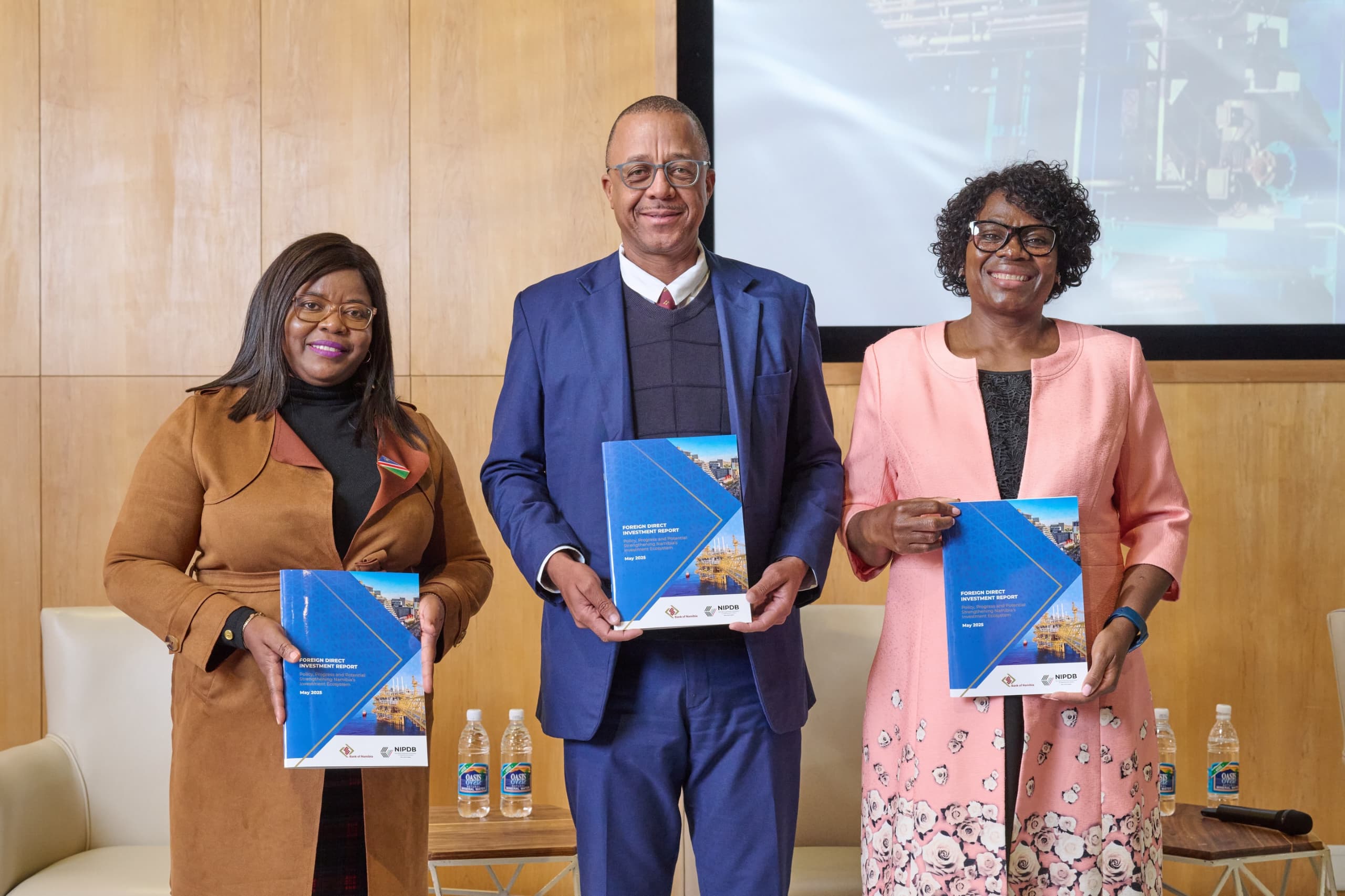

Namibia has recorded cumulative net foreign direct investment (FDI) inflows of N$114.9 billion since 2021, marking a resurgence in investor confidence fuelled by major hydrocarbon discoveries and sweeping reforms to create an attractive investment environment.
This was revealed on Wednesday in Windhoek during the launch of Namibia’s FDI report, which marked a significant moment for the domestic economic transparency and data-driven policymaking.
Deputy governor of the Bank of Namibia, Ebson Uanguta, said the upward FDI trajectory reflects renewed global interest in Namibia, particularly following the discovery of vast oil and gas reserves in Namibia’s Orange Basin.
“From 2021 onwards, we’ve seen a dramatic turnaround in net FDI flows, largely owing to the energy sector. This recovery follows a temporary dip in 2019 and 2020, when global uncertainty and the Covid-19 pandemic subdued investor activity,” he said.
He added that Namibia is positioning itself as a stable and resource-rich destination for capital in an increasingly competitive global landscape. While the energy sector remains a key draw, the government is also eyeing investment expansion into agriculture, tourism, digital technology, transport and logistics, and green industries such as hydrogen.
The country’s FDI trajectory has not been linear. Since independence in 1990, Namibia has taken bold policy steps to foster a conducive investment environment. Early legislative frameworks, including the Foreign Investment Act of 1990, laid the groundwork for economic openness.
A major boost came in 1996 with the introduction of the Export Processing Zone (EPZ) regime, offering tax incentives and policy certainty to export-focused investors.
Between 1998 and 2008, the country attracted N$25.7 billion in FDI, largely targeting the manufacturing sector. This was followed by a further N$56.5 billion in net FDI between 2009 and 2018, driven by greenfield projects in the mining sector, particularly uranium and gold, as well as growth in the financial and retail sectors.
Deputy Minister of International Relations and Cooperation Janelly Matundu said Namibia’s recent FDI surge is not only driven by oil and gas, but also by increased capital inflows into diversified sectors.
“Over the past four years, Namibia attracted over N$114.9 billion in net FDI inflows, including N$56 billion into sectors beyond oil and gas. This reflects growing global recognition of Namibia’s strategic assets our natural resources, our governance credentials, and our geographic advantage at the intersection of African and global markets,” she said.
Matundu highlighted several investment success stories, including Namibia Berries in Divundu, which exports premium fruit to Europe and Asia while creating hundreds of local jobs, and the Clean Energy green hydrogen pilot project in Walvis Bay, which is positioning Namibia as a regional leader in renewable energy.
“Inactive mines have resumed operations, and new ventures are taking root across our region, offering renewed hope and opportunity to our people,” she added.
Matundu added that the report also calls for introspection and informs policy makers that nearly 70% of FDI remains focused on capital-intensive, resource-seeking investments. While these investments are critical for revenue and foreign reserves, they do not address some of the most urgent development imperatives, including creating employment at scale and building value chains that retain more local benefits.
“To this end, we must now focus on attracting and facilitating FDI in labour-intensive and innovation-driven sectors such as tourism and hospitality, agribusiness and agro-processing, the digital and creative economy, light manufacturing, and logistics. These sectors offer the greatest potential for job creation, skills development, and long-term sustainability,” she said.
-pmukokobi@nepc.com.na