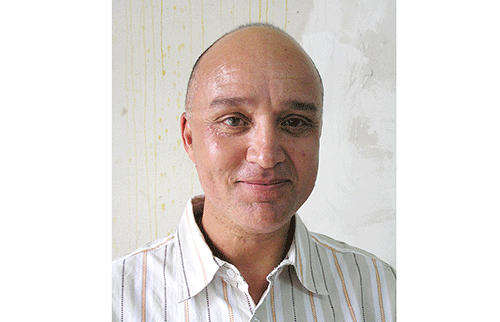

Rudolf Gaiseb
The number of female-headed households has increased over the past five years, with almost half of Namibia’s households being headed by women.
The population and housing census revealed that 49% of total households in the country are headed by women, compared to 43.9% reported by the World Bank 10 years ago.
In a recent interview with New Era, psychologist Shaun Whittaker said the rise stems from how women react to the joblessness Namibia is facing.
He said post-independence has noticed a dissolution of patriarchy in some societies to level the playing field for all sexes.
On the other hand, Whittaker believes the whole nuclear family paradigm has never taken a stronghold, adding that Namibian communities have matriarchal families.
He noted that female-headed households are not having it easy.
“It’s difficult because there’s tremendous financial pressure if you only have one income. It’s tough on the children because there’s limited finances. It makes a difference in terms of the kind of food you eat, the kind of extramural activities you can do, and the kind of school you can go to. It makes a huge difference in terms of how people live,” he noted.
Whittaker said men should take responsibility of helping to raise their children through financial and emotional means even when separated from the child’s mother.
He added that taking care of children should not be dependent on whether parents are still in a relationship or not.
“Men are still responsible for the children and should provide financial and emotional support,” he stated.
The Namibia Statistics Agency (NSA) communications officer Mirjam Shihepo, breaking down the data, said even though the NSA expected the head of household should at least be 12 years or older, the census has found children as young as seven years old who are heading households.
“These children are taking care of other children in that specific household. This was observed to be mostly orphaned children,” she said.
–rrgaiseb@gmail.com