

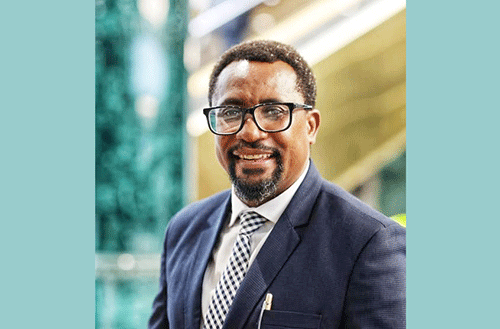

For Namibia, green industrialisation is a pathway to dignity, jobs, and empowerment for communities. It is a catalyst to breaking the cycle of exporting raw materials and import-dependency. This was the sentiment expressed yesterday by Natangue Ithete, Deputy Prime Minister and Minister of Industries, Mines and Energy.
As the keynote speaker during the opening session of the Global African Hydrogen Conference taking place in Windhoek, Ithete called on the domestic green hydrogen sector to make a real impact in the livelihood, access to health services and education of Namibians.
“It therefore my hope that the Global Africa Hydrogen Conference will be a turning point, a moment where we as leaders, investors, and innovators commit to move from promises on paper and speeches to tangible progress on the ground. At a risk of sounding like a broken record, as Namibia’s Deputy Prime Minister and Minister of Industries, Mines and Energy, my message to you today is simple: We have spoken enough, we have written enough, now let us transform our speeches into real results that our people can see and feel. Our collective vision must be to process our minerals here in Namibia, and Africa to power our homes and industries with our own renewable resources and build a new economy where Namibians, young people, women, and workers in our towns and villages, are direct beneficiaries of this green transition”, said Ithete.
The deputy PM commended already visible investments in large scale production of green hydrogen, which he said are essential for Namibia’s ambition to become a green hydrogen hub for Africa. He urged delegates attending the conference and Namibian industries in general to work on consuming what is produce locally to drive local industrialisation, value addition, and energy security.
“Because while the flagship projects such as Hyphen Green Hydrogen, Daures Green Hydrogen, Oshivela HyIron and Cleanergy Solutions are achieving remarkable milestones, our work is not done if the youth in our villages cannot point to the impact of these projects in their lives. We will fail in our efforts if we cannot tell our parents at the community level how many jobs are created? How many young Namibians are being trained with new skills? How are women being empowered to lead in this sector? How are we ensuring that energy scarcity is being eradicated and not reproduced? Let this conference bear roadmaps to answering these questions, not through estimations but in practice,” said Ithete.
He went on to say that each green hydrogen project must be able to point to schools built, skills transferred, families lifted out of poverty, and communities made stronger.
“This is the test of leadership, and this is how we will write a new story for Africa, one of resilience, progress, and shared prosperity. Namibia is not only talking about hydrogen, but we are also building industries across our sectors,” said Ithete.
Globally, the hydrogen sector is picking up serious momentum. More than 1 572 clean hydrogen projects are active world-wide, with US$75 billion committed to projects that have reached Final Investment Decision (FID).
Total announced investments through 2030 now exceed US$680 billion. Africa, with Namibia, Egypt, Morocco, and Mauritania, emerging as the continent’s strategic hubs, is fast becoming a focal point of this revolution, with over 110 green hydrogen projects across the continent, according to the latest research findings from ETASCA (Energy Transition and Sustainable Chemicals Advisory).
The Global African Hydrogen Summit (GAH2S) 2025 is a three-day event taking place in Windhoek and convening heads of state, government agencies, industry business leaders, project developers, investors, thought leaders, technologists and end users from across Africa and around the world to drive partnerships for and critical investments and financing into bankable green energy projects of strategic and national importance across Africa.