


Lahja Nashuuta
The Gobabis Municipality said it has positioned the town as “the jewel of the east” and a thriving hub.
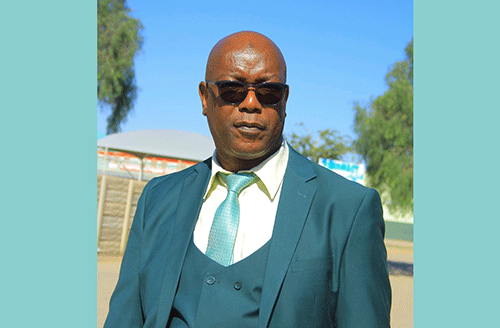
The town has a strong focus on infrastructure, environmental and social development, tourism and local economic growth.This could be deduced from a recent sit-down with the town’s spokesperson, Frederick Ueitele, who said Gobabis’ location makes it a natural gateway for trade and industry.
Situated along the Trans-Kalahari Highway, the town links Namibia to Botswana, South Africa, and, by extension, the rest of the Southern African Development Community region.
He stated that with the development of dry ports and terminals to handle goods transported through the Walvis Bay Corridor, Gobabis could become an ideal transit and processing point for exports to neighbouring countries and beyond. “If your interest is in agriculture or the transportation of goods for export, Gobabis is the place,” Ueitele said confidently. “The town is investor-friendly for all types of investment, ranging from logistics to manufacturing and hospitality to real estate,” he said.
Ueitele noted that the municipality is working to enhance tourism offerings.
With its blend of cattle-farming heritage, cultural diversity and proximity to wildlife areas, he said Gobabis has untapped potential as a stopover for visitors travelling between Namibia, Botswana and South Africa.
Housing
Ueitele said Gobabis has been one of the biggest beneficiaries of Namibia’s Decentralised Build Together Programme (DBTP), launched to improve housing delivery across the country.
Since 1998, the programme has enabled the construction of over 150 houses in the
town.
He said most beneficiaries have fully repaid their loans and are now proud title deed holders.
“We call ourselves the ‘jewel of the east’ for a reason. We have the location, the infrastructure and the people to shine. Now we need to keep polishing that jewel so it benefits everyone who lives here and everyone who comes here,” Ueitele said. One of the standout successes under the DBTP is the Single Quarters Transformation Programme, which relocated 140 households from dilapidated colonial-era compounds to fully serviced plots measuring more than 300 square metres each.
These plots came equipped with ablution facilities and electricity, providing a solid foundation for residents to build permanent homes. “Many of these families started with whatever materials they had – but over the years, they’ve built strong, proper houses they can proudly call their own,” Ueitele said.
In addition, the municipality upgraded the Kannan A informal settlement, installing underground water and electricity infrastructure under the DBTP’s informal upgrading segment.
Social welfare projects have also benefitted.
The Epako Old Age Home received a N$400 000 expansion, adding new rooms to accommodate more elderly residents.
In total, DBTP-related developments in Gobabis amount to more than N$18 million in investment, a figure Ueitele said has made a tangible difference in people’s lives.
Post-independence
Reflecting on the town’s journey since Namibia’s independence in 1990, Ueitele pointed to several transformative achievements.
He said it is not all doom and gloom.
The suburbs of Epako and Nossobville – once reserved for non-white residents under apartheid – have been fully electrified, with roads upgraded to tar and interlock paving.
New suburbs in Epako were established with support from the Municipality of Smallingerland in the Netherlands, which maintained a 20-year twinning agreement with Gobabis. Another landmark is the Legare Sports Complex, a multi-sport facility built by the municipality. It features two grass soccer pitches with security fencing, netball and volleyball courts, shaded and open pavilions and space for future additions such as rugby fields, basketball courts and even an amphitheatre.
The municipality has also worked with the Shack Dwellers Federation of Namibia and the Namibia Housing Action Group to formalise informal settlements. Over 1 200 residents have received ownership of erven and homes under the Flexible Land Tenure Act. This programme is ongoing, with land surveying underway in the Kannan C area.
“Private developers have also been brought on board to construct houses, helping to ease the housing backlog that has challenged the town for decades,” Ueitele revealed.
Projects, challenges
Today, the municipality is focused on ring-fencing the electrical network and replacing ageing water pipes, which frequently burst and disrupt supply to residents.
However, Ueitele admitted that financial constraints are slowing progress.
“The main obstacle is the non-payment of municipal accounts by the majority of residents. This is our only source of income – and without it, we can’t carry out projects as quickly as we want. We need a culture of paying for services if we are to grow,” he said.
To address these challenges, Ueitele said the municipality is exploring efficiency improvements, debt recovery strategies and potential public-private partnerships for key infrastructure projects.
What is more, despite the progress made, the town has not been without challenges.
Recently, Minister of Urban and Rural Development James Sankwasa visited the local authority to ascertain facts on the ground after residents pleaded for his intervention, citing what they described as “poor service delivery” by the local authority.
He met with the leadership of the Gobabis Municipality to deliberate on a report by the Ombudsman, which uncovered serious governance failures, mismanagement and internal strife within the municipal structure.
During the visit, residents listed a wide range of grievances, among them being chronic electricity and water outages, deteriorating sanitation, non-functional infrastructure and the stalling of housing projects meant for the poor.
The community said power and water supply disruptions have become the order of the day, often lasting several hours or even days.
They further revealed that waste management is another challenge, stating that rubbish is left uncollected for weeks in several neighbourhoods, leading to the accumulation of garbage and rising health risks. –lnashuuta@nepc.com.na