

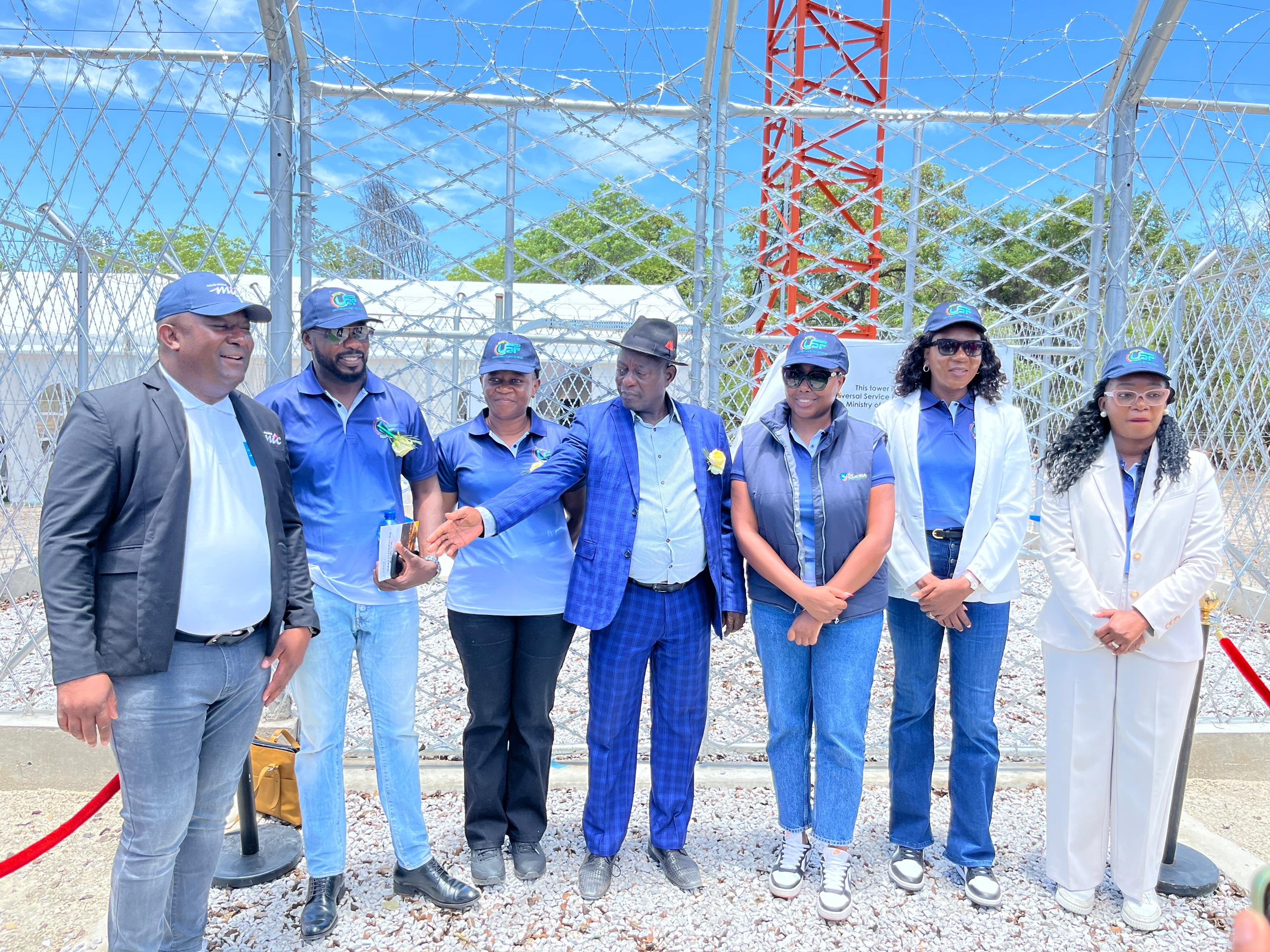

The social and economic ripple effects of the Universal Service Fund (USF) programme is expected to be substantial, including improved connectivity for schools that will benefit from reliable internet speeds of up to 35 Mbps. This is as the government continues to roll out the USF and has already allocated N$145 million to connect underserved rural communities.
The USF will grant schools and communities access to e-learning tools, global educational resources, and modern teaching aids. It also strengthens the educational pipeline for future digital professionals by providing access to e-commerce platforms, mobile payments, and digital marketing, unlocking new avenues for growth and job creation.
MTC, as the technical implementer of Phase 1 of the USF by the Communications Regulatory Authority of Namibia (Cran), has handed over the first USF network tower. The site was officially commissioned this week by Minister of Information and Communications Technology Emma Theofelus, at Epinga village in the Ohangwena region.
During the event at Epinga, Theofelus said the government is committed to the USF rollout.
“As we advance into Phase 2 of the Universal Service Fund rollout, the government has already committed N$145 million to ensure that no community is left behind. This allocation forms part of the national commitment under capital projects for the period 2024 to 2027, aimed at accelerating the deployment of digital technology and infrastructure across the country,” Theofelus added.
“With the USF, government is ensuring that rural communities, often the most in need of digital access, are not left behind in the broader national development agenda, she said.”
Also speaking at the event, MTC’s Managing Director, Licky Erastus, highlighted that in addition to the Epinga site, the telco has also completed three more sites as part of Phase 1.
“In addition to Epinga, we have completed sites in Hedimbi, Ehomba and Ongongo. While pending completions are Naimanya, Kudumbu/Mupapama, Owiwi in the Kavango West region and Gwatjinga and Shinyashi in the Kavango East. Civil works have already been completed, and currently we are simply awaiting finalisation of the electrical connection from the power utility,” said Erastus.
“The completion of phase one of the USF will see over 9000 Namibians gain 4G access, many for the first time. About 10 277 customers will get to enjoy improved connectivity through 4G and Spectra services.” Licky added, “In implementing Phase 1, we are deploying several tower types, including 60m lattice towers, 80m guyed masts, and 120m guyed masts, all of which have robust loading capacities. This ensures these sites will remain structurally sound and technologically adaptable for future innovations.”
He expressed that “MTC embraced the opportunity because the USF vision aligns perfectly with our mission to provide connectivity to every corner of our country.” Meanwhile, Cran board chairperson, Tulimevava Mufeti, commended MTC on its commitment to deliver on the expectations of implementing Phase 1 of the USF. “We are pleased with the delivery of work by MTC and do not doubt that Phase 1 will be completed within the set timeline.”
The Universal Service Fund is a programme initiated by the ICT ministry and diligently administered by Cran. Its purpose is to support operators in extending coverage to underserved rural regions where traditional commercial investment is not economically viable.
The objective of USF is to expand network coverage, with a focus on remote areas in regions such as Kavango West, Kavango East, Kunene, Oshikoto and Ohangwena, by building sites to achieve at least 80% broadband coverage in underserved areas in these regions as part of Phase 1. -ebrandt@nepc.com.na