
The government has allocated N$12 million to provide electricity to 969 peri-urban households in the Hardap and //Kharas regions.
In the Hardap region, the electrification projects will benefit communities in Rehoboth, Mariental, Aranos, Hoachanas and Gibeon. In the //Kharas region, the projects will cover Aroab, Bethanie, Berseba, Aus, Grünau and Warmbad.
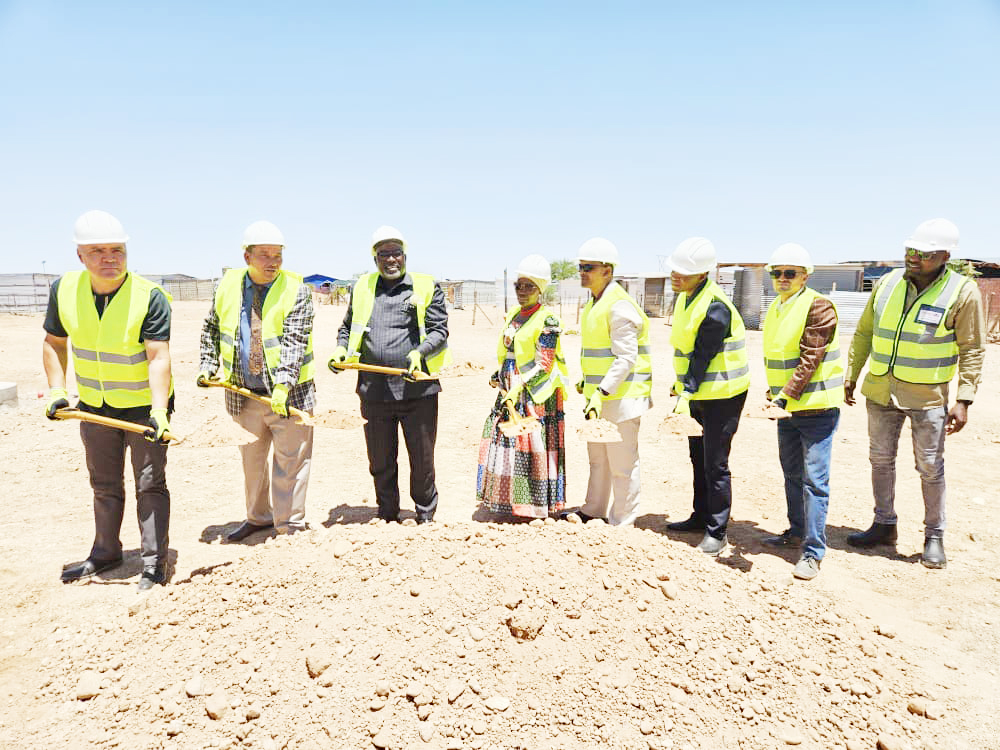
Speaking at the groundbreaking ceremony and site handover in the Hardap region for the electrification project, Minister of Industries, Mines and Energy Modestus Amutse said peri-urban communities have faced persistent challenges over the years. He noted that these areas often grow rapidly as people migrate in search of employment and better opportunities, while basic services, such as electricity, are lacking.
“For many years, peri-urban communities have existed in a difficult space. They grow rapidly, absorbing people seeking opportunity, yet infrastructure development often struggles to keep pace. Today’s projects are a direct response to that reality,” Amutse said. He added that the programme builds on work already undertaken in both regions but represents a significant scale-up.
With this expansion comes the need for closer collaboration and improved coordination among stakeholders.
He commended local authorities for their financial contributions, praising the Rehoboth Town Council for allocating N$2.5 million and the Mariental Municipality for contributing N$1.5 million.
“These are not symbolic amounts. They are real investments that demonstrate ownership, partnership and commitment to improving the lives of local communities,” he said.
He noted that, in recent years, much of government’s electrification efforts have focused on rural areas, including villages, settlements, schools and clinics in remote parts of Hardap and //Kharas.
“This work remains a priority and will continue. However, rural electrification is extremely challenging and expensive. In some areas, connecting a single household can cost between N$80 000 and N$300 000, depending on distance, terrain and settlement patterns,” Amutse said.
By comparison, peri-urban electrification typically costs between N$30 000 and N$50 000 per household, allowing government to connect more households in a shorter time while improving safety, livelihoods and dignity.
He noted that electricity infrastructure is costly to establish and even more expensive to maintain over long distances, cautioning that relying solely on grid extension could slow progress.
The ministry currently operates a solar revolving fund to help households finance solar systems affordably. Government is also working with partners under initiatives such as Mission 300, which aims to expand electricity access by combining grid expansion with properly regulated solar solutions.“Our intention is to increase this allocation to at least N$20 million, and potentially more, as we strengthen partnerships with other stakeholders and funding partners,” Amutse said.
He added that the main challenge going forward would not only be securing funding, but also ensuring effective coordination, timely execution and transparent project management.
-pmukokobi@nepc.com.na