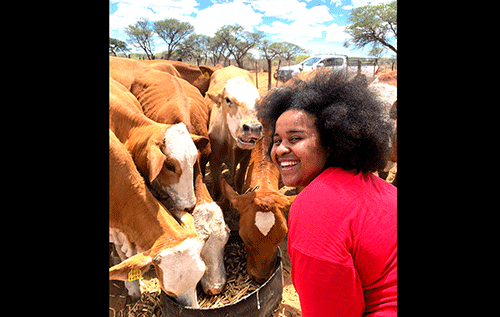

GOBABIS – For 26-year-old Gracell Goeieman, farming is more than just early morning errands in the kraal, cattle branding sessions and livestock herding; it is a profound natural calling and a pathway to create inter-generational equity.
For a sector that has for centuries been male-dominated, Gracell is breaking down barriers and through hard work, discipline and dedication, she is redefining the art of farming and inspiring fellow young female farmers in the Omaheke region.
“My farming journey officially began in 2019, but in truth, the seeds were planted much earlier during childhood visits to the farm. While most kids counted down the days to holidays for relaxation, mine were filled with early mornings in kraals, branding sessions, livestock herding, and listening closely to my father’s wisdom on the land. Back then, I never imagined that this would become my life’s calling…”
“That practical schooling shaped an independent streak that showed up early. My academic ambition initially pointed me toward science, especially after losing my brother in a tragic car accident. I experienced a major life shift and enrolled for a Bachelor of Science in Chemistry with a specialisation in Environmental Chemistry at the University of Namibia, driven by my love for sustainability, laboratory work and making a positive impact on the planet, but my father’s death in 2014 redirected me toward land stewardship,” she shared.
But it has not been an easy journey for the young farmer due to the complexities of balancing a busy academic life with her undying love for farming.
“Covid-19 paused my studies, yet it opened an entrepreneurial chapter through co-managing our Nossobville retail outlet, overseeing rental property and exporting Namibian hardwood internationally to countries like Saudi Arabia and South Africa and also selling locally. We are also into processing meat products and breeding pedigree Boerboels. Each venture sharpened my supply-chain literacy, but my spirit kept circling back to livestock. I therefore enrolled for a B.SC. Agriculture (Animal Science) Honours and today I operate our 4 391ha commercial farm near Gobabis. The enterprise comprises Simbra, Simmentaler and Brahman cattle selected for heterosis, fertility and feed-lot conversion.”
“My late father remains my North Star. A self-made man whose love for the land was only matched by his discipline and foresight. He farmed not merely to produce protein but to create inter-generational equity. His ethos of stewardship, integrity and balance-sheet discipline became my business plan.
The journey, though fulfilling, is unforgiving as multi-year drought cycles, livestock theft, price volatility and the social isolation of being a woman in a male-dominated industry have not been easy. However, it also refined my managerial agility, teaching me when to deploy innovation capital and when to fall back on first principles of rangeland ecology. What began as grief has matured into a resilient, data-driven business model anchored in faith, patience and continuous improvement. And yet, through it all, I remain deeply grateful.”
Gracell farms at Farm Mooipan, a privately-owned farm covering 4 391.83 hectares situated approximately 38km northeast of Gobabis along the Trans Kalahari highway in the very heart of Omaheke region.
Generational mission
Gracell hopes her young daughter will one day be inspired by her devotion and love for farming and that she, too will add to the rise of dedicated young female farmers who are redefining the outmoded traditional ways of farming.
“My daughter, who follows me everywhere, is my constant reminder of why I do this. Literally, she is my “why”.
I am equally energised by President Netumbo Nandi-Ndaitwah’s agenda for women’s empowerment and by the global #farmingwithgracell community, whose messages turned digital storytelling into a movement. What began as a simple idea has grown into something far more meaningful, a bridge between traditional agriculture and modern digital storytelling…”
“Today, social media platforms such as Facebook, Instagram, YouTube and TikTok have helped me build a growing community of young people and women who are beginning to see farming not just as a career, but as a calling. Knowing that my story is helping others believe in their dreams, fuels me even when the sun is hot, the feed is low, or the kraal is quiet. I’m showing what’s possible. I want people to see that farming can be clean, innovative, profitable and purpose-driven. I want young girls to walk into kraals with confidence, and rural youth to understand that land is not just soil, but it’s strategy, opportunity and legacy,” added the budding farmer.
Challenges
Livestock theft remains a constant threat to her operations due to the close proximity of the farm to Gobabis, as it makes it easy for cattle rustlers to foot from Gobabis to intrude on the farm.
“Last year, I suffered a devastating loss of a genetically superior Bonsmara bull that succumbed to urea poisoning. This was not just a financial setback; it was deeply emotional. The tragedy stemmed from negligence during my absence from the farm, exposing painful lessons about trust, systems, and the non-negotiable value of hands-on leadership. That moment reshaped my understanding of oversight and accountability…”
“Drought is another ever-present threat. Namibia has experienced cyclical droughts for over two decades. This climate demands innovation and resilience. In response, I’ve invested in rainwater harvesting systems, introduced drought-resilient crops, and prioritised fodder supplementation. Still, nothing quite prepares you for the ache of watching your veld fade and knowing your animals are depending on you. and then there’s the quiet but persistent weight of gender bias. As a woman in agriculture, I’ve faced scepticism. I’ve been underestimated, overlooked, but never broken. Instead of shrinking, I showed up. I educated myself. I focused on outcomes. I led with consistency and competence, not comparison, and over time, even those who doubted me came to respect the work. Some believed I couldn’t manage an integrated farming operation or make strategic breeding decisions.”
Future
Gracell remains hopeful for the future as she plans to expand and further grow her operations through superior genetics, conservation, agritourism and digital education.
“In five years, I envision a fully integrated farm that brings together genetics, conservation, agritourism and digital education. My long-term goal is to develop a genetically elite herd that thrives under arid conditions; animals that are disease-resistant, highly fertile, and aligned with market demands. Currently, I am conducting a comparative study of gastrointestinal parasites in eland and cattle coexisting on shared rangeland.
This is part of my honours research project, integrating both molecular diagnostics and traditional parasitological methods to assess cross-species transmission risks, parasite loads, and the broader implications for disease resistance and control.”
“The findings aim to inform evidence-based parasite management strategies, particularly critical for semi-arid ecosystems like those in Namibia. Down the line, I aim to combine cutting-edge research with practical field applications, especially in the areas of genomic selection, marker-assisted breeding, and disease resistance mapping. My mission is not only to build a high-performing, climate-resilient herd but to translate academic knowledge into grassroots farming realities. To further strengthen sustainability and profitability, I also plan to plant hectares of forage crops, both for internal feed production and export. Drawing inspiration from successful models like Wagnou Voer, my goal is to diversify revenue streams, reduce feed-related vulnerabilities, and contribute to feed security in the region.
“Furthermore, I also plan to transform my farm into a one-stop hub for agricultural development, an ecosystem where science meets practice. This includes a breeding and genetics consultancy offering DNA testing, selection advice, and herd improvement strategies tailored to dryland conditions. Beyond this, I want the farm to become a space that supports future farmers and researchers, hosting agricultural students for field attachments, research projects, and mentorship. I also envision team-building retreats and knowledge-sharing events for youth, women, and emerging agri-entrepreneurs.”
Women power
Her advice to aspiring female farmers is for them to start where they are, with what they have and to always be ready to learn new skills and to adjust when conditions dictate. “Most importantly, start where you are.
You don’t need perfect conditions to begin; just discipline, a teachable spirit, and the hunger to grow. Whether you farm one hectare or 10 000ha, the truth is that one tomato seedling or a single calf can teach you everything from inventory management to biosecurity and market timing. It’s not about how much you start with, but how well you steward what’s in your hands. Secondly, engage, learn and show up. Join farmer networks. Attend auction days. Apply for land and funding opportunities…”
“Thirdly, remember- there’s room for everyone at the table. The agricultural “cake” is large enough for anyone willing to rise early, keep learning, and steward land with integrity. There are thousands of women across Africa ready to push, rise, and cheer you on.”
-ohembapu@nepc.com.na