
Hilma Hashange
Rudolf Gaiseb
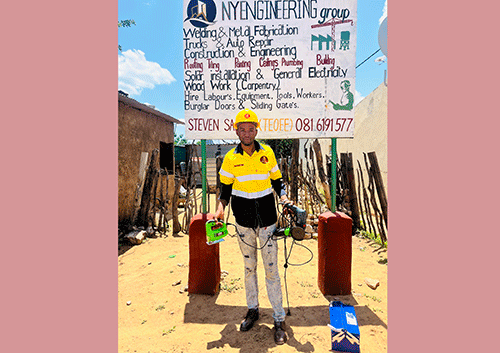
Teofelus Haitamba (24) from Oshivelo in the Guinas constituency of Oshikoto region, is determined not to be just another statistic in Namibia’s high youth unemployment rate.
The young artisan has transformed his academic and practical training into a fully fledged construction business, creating employment not only for himself but for other young people as well. Among the projects he is most proud of are the construction of tank stands for Uukumwe Combined School in Oshivelo and the renovation of the school’s toilets and showers.
While Haitamba is among many other young people who have rolled up their sleeves and dared to dream instead of taking the wait-and-see approach, deputy youth minister Dino Ballotti announced that the government has a planned investment of N$9.9 billion towards youth development.
This amount, he said, over the next five years, is specifically for entrepreneurship, infrastructure and skills development programmes.
Further, over N$2 billion is allocated to apprenticeships, N$3 billion to internships, while N$1 billion is allocated to industrial renovations, and over N$400 million to youth multipurpose centres.
Ballotti spoke at the International Youth Day commemoration in Windhoek on Tuesday.
Education
Originally from Ohangwena region, Haitamba graduated in welding and metal fabrication from the Namibian Institute of Mining and Technology (NIMT). Choosing self-employment over formal employment, he founded his first company, Namibia Youth’s Engineering Group cc, in November 2019 at the age of just 19. This later led to the establishment of his second venture, Quality Makes Quantities (QMQ) Dominations Investment cc, in 2024.
“I went to Walvis Bay the same year I graduated and hustled hard, but the income was too little to cover rent. That’s when I decided to return to Oshivelo and help my father in his business. After about three months, I realised I wanted to run my own business instead,” Haitamba explained.
During his short time working with his father, he acquired skills in car repairs, trailer maintenance, furniture manufacturing and construction. Leveraging these skills, he marketed his services via social media platforms such as WhatsApp and Facebook, attracting clients from as far as Oshikango and even Angola.
Although he started without external funding, Haitamba has been applying for microfinance since 2020 without success. He now hopes to secure machinery such as a concrete mixer and a generator to expand his operations.
“In 2024, I submitted proposals for funding through the regional governor’s office and the Ministry of Industrialisation and Trade. I’m hopeful they will be approved. I have also applied to the local authority council for a plot so I can officially run my businesses, as I currently operate from a rented house,” he added.
Namibia’s youth unemployment rate stood at 44.4% in 2023, according to the Namibia Statistics Agency, a slight decrease from 46.1% in 2018. However, the labour market remains challenging for job seekers. The 3rd revised National Youth Policy (2020–2030) stresses the need for higher learning and vocational training institutions to produce skills that are aligned with market demand.
Youth Fund
Furthermore, on Youth Day, Ballotti highlighted that the National Youth Development Fund, recently introduced and separate from the above, has been capacitated at over N$257 million.
“The fund [which comes as a loan for those under 35] does not require collateral,” he indicated.
Speaking at the occasion, United Nations Population Fund (UNFPA) representative Erica Goldson said: “The digital revolution offers unprecedented opportunities for young people to become innovators, entrepreneurs, and leaders on the global stage. By leveraging digital technology, we can create more inclusive and sustainable economic growth, ensure access to quality education and healthcare, and empower young people to actively participate in shaping the future of our nation,” she said.
Meanwhile, Commonwealth Youth Council chairperson Joshua Opey encouraged young people to drive change with resilience, starting on the grassroots level.
“If we are ever serious about achieving the Sustainable Development Goals and building beyond them, we must go beyond these speeches. We must put real resources behind young people’s efforts,” he said.
*Hilma Hashange is an Information Officer at MICT Oshikoto.