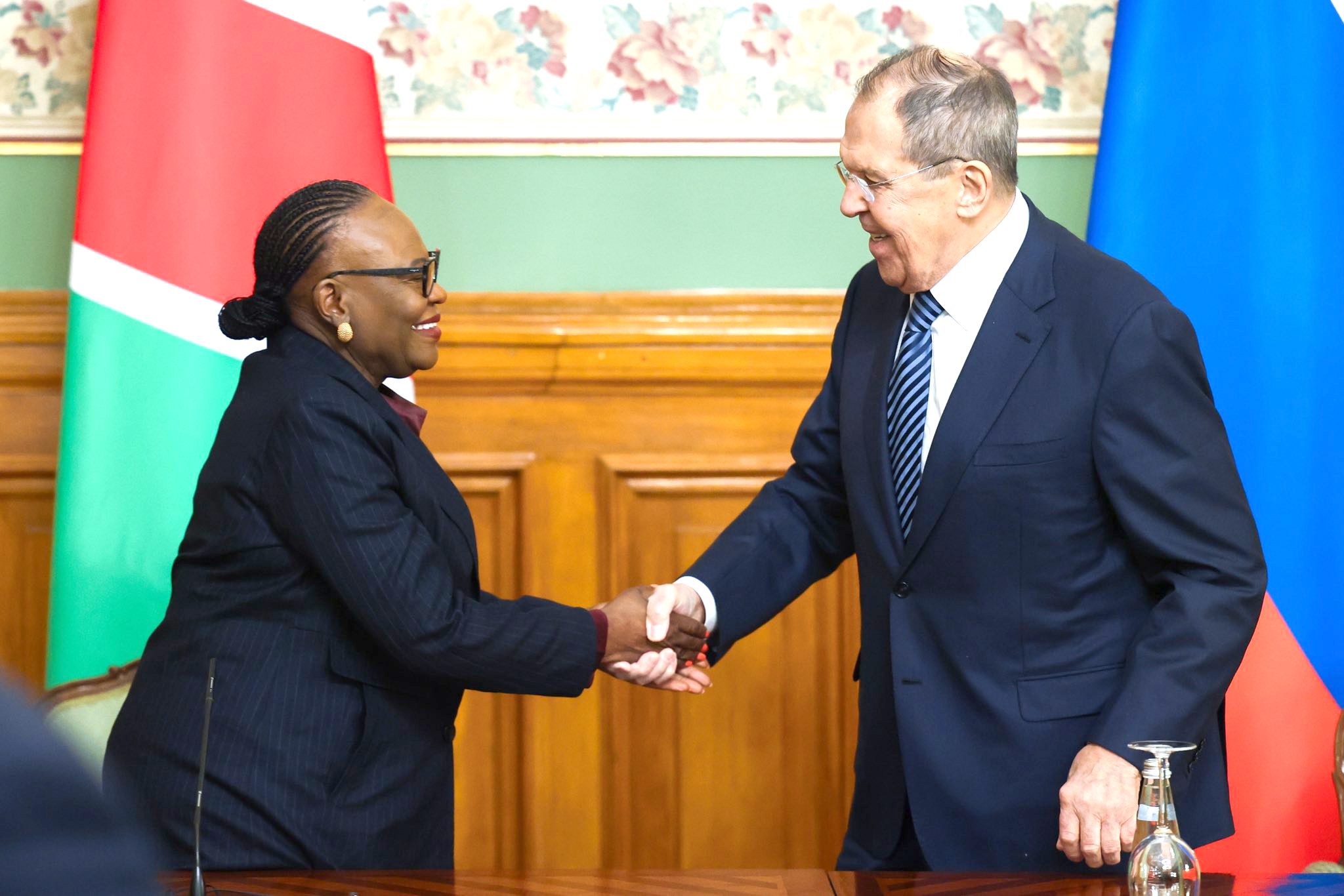

International relations minister Selma Ashipala-Musavyi’s recent high-level engagements in Russia are expected to translate into stronger trade, new investments and business opportunities that could benefit ordinary Namibians.
Ashipala-Musavyi, in a recent interview with New Era while in Russia, confirmed holding talks with senior government officials and meeting companies interested in doing business in Namibia.
The visit was aimed at strengthening long-standing bilateral relations and ensuring that cooperation with Russia supports the priorities of the President Netumbo Nandi-Ndaitwah-led administration.
“You will recall that the 8th administration has set itself to implement and advance seven priority areas, which are agriculture, sports, youth empowerment, education and training, creative industries, health, land, housing and sanitation,” she said.
A key outcome of the visit was agreement on preparations for the 11th Session of the Namibia–Russia Intergovernmental Commission on Trade and Economic Cooperation, which will take place in Windhoek from 26 to 27 February 2026.
Ashipala-Musavyi, who co-chairs the commission, said the meeting will be split into two important segments.
“To enhance bilateral strategic partnerships between Namibians and Russians, the meeting will take place in two segments: the business forum will take place on 26 February, while the ministerial segment will be held on 27 February 2026,” she said.
She stressed that the business forum will be a major opportunity for Namibian companies to connect directly with Russian investors and business partners.
“Investment opportunities that Namibia offers will be presented at the forum,” the minister said.
She added that direct engagement between businesses from both countries could unlock new economic opportunities.
“The presence and participation of the Namibian and the Russian business enterprises in the Business Forum will therefore provide an opportunity for the business representatives from our two countries to explore potential partnership opportunities and make business-to-business connections,” she said.
The minister also used the visit to encourage local companies to take advantage of the upcoming forum.
“I, therefore, invite the Namibian business community to the said business forum,” Ashipala-Musavyi said.
Beyond future meetings, the Russia visit already showed growing interest from Russian companies, particularly in trade and investment opportunities in Namibia.
“Meetings were also held with different Russian companies. Despite the early days of the year, a high number of Russian companies participated,” she said.
According to the minister, this strong turnout is a positive sign for Namibia’s economy.
“This strong interest in doing business in our country speaks to the importance of engaging our development partners and explaining the prevailing trade and investment opportunities,” she said.
Ashipala-Musavyi said trade was a central focus of her engagements, noting that political relations must be supported by economic cooperation.
“Bilateral relations and cooperation between countries without the trading component are incomplete,” she said.
For the future, she said Namibians should expect clear and measurable economic outcomes from the engagements with Russia.
“The measurable outcomes are ultimately enhanced trade as reflected in the trade balance, greater movements of goods and services and people-to-people contacts,” Ashipala-Musavyi said.
She added that high-level talks help open doors across different sectors of the Russian economy.
“The engagements at this high level create the necessary impetus for further engagements in multiple sectors of the Russian economy,” she said.
The minister maintained that Namibia’s engagement with Russia is guided by national interests and the Constitution and is aimed at delivering tangible benefits for the country and its people.
Russia
From the Russian side, that country’s top diplomat, foreign affairs minister Sergey Lavrov, said Moscow views relations with Windhoek as steadily growing and rooted in mutual respect and equality.
“Friendly relations between Moscow and Windhoek are developing gradually, based on the principles of equality, solidarity, mutual respect and support that are traditional for our relationship,” Lavrov said.
He said Russia highly values Namibia’s historical ties with Moscow.
“We highly appreciate that Namibian friends remember well the assistance that the Soviet Union provided to them in the years of the struggle against colonialism and in establishing the foundations of statehood,” he said.
Lavrov welcomed Namibia’s intention to deepen cooperation, particularly under Nandi-Ndaitwah’s government.
“Welcomed the intention of the new leadership of Namibia, personally President Nandi-Ndaitwah, to deepen ties with Russia,” he said, adding that both countries support expanding dialogue and resuming regular foreign policy consultations.
On economic cooperation, Lavrov said both sides agreed to strengthen trade ties.
“Agreed to make additional efforts to activate trade-economic interaction,” he said.
He identified education and tourism as areas with strong potential for Namibia.
“Another area where there are good prospects and there are already good tasks, is healthcare. Staff training is traditionally an integral part of our cooperation,” Lavrov said.
He added, “Thousands of Namibians received education in the Russian Federation or in the Soviet Union. Now that practice continues.”
Lavrov also confirmed Russia’s readiness to support Namibia internationally on international platforms, including in the provision of humanitarian assistance under the UN World Food Programme.
Lavrov is expected to visit Namibia soon.