
Maqonda Ndlovu
The Japanese embassy in Namibia and the United Nations Children’s Fund (UNICEF) pledged support to Oukongo Combined School and Otjimuhaka Primary School in the Kunene region after their joint field visit last week.
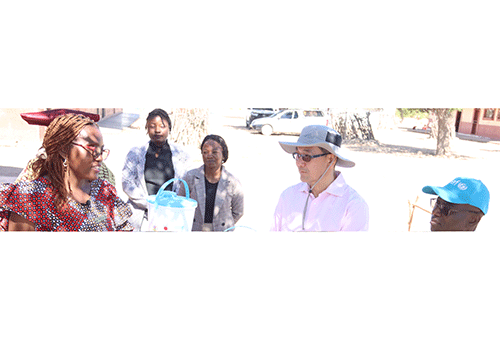
The visit was led by the Japanese Ambassador to Namibia, Shinichi Asazuma, alongside the UNICEF representative, Samuel Ocran.
The visit began at the Oukongo Combined School, about 15 kilometres outside Opuwo, where the two officials noted that teaching and schooling in rural areas in Namibia have many challenges.
Addressing the officials, school principal Namata Lingeza pleaded for support, saying there are currently many challenges being faced by the school, ranging from a lack of ablution facilities to hunger amongst school children, accommodation, and security.
“Having a fully functional hostel would be extremely beneficial. This will help to prevent dropouts, as children have to walk long distances to and from school. We have no ablution blocks, so we must use nature to relieve ourselves. We would really appreciate it if we could have something that could help us in terms of sanitation,” he said.
Lingeza added that the school currently does not have a fence, with both teachers and students exposed to vandalism, stressing that a school fence would go a long way in securing the buildings and protecting learners during classes.
Other challenges include a lack of running water, as the main source of water is from a borehole with one functional tank, and the school shares the borehole water with the surrounding community of about 800 people.
In his response, Ambassador Asazuma, who donated sanitation dignity kits, said that after touring the school, he had identified so many challenges that call for urgent attention.
“I am happy to be here, and I have just walked around the school site. I found so many challenges, especially the need to build a hostel here and the sanitation. I sincerely hope that the donation of sanitation dignity kits will help the learners study better at this school,” he said.
The sanitary dignity kits comprise sanitary pads, soap, detergents, and water-carrying containers.
The chairperson of the school board of the Oukongo Combined School, Lina Tjikotoke, expressed gratitude for the donation, stating that the support from Japan is a blessing.
“The impact of the Japanese assistance is great, especially when it comes to building infrastructure, health, sustainability of food for the learners, and all the needs of the school. These improve the school environment and the health and needs of teachers and learners. Our school is left behind in many aspects. We have asked our Japanese counterparts to assist us by providing books, computers, and agricultural equipment because we need these things,” she said.
He expressed happiness over the support from the Japanese government, saying it was an example for other partners to reach out to marginalised groups like the Himbas and the Zemba.
Meanwhile, UNICEF Country representative Sam Ocran lauded the dedication and commitment of the teachers and learners in an environment that does not have all the facilities for teaching and learning, saying the school is doing a wonderful job.
“I have observed the dedication and commitment of the teachers; although the environment lacks all necessary facilities, at least the basic ones are present. Some teachers have made temporary changes to help the kids learn better. Such behaviour is applaudable. I have also seen some development ongoing; this shows commitment from the government, as you can see new buildings being constructed. The construction is a sign of government commitment to learning in Namibia,” he said.
Ocran added that the partnership and investment between UNICEF, Japan, and the government can help improve the learning environment for children.
He added that the results of such partnerships will be there for all to see soon.
He concluded by calling on other partners to come on board and help the school and improve the learning opportunities that are available there.
Meanwhile, the Kunene education director, Sophia Frederick, said plans to turn the Oukongo Combined School into a secondary school are on the table.
“This is one of the regions that is under-resourced when it comes to infrastructure. There are plans to turn this into a secondary school up to grade 11. However, there is a critical need for hostels. There will be road construction very soon, and the school will be easily accessible from Opuwo, and parents can bring their children here,” she said.
She added that the region has revived the school health integrated plan, where they have even trained stakeholders to prevent the risk of HIV infection in May through the support of UNICEF.
“We have also launched the end of learning poverty, which is an African agenda that was launched in Outjo in the Kunene region with the support of UNICEF. This means a lot for us, as our learners will be prepared and confident enough to be in the classrooms to receive education,” she concluded.
Meanwhile, the Otjimuhaka Primary School principal, Elias Uusizi, says they must go door-to-door begging parents to bring their children to school, a situation some may see as abnormal.
“To us, this is normal. We must do what we have to do to provide education to everyone here. We must be there for our children, who are the future of this country,” he said.
Frederick said when the school was mobile, teachers would go around following the nomadic families to their grazing areas to provide education.
“Once we saw that the community was now settling, we converted the school to a more permanent structure. This is how this school came into being,” she said.
She said at the request of parents, they have established two schools in the area.
“You get into a retail store, and you find a Himba man and woman buying school uniforms for their children.
This is welcoming and encouraging from the community. Even though we come from a marginalised background, we will soon be on par with the rest of the country,” she said.
Ambassador Asazuma and Ocran donated sanitary equipment and other teaching aids.
Ocran said it was worthwhile to travel the long distance to visit Otjimuhaka village because UNICEF’s programme focuses on hard-to-reach areas and minorities, adding that it is encouraging to witness minorities having access to schooling.
Otjimuhaka Primary School was established in 2022 and has 11 teachers, including the principal. It provides education from pre-primary to Grade 7. It has been operational since 2002 as a mobile school (Ondao Mobile School), and it serves a rural, semi-nomadic population, including 86 children from neighbouring Angola. It has a learner population of 287. Following a successful door-to-door campaign, enrolment stood at 308 this year, but 21 learners dropped out.
Oukongo Combined School was established in 1995. The school now caters to 388 learners from pre-primary to Grade 9, served by 16 teachers.
A community hostel was also built in 1995, accommodating 60 learners—30 boys and 30 girls. Four bachelor flats serve as teacher accommodation, while other teachers stay in makeshift corrugated iron structures. There are 10 non-functional pit latrines at the school.
There are currently 86 schools in the Kunene region.
– jrnsmarko@gmail.com