

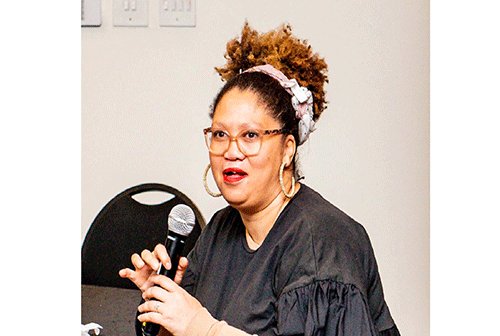

The removal of journalist Jemima Beukes from State House yesterday has prompted questions about a potential breach of security protocol on her part, the right to press freedom and responsible journalism.
The Presidency has since responded, reaffirming its commitment to press freedom in Namibia.
Shortly after addressing the opening of Cabinet for 2026, President Netumbo Nandi-Ndaitwah requested her team to adjourn briefly and give the media a photo opportunity before continuing with their meeting.
Following the brief photo opportunity yesterday, as Nandi-Ndaitwah walked past members of the press to return to the meeting venue, Beukes approached her and fielded a question.
Beukes wanted to know if members of Nandi-Ndaiwah’s family were “controlling the country’s oil industry”.
To this question, Nandi-Ndaitwah replied, “We are in Cabinet. I am not at a press conference. You know I like the media. But it is not the time. [Wait for the] press conference,” Nandi-Ndaitwah said before proceeding.
Following the exchange, Beukes continued following the President, who was on her way back to the Cabinet room to continue with the year’s first meeting.
What is more, Nandi-Ndaitwah informed Beukes that if she was not satisfied with the response she had given, she could send her questions through the presidential spokesperson, Jonas Mbambo.
Despite this, a first-hand witnesses said Beukes continued pursuing the President within close proximity.
It was at this stage that the President’s security detail requested Beukes to stop and do as requested.
However, Beukes allegedly refused to heed the call.
The President’s security officials then intervened, escorting Beukes out of State House.
Reacting to the incident, the Presidency reiterated that Nandi-Ndaitwah has consistently shown appreciation for the media and its role in public accountability.
“The President has, on numerous occasions, publicly expressed her appreciation for the media fraternity and the important work journalists do in informing the nation, fostering accountability and giving voice to the public interest,” Mbambo said.
However, the Presidency said engagement with the Head of State takes place through clearly defined platforms.
“Once the Head of State has indicated that a session has concluded or that questions should be directed through the appropriate official channels, such guidance is expected to be respected,” said Mbambo.
He added that State House operates under strict security protocols.
“Press freedom, like all democratic rights, is accompanied by responsibilities. These include respect for institutional processes, observance of house rules and professional conduct within sensitive and secure environments such as State House, where the President must be afforded the space to attend to official duties without disruption,” he stated.
The Presidency added that, when conduct is considered inappropriate or disruptive, security personnel are empowered to act.
“In circumstances where conduct is considered unbecoming of the standards expected within State House, or where actions are assessed by security personnel as potentially compromising the safety, dignity or orderly functioning of the Presidency, such matters will be addressed in accordance with established security protocols and the professional judgement of trained, uniformed staff,” said Mbambo.
He stressed that press freedom must be exercised within agreed rules, particularly in sensitive and secure environments such as the State House.
“The Presidency wishes to reaffirm its longstanding commitment to media freedom and the vital role played by journalists in strengthening Namibia’s democracy, transparency and public discourse,” he said.
Criticism
The incident, however, drew criticism from certain quarters, who are of the fervent position that Beukes’ ejection was disproportionate and intimidating.
The Namibia Media Professionals’ Union (Nampu) condemned the removal, calling it “a chilling escalation in the erosion of Namibian media freedom”.
“While attempting to fulfil her professional duty by questioning President Netumbo Nandi-Ndaitwah on public concerns regarding the oil industry, Beukes was met not with an answer, but physical manhandling and the confiscation of a colleague’s phone used to record the incident,” the union said.
Nampu described the conduct of State officials as intimidation.
“The State’s response, which included photographing the journalist’s car, threatening her with arrest, and following her, is a clear tactic of State-sponsored intimidation,” the statement reads.
The union cited constitutional protections, stating, “Article 21 (1) (a) of the Namibian Constitution serves as the supreme legal guarantee of freedom of expression and the press for all media platforms”.
It further criticised the Presidency’s media engagement record.
“For nearly a year, this Presidency has not regularly hosted briefings, and has largely ignored formal email queries, effectively insulating itself from public accountability,” the union said.
Opposition
Opposition leader Immanuel Nashinge also issued a strong condemnation, describing the incident as part of a wider pattern.
“Yet another journalist, Jemima Beukes of The Whistle, was manhandled, threatened and forcibly removed from our State House for simply asking a question the President did not like!” Nashinge said.
He added, “This is not an isolated incident. It follows the disturbing pattern of intimidation seen in the attack on journalist Anna Nicodemus. When will it stop?”
Nashinge questioned the justification for the security response.
“Since when does a President’s ‘no’ to a question become a lawful reason to escort, threaten and silence the press? This is authoritarian bullying!”
In addition, Popular Democratic Movement secretary general Manuel Ngaringombe sought clarity from State House.
“If these reports are true, the PDM strongly condemns the actions described. Fundamental freedoms enshrined in the Namibian Constitution must be respected at all times. Among these are freedom of the media, access to information, and the right of journalists to carry out their work without intimidation, harassment or fear of reprisal,” Ngaringombe said.
The Landless People’s Movement also expressed concern.
“The Landless People’s Movement expresses growing concern on the conduct of State House officials and, subsequently, the President in regards to the handling of journalist Jemima Beukes.
“It is important to note that the job of journalists and the media is to ensure that information is obtained and distributed to the masses so that there is a level of transparency of all stakeholders that may impact the people of the country.
This is understood as their duty as the Fourth Estate,” LPM spokesperson Lifalaza Simataa said.