
Lahja Nashuuta
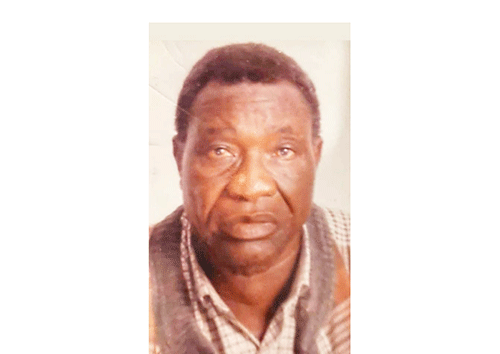
As Namibia reflects on the events of 10 December 1959, commonly referred to as ‘Human Rights Day’ or ‘Old Location Day’, one name crops up from the archives. Many might not have heard of him, but Moses Kavetjimo Katuuo’s role in the uprising has been told and retold in oral history for years.
Katuuo played a direct role in confronting the apartheid authorities on the day of the uprising.
Amongst others, oral history places him as having set a police vehicle on fire—an act believed to have triggered the chain of events that later claimed the life of Anna Kakurukaze Mungunda, who remains formally recognised as a national hero.
In the skirmish and ensuing confusion on the day, some of Katuuo’s contribution to the revolt has inadvertently been credited to others – most prominently to Mungunda, his family claimed in an interview with New Era yesterday.
The family has been calling for long-overdue recognition of Katuuo’s role in the historic Old Location uprising, arguing that his contribution has been overshadowed in Namibia’s national narrative.
Despite the difference in versions of chronology of events on the day, Katuuo and Mungunda were but some of those that took a brave stand against the regime of the day by standing up.
Many others, just like Mungunda, paid the ultimate price with their lives too. These include Constancia !Uriro Xamses,Drisilla Dithma Lindt-Garises, Isabella Guriras and Priscilla Gaingos, according to various written sources narrating the history of the country’s struggle for liberation.
Speaking to New Era, Ferdinand Katuuo, son of the late activist, said his father spent years trying to have his role acknowledged before he passed away in 2020. “My father told us he was one of the masterminds behind the Old Location Uprising,” Ferdinand said. “He said he was the one who set the colonisers’ vehicle on fire. He fetched petrol from a nearby filling station, noticed the superintendent’s vehicle unattended, set it ablaze, and ran to hide,” Ferdinand narrated.
He said his father kept the truth to himself for decades out of fear for his life.
“He told us that although people believed a woman had set the vehicle on fire, he couldn’t reveal the truth because the situation was dangerous and highly political.” Another relative, Ngavipangurue Makari, said their elders repeatedly told them that Moses Katuuo was a trained soldier, and among the men reportedly sent by the late Chief Hosea Kutako to Botswana for training in preparation for armed resistance.
The family believes that official records and public memory have excluded Katuuo’s contribution, resulting in a historical gap that they now want corrected.
He clarified that Katuuo family are not seeking to diminish the legacy of Anna Kakurukaze Mungunda, who was shot and killed during the uprising and remains a symbol of resistance.
“We recognise Mungunda’s sacrifice,” the family said. “We are only asking that the history books also acknowledge Moses Kavetjimo Katuuo’s role. His bravery set in motion the events of that tragic day.”
Das Murangi, a close family member, supported the claim, saying “My mother told me that it was indeed Moses Katuuo who set the vehicle ablaze, not Mungunda. His bravery deserves recognition.”
Ferdinand said his father tried on multiple occasions to share his version of the story with national leaders.
“The matter was brought to former parliamentarian Brave Tjizera, who took it to two previous presidents,” Ferdinand said. “I’m not trying to cast a shadow over Mungunda’s legacy, but history must be recorded as it truly happened.”
Community historian and history teacher Josia Hitanwa agreed that the narrative should be revisited.
“We need to document the views of surviving elders. With approval from the National Textbook Board, Namibia can amend its history to accurately reflect what transpired,” he said.
– lnashuuta@nepc.com.na