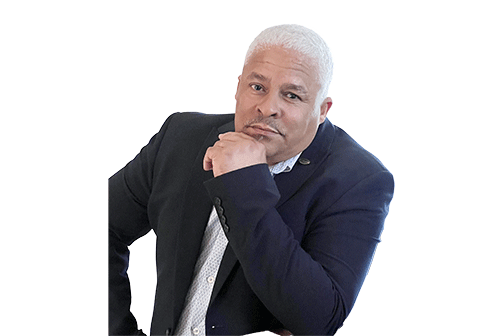

William Ian van Wyk (51) is a dedicated civil servant with 28 years of experience within the halls of the Parliament of Namibia, serving as a systems controller and videographer for the National Assembly.
His role is to be the ‘eyes’ of the public, ensuring that every debate, motion and legislative decision is captured visually for the historical record and public consumption.
During sittings, van Wyk is responsible for the live visual broadcast and recording of proceedings, including operating camera equipment, managing angles to capture speakers clearly, and ensuring the technical quality of the feed.
“Whether it is a standard sitting or a high-profile event like the State of the Nation Address (SONA), my job is to ensure the visual output is seamless and dignified,” van Wyk said proudly.
A purpose-driven
Van Wyk’s journey began with a curiosity for technology and storytelling.
He joined the public service nearly three decades ago because he wanted his work to have a purpose beyond just entertainment.
He wanted to contribute to the nation.
Seeing how information flows from the chamber to the citizens motivated him to stay and grow within the institution.
Van Wyk is an alumnus of Ella du Plessis High School.
Following his secondary education, he pursued his interest in technology at the Institute of Information Technology, where he obtained a certificate in Information Technology.
He said the technical foundation he built was crucial, as videography in a parliamentary setting has evolved from analogue systems to the highly digital, information technology-integrated environment used today.
“Beyond technical camera skills, you need patience, situational awareness and deep focus. You must understand the flow of parliamentary debate to anticipate who will speak next. Technical troubleshooting is also vital. If a cable or signal fails during a live session, you must fix it in seconds,” van Wyk explained.
Challenges of working live
The biggest challenge van Wyk faces is the ‘live’ nature of the work.
There are no second takes in Parliament.
If a high-pressure debate breaks out or a technical glitch occurs, one has to remain calm and keep the broadcast running. Managing complex equipment for several hours without losing concentration can be physically and mentally demanding.
One common misconception about his job is that a button is simply pressed.
People do not see the hours of setup, the maintenance of servers or the intense pressure of a live broadcast.
“People often think civil servants are ‘slow’ – but in the National Assembly, we have to work at the speed of the debate,” he said.
Remaining neutral
Neutrality is the cornerstone of van Wyk’s work.
As a videographer, he does not take sides. He follows the Speaker’s lead and the Standing Rules and Orders, ensuring every Member of Parliament is captured with the same level of professional clarity, and focusing on the person who has the floor, regardless of political affiliation.
Van Wyk said parliamentary videography is more about precision than artistic flair.
However, he finds creativity in composition, using the right lighting and angles to convey the dignity of the August House.
“I work within protocol by respecting the decorum of the chamber while still trying to produce high-quality, modern visuals,” he said.
Democracy and history in the making
Van Wyk believes that, by providing a visual window into the National Assembly, his work allows citizens to see exactly how their representatives are advocating for them.
It demystifies the legislative process and holds leaders accountable, which is the very heart of a transparent democracy.
Over the past 28 years, van Wyk has witnessed many Presidents and historic bills.
However, the opening of new parliamentary buildings and the transition of power during presidential inaugurations always stand out for him.
“The most rewarding part is knowing I am creating a visual archive for future generations. Long after a specific Parliament has dissolved, the footage I captured will remain as a record of our country’s progress,” he noted. Van Wyk’s motivation comes from a strong sense of duty.
Af ter 28 years, Parliament feels like home to him. He is continuously motivated by the younger generation of IT and media professionals entering the field.
He enjoys sharing his experience with them while learning about new technologies himself.
“Professionally, this job has made me highly disciplined. Personally, it has given me a front-row seat to Namibia’s history. It has taught me the value of patience and the importance of institutional memory.
“I’ve learned that every person, whether behind the camera or in front of it, plays a role in building the nation,” van Wyk said gratefully.
-hnalupe@nepc.com.na