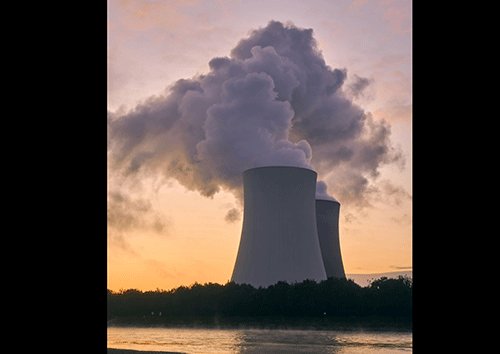

Marius Johannes, a lecturer at the University of Namibia’s Business School, says Namibia should explore nuclear energy, especially because it is one of the world’s largest uranium exporters.
Johannes explained that although Namibia does not yet have the capacity to build a nuclear power plant, the country can begin preparing step by step. This includes training scientists, involving young people in discussions, and slowly building national expertise.
“It is a beautiful science to get involved in and a beautiful business model,” he said. “If we spread ourselves better in this mixed-energy race, we place Namibia in a stronger position to export electricity.”
Namibia currently imports about 60% of its electricity. He said that pursuing nuclear energy could support the country’s long-term goal of becoming energy-independent and eventually an electricity exporter. He compared this idea to the vision behind green hydrogen, a plan focused on reducing reliance on foreign energy and boosting national exports.
He also said that Namibia already ranks among the world’s top three uranium producers. In 2024, production rose to 7,300 tonnes, accounting for around 12% of global supply. As uranium prices nearly doubled over the past year, confidence in the mining sector has grown.
New extraction techniques, such as in-situ recovery (ISR), were recently showcased in Moscow. Johannes said these cleaner and cheaper methods are becoming more dominant worldwide, now making up more than 60% of global uranium production.
He added that ISR could offer Namibia safer and more sustainable ways to expand its uranium industry while preparing for future nuclear energy development.
“Globally, 422 nuclear reactors already provide over 10% of electricity with minimal carbon emissions. As Africa’s only operational plant, South Africa’s Koeberg remains a regional model for reliability. Inspired by new BRICS cooperation frameworks, Namibia could follow Egypt, and especially the strong presence of Niger and others in exploring nuclear energy partnerships that balance cost, safety, and sustainability,” he said.
In September, Johannes attended the World Atomic Week in Moscow, which on the discussions, they spotlighted nuclear medicine, a field with immense promise for Namibia’s healthcare system.
Radiopharmaceuticals are revolutionising cancer treatment and diagnostics worldwide, and Russia alone performs nearly a million such procedures annually. Namibia’s few nuclear medicine facilities are growing, but demand far exceeds supply.
“By investing in isotope production and medical technology training, Namibia could not only improve healthcare access but also establish itself as a regional supplier. The creation of a medical cyclotron or isotope production lab would cut costly imports and provide skilled employment,” he said. -pmukokobi@nepc.com.na