


Southern African liberation movements must defend their legacy and urgently respond to the socio-economic needs of their people to remain relevant.
This was collectively said by leaders at the 2025 Liberation Movements Summit in Johannesburg on Saturday.
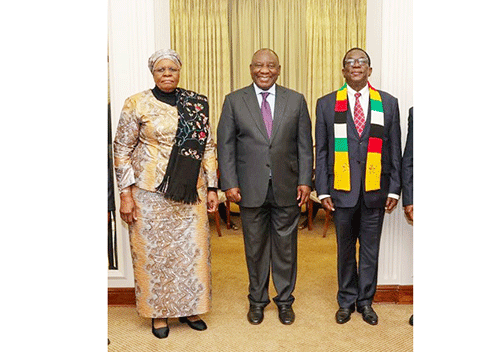
Speaking at the 2025 Liberation Movements Summit, presidents Netumbo Nandi-Ndaitwah of Namibia, Cyril Ramaphosa of South Africa and Emmerson Mnangagwa of Zimbabwe called for urgent reforms, stronger unity and renewed commitment to the ideals that inspired the liberation struggles.
The three-day summit, held under the theme ‘Defending Liberation Gains, Advancing Integrated Socio-Economic Development, Strengthening Solidarity for a Better Africa,’ brought together the ruling parties of the African National Congress (ANC) of South Africa, the Swapo, ZANU-PF, MPLA of Angola, FRELIMO of Mozambique and Tanzania CCM.
This year’s edition marked a shift from past meetings, with heads of state themselves attending instead of delegating only party officials.
This is a sign of growing concern over the future relevance of liberation movements.
President Nandi-Ndaitwah warned that external and internal forces were threatening the gains made by liberation movements.
She stressed the need for unity, accountability and youth engagement.
“We must do things differently and better to get different and better results,” she said.
The President urged sister parties to stand together against what she called “economic, political and diplomatic conspiracies” by former colonial powers seeking to weaken liberation movements.
She added that “those who once colonised us are now trying to avenge the humiliation they suffered” by targeting young voters, and funding opposition parties and civil society to push for regime change.
Nandi-Ndaitwah used her speech to reaffirm Namibia’s solidarity with the people of Western Sahara and Palestine and condemned the “imperialist scramble” for Africa’s mineral resources in the name of artificial intelligence and green energy.
She reiterated Swapo’s support for Cuba and called for the lifting of the US economic embargo.
“The time for revolutionary renewal is now,” she declared.
Meanwhile, Ramaphosa echoed many of these sentiments, urging African countries to stop exporting raw materials and instead build industries that process them locally.
“We must process, build and produce all that we need here on the African continent.
“This calls on us to invest in infrastructure that extends beyond national boundaries to build a region that is both physically and economically integrated,” he said.
He admitted that most of the threats facing liberation movements today are internal.
“For many of us, corruption and patronage have contributed to the destruction of our social fabric… The competition for public positions has undermined our ability to respond to the needs of the people,” Ramaphosa stated.
“The impatience of young people is not something we should fear. It is to be welcomed… Youth leagues must not be ceremonial wings of our movements but engines of ideological clarity, economic innovation, digital activism and renewal,” he said.
He warned against the growing use of migration as a political weapon, saying xenophobia must be rejected.
“Migration is a consequence of underdevelopment, war and global inequality, not a moral failing,” he said.
Ramaphosa called for women’s full participation in society, saying there could be no complete freedom without the liberation of women.
“If girls cannot complete school, if women do not receive equal pay or are vulnerable to violence, then our freedom will not be complete and our societies will remain poor,” he stated.
Zimbabwe’s Mnangagwa, also speaking at the summit, said the time has come for former liberation movements to modernise without abandoning their revolutionary roots.
He said the region must build new alliances to resist economic warfare through sanctions, unjustified tariffs and foreign-funded campaigns that seek regime change.
He warned against complacency and reminded fellow leaders that liberation parties across Africa had suffered electoral defeats or lost relevance when they failed to meet the demands of their people.
“If we rest on our past glories, we will become history ourselves. The struggle is not over. It has only changed form,” Mnangagwa said.
He urged liberation movements to focus on food security, industrialisation, youth employment and digital transformation.