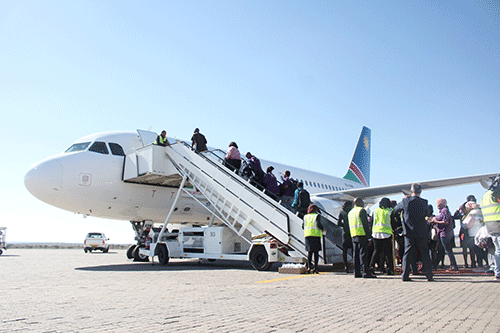

Reactions have been mixed since the announcement that Cabinet approved the establishment and name of Namibia’s new national airline, Namibia Air, that is scheduled to become operational in the next financial year with government as the sole shareholder.
A technical committee of local aviation experts has been established to guide the establishment and operations of the new carrier.
An interim board and some staff have already been appointed, while market analysis, traffic forecasting and business model formulation for the new airline are ongoing.
Local media recently reported that the Minister of Works and Transport Veikko Nekundi said once operational, the airline will enhance regional connectivity and support intra-African trade under the African Continental Free Trade Area agreement.
“One of the failures that contributed to Air Namibia’s challenges was expensive leasing arrangements. We will ensure all decisions are commercially viable and sustainable,” said Nekundi.
Aviation experts have suggests that the new airline should be linked to national growth aspirations.
An economist has questioned prioritising the airline while the public seems hopeful for job creation and opposition parties are concerned about who will pay the bill if the new venture is not profitable.
Linden Birns, the managing director of Plane Talking, a South African-based aviation publication, said airlines are capital-intensive and need to be carefully calibrated, sufficiently financially-resourced and tailored, in terms of staff, equipment, business plan and strategy, to match the realities of the markets they serve.
“More important than having an airline is having a national economic growth and development strategy with air connectivity a core element. In such an environment, airlines become powerful levers of growth because they enable and facilitate trade, investment, transport, tourism and travel. But the benefits will not be realised if airlines and air transport are treated as a luxury, a nice-to-have or as political vanity projects,” Birns told New Era.
Meanwhile, economist John Steytler, the previous CEO of the Development Bank of Namibia and former presidential economic advisor, cautioned that Namibia cannot currently afford a national airline, even if it is done on a public-private-partnership basis as State will have to invest substantial capital.
“The mid-term review of the budget showed a drop in revenue collection and our debt to GDP ratio is already high. Even if affordable was not an issue, there are far more important competing priorities, such as the national housing crisis, and food security, water supply security and affordable electricity to name but few,” Steytler commented.
Some of Namibia’s political opposition parties have cautioned that if lessons learned from the now defunct Air Namibia, that accumulated billions in losses, are not taken to heart then the Namibian taxpayer will have to bear the brunt of the debt. In this regard, Popular Democratic Movement (PDM) warned the new carrier should not be “an ego airline”, while the Affirmative Repositioning (AR) warned against mismanagement and political interference in the operations of the new airline.
Meanwhile, some members of the public are hopeful that the new airline will improve domestic employment prospects, provided that the carrier is implemented to become sustainable. Some members of the public have also called for Namibia Air staff to be appointed based on aviation industry experience and not based on political affiliation. The country’s previous airline, Air Namibia, was liquidated in 2021 due to significant debt, including some N$3.5 billion in operational debt and N$2.5 billion in government-guaranteed debt, adding up to total liabilities of N$5.4 billion against assets of only N$1.1 billion. Despite this exorbitant debt, a local analyst preferring anonymity pointed out that despite financial obstacles, Air Namibia managed to rake in numerous awards throughout the years and its crews, maintenance, and operational teams always remained professional and efficient.
“Air Namibia didn’t fail because Namibians couldn’t run an airline. It failed because management failed it. With professional governance and clear accountability, Namibia can rebuild, and this time, keep it flying,” said the analyst.
-ebrandt@nepc.com.na