

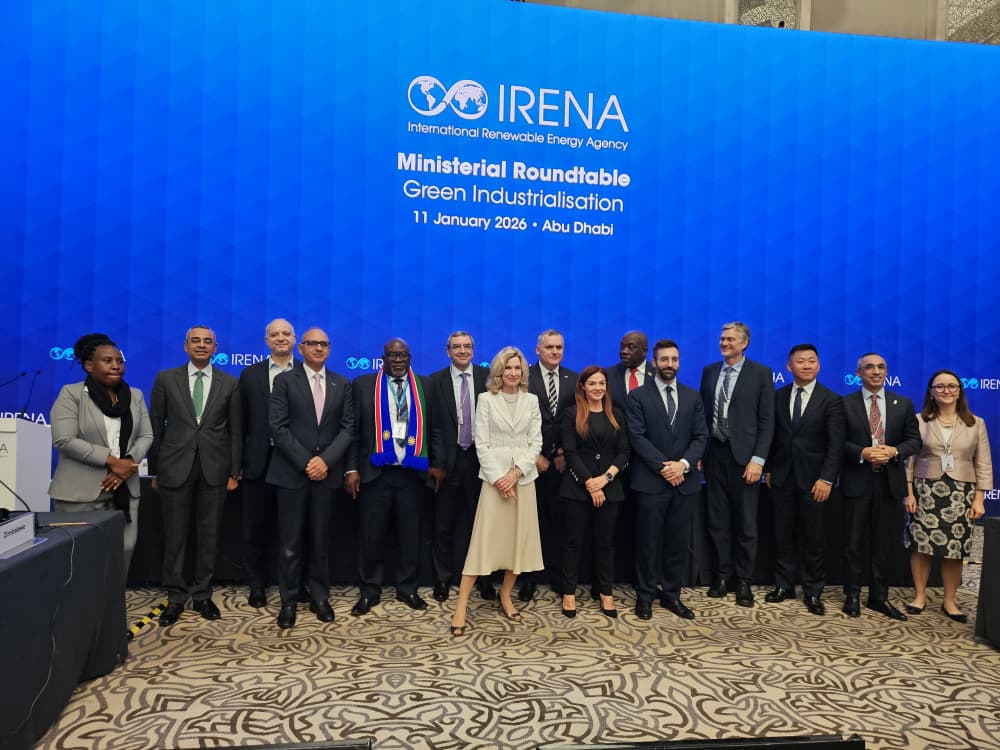

Namibia took centre stage in the global push for clean energy, as world leaders met in Abu Dhabi to discuss how renewable power can drive shared prosperity and fight climate change.
The International Renewable Energy Agency (IRENA) on Saturday launched the Pre-Assembly Day of its 16th Assembly under the theme “Powering Humanity: Renewable Energy for Shared Prosperity.” More than 1,500 participants, including senior government officials, global leaders and energy policymakers, attended the high-level meeting to review progress and agree on next steps to speed up the global energy transition.
The discussions were aligned with the UAE Consensus, the 2030 Sustainable Development Goals and the Paris Agreement, with a strong focus on expanding renewable energy capacity around the world.
Speaking at the event, which ended yesterday, Deputy Speaker of the National Assembly Phillipus Katamelo said Namibia is now seen as a fast-moving and attractive renewable energy market. He said the country has a clear strategy, strong political support and growing leadership in green hydrogen.
Katamelo told delegates that Namibia’s success did not come from one single policy decision. Instead, it came from a series of well-planned reforms that built trust and confidence among investors. He explained that the creation of a national green hydrogen programme gave investors a single-entry point, reduced delays between ministries and made it clear how projects move from idea to approval. This helped speed up development and cut red tape.
“Namibia also made it easier for the private sector to invest by using competitive bidding, partnerships and phased project development, rather than issuing licences on an ad hoc basis. Clear rules for land access, environmental approvals and social assessments further improved predictability for large projects,” he said.
Katamelo added that government and private companies also share risks in a balanced way. The State handles early planning and coordination, while private developers take on construction and operational risks, supported by development finance institutions.
“In summary, Namibia’s progress shows that a small economy can move fast when policies are clear, institutions are strong, markets are well designed and political support is firm,” Katamelo said.
Minister of Industries, Mines and Energy, Modestus Amutse, said Namibia’s energy transition is firmly rooted in renewable energy. The country has some of the best solar and wind resources in the world and has set a target to reach 70% renewable energy in its electricity mix by 2030.
He added that, this goal is backed by clear policy and regulatory reforms aimed at attracting investment. One key reform is the introduction of the Modified Single Buyer model, which opened the electricity market to greater private sector participation while keeping system stability.
“As a result, more independent power producers are now investing in renewable energy projects, increasing local generation, diversifying the energy mix and reducing Namibia’s dependence on imported electricity. The reforms have also made it possible for Namibian producers to export renewable power to neighbouring countries,” he said.
Namibia is one of the driest and sunniest countries in the world, making it highly suitable for solar energy development. The country also has strong coastal winds that support wind power generation. To reduce dependence on imported electricity and improve energy security, Namibia has increasingly invested in renewable energy over the past decade.
Today, renewables play a growing role in supplying power to homes, businesses and industries across the country.