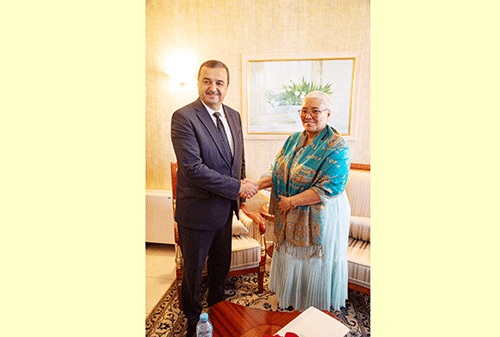

Namibia has taken a significant step in strengthening its oil, gas and renewable energy sector, as Vice President Lucia Witbooi secured Algeria’s support during high-level talks in Algiers on Friday.
Witbooi met Algeria’s minister of energy, mines and renewable energy, Mohamed Arkab, to advance cooperation in energy development. Discussions focused on legal advisory support, technical training, and expert exchanges to help Namibia build a strong foundation for its fast-emerging petroleum industry.
“Namibia is committed to ensuring our people fully benefit from our emerging oil and gas sector. We will leverage Algeria’s expertise to strengthen our laws, build capacity, and secure greater benefits from our natural resources,” Witbooi said.
Algeria, one of Africa’s most established energy producers, reaffirmed readiness to work with Namibia as a strategic partner. The North African country pledged to share its expertise in oil and gas legislation, capacity building, and renewable energy development, in line with President Abdelmadjid Tebboune’s vision.
The talks mark one of Namibia’s strongest moves yet to establish African partnerships in energy, as the country prepares for large-scale oil production in the coming few years.
Witbooi was accompanied by deputy minister of international relations and trade Jenelly Matundu, special advisor Kornelia Shilunga, and senior officials from the Presidency.
Both countries also agreed on the importance of high-level visits in the near future, including site tours to Algeria’s strategic oil, gas, liquified natural gas, and renewable energy facilities. These visits will give Namibian officials first-hand insight into how Algeria has managed its vast resources.
“This partnership is not just about resources. It is about shaping a sustainable African energy framework that creates prosperity for our nations and our continent,” Witbooi said.
Algeria’s experience in managing state-owned enterprises, negotiating with international oil companies, and investing in downstream facilities could help Namibia avoid common pitfalls in the sector.
Spotlight on creativity
Alongside energy cooperation, Witbooi placed a spotlight on Africa’s creative economy. On Saturday, she delivered the keynote address at the Creative Africa Nexus (Canex) during the Intra-African Trade Fair in Algiers, a platform designed to connect Africa’s cultural industries with global markets.
In a speech that drew loud applause, Witbooi described Africa’s youth as the “heartbeat” of the continent’s future.
“Our young people are not just dreamers, they are doers shaping tomorrow,” she said.
She highlighted the rise of African music on global charts, African films winning international awards, and African fashion houses gracing Paris and New York runways – all signs of how culture can be transformed into capital.
Witbooi urged African governments to integrate the creative economy into national development strategies. She further urged the private sector to invest in film, music, fashion and digital platforms, while encouraging development partners to view Africa’s youth as a source of unmatched potential.
“For too long, Africa’s creative industries were undervalued. They were seen as entertainment, not economics. But that era has ended,” she said. “Today, we declare together that creativity is a currency, culture is capital, and Africa’s youth are the entrepreneurs of a new age.”
From Namibia’s perspective, her remarks at Canex highlighted the push to integrate creative industries into tourism, employment, and economic inclusion.
“To the young Africans, I say: the world is listening and watching,” Witbooi told the gathering. “Create loudly, innovate boldly, and dream unapologetically. You are not just part of Africa’s future, you are its present.”
With Algeria’s support, Namibia is set to accelerate preparations for managing oil wealth responsibly, while building the skills and institutions required to benefit its people. At the same time, Witbooi’s call for investment in the creative economy underlined a broader vision of transformation – one that goes beyond extractive industries.
“This is our moment. A continent united in culture, driven by creativity, and championed by its youth can no longer be ignored in the world’s imagination,” she said as she ended her address.