

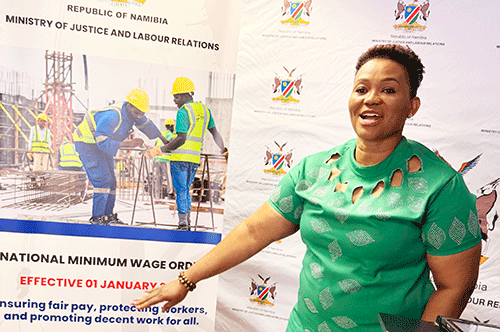

The Ministry of Justice and Labour Relations yesterday launched a nationwide campaign on the new minimum wage rates that will take effect from 1 January 2025, with planned increases continuing into 2026 and 2027.
Speaking at the launch of the promotional material on the national minimum wage, acting director of labour services, Shou-Henock Amukwa, urged all employers and workers to familiarise themselves with the new wage order published in the Government Gazette. Amukwa said that, under the changes, domestic workers must be paid in accordance with the current wage order, effective 1 January 2025. This sector will then see another adjustment next year. From 1 January 2026, domestic workers must earn a minimum of N$15 per hour. “The agriculture sector will also see annual increases. All agricultural and farm workers will earn N$10 per hour from 1 January 2025. This wage will rise to N$14 per hour in January 2026, and again to N$18 per hour in 2027. For security workers, the minimum wage will be N$13.50 per hour starting 1 January 2025. Their pay will increase to N$16 per hour from 1 January 2026, reaching N$18 per hour in 2027,” he said. He explained that these wage calculations are based strictly on the ordinary hours of work. They do not include deductions or extra payments such as food allowances, overtime, Sunday work, or public holiday pay. These remain separate, as outlined in the wage order.
Deputy Executive Director in the ministry of justice, Aune Mudjanima, noted that with help from the International Labour Organisation (ILO), the ministry has now produced new educational and promotional material that is designed to give clear, accurate, and reliable information about the national minimum wage. They aim to help both employees and employers understand the law and their responsibilities. “The minimum wage was introduced to promote decent work and ensure that every worker receives fair and lawful compensation. Also, the success of the national minimum wage depends on continued cooperation, education, and correct implementation,” said Mudjanima.
This minimum wage development is pursuant to Article 95 of the Namibian Constitution, subsection (e), that requires the State to adopt policies aimed at: “Assurance that workers are paid a living wage adequate for the maintenance of a decent standard of living and the enjoyment of social and cultural opportunities.”