


Mathilde Kudumo
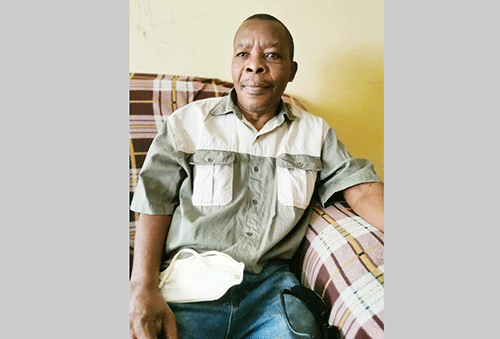
The day Petrus !Hoaeb collapsed beside his workstation inside a uranium mine in southern Namibia, is one he will never forget.
The air was dry, thick, and silent, broken only by the shouts of co-workers rushing to lift his body.
It was not the first time. He had fainted before. Each time, he was rushed to the hospital, patched up with medicine, and sent back underground.
“I thought it was just the flu, or maybe exhaustion. But it kept happening,” !Hoaeb recalled in an interview with Nampa.
What followed was a revelation that would change his life forever.
The 67-year-old former mine worker is now demanding compensation, saying he has suffered long-term health complications after being exposed to radiation during his years of service.
!Hoaeb joined the mine in 1976 as an assistant laboratory technician. Years later, after repeated fainting spells, medical checks revealed something far more serious than exhaustion.
“The union (Mineworkers Union of Namibia – MUN) called in a doctor to test us. But when the mine found out, there was a big fight between management and the union,” he recalled.
“The doctor told us to follow up with our medical reports. That’s when I discovered I had been exposed to radiation.”
The confirmation marked the beginning of a steep decline. !Hoaeb was paralysed for a year, confined to a wheelchair, and booked off work from 2000 until 2012.
During this period, he was paid only 75% of his salary.
“The exposure took me to the wheelchair for at least a year, where I had to fight for my health till I started walking again,” he said.
The fallout went beyond his body. His son, Hananja, described how the ordeal tore through the family.
“Just seeing him in that state was traumatising for both me and my brother. We went for therapy for two or three months, but we couldn’t continue because of money,” Hananja told Nampa.
He remembers his father as an energetic man who exercised, boxed and ran.
“All of a sudden, we were told he could no longer walk.
Even small movements became difficult for him,” Hananja added.
Although mobility has returned, !Hoaeb continues to battle fatigue, aches and restricted movement – reminders of the invisible hazard he faced daily underground
His story is not unique. Across Namibia’s mines, workers have long complained about unsafe conditions and health complications.
Yet, when illnesses surface, many say they are left to fend for themselves.
George Ampweya, MUN secretary general, admitted the union struggles to track the long-term effects of hazardous working conditions.
“We do not have a central database of health and safety records, which weakens our case,” he said.
Ampweya stressed that Namibia’s lack of an occupational health law leaves workers vulnerable.
“It is difficult for workers to receive compensation, which is why the union is pushing for regulations under the new health bill,” he added.
However, there is light at the end of the tunnel, as preparations are at an advanced stage to introduce the long-awaited Occupational Safety and Health (OSH) Bill.
Earlier in May, the Ministry of Justice and Labour Relations held a two-day validation workshop for the OSH Bill, with technical support from the International Labour Organisation.
Maria Hedimbi, Chief Public Relations Officer at the Ministry of Justice and Labour Relations, told Nampa that the Bill is in its final stages.
“The tripartite drafting team has incorporated the final stakeholder inputs. The Bill will be presented to the Labour Advisory Committee by September 2025,” she said.
The ministry official noted that the Bill is designed to strengthen workplace safety by enforcing preventative programmes across industries, including mining.
However, compensation for workplace injuries remains governed by the Employee Compensation Act of 1941, administered by the Social Security Commission.
“The OSH Bill focuses on prevention. Employees with occupational injuries that result in permanent disablement are still covered by the Social Security Commission,” Hedimbi explained.
Since independence, mine workers have organised strikes and union campaigns for better wages and conditions.
Yet, stories like !Hoaeb’s highlights an unresolved battle – the recognition of the health toll mining takes. For him, it is a fight for dignity.
“Companies must take responsibility, not just treat people well when you are healthy, then discard you when something goes wrong,” he said.
As Namibia prepares to finalise the OSH Bill, the hope is that future generations of miners will not endure the same neglect. But for men like Petrus !Hoaeb, the scars, both physical and emotional, are permanent reminders of a system that has yet to fully value its workers.
Until justice is realised, he remains one of many carrying the heavy burden of building Namibia’s mining industry at great personal cost.
-Nampa