

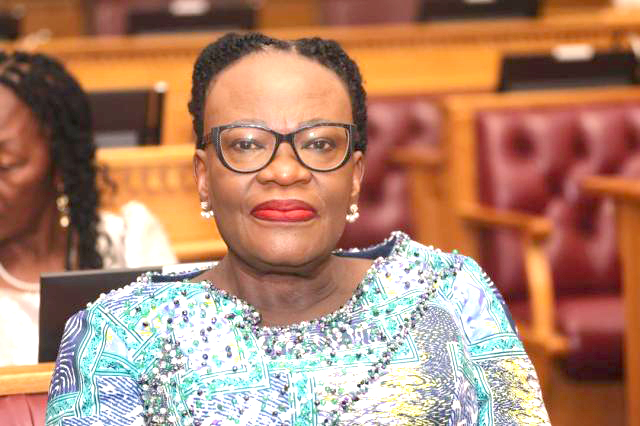

I remember vividly the corridors of the United Nations in October 2000.
During Namibia’s leadership of the Security Council in October, I carried with me the conviction that the world needed to view conflict differently.
We had emerged from our own liberation struggle, a struggle during which women were not only victims but fighting side by side with our male combatants, leaders and even mediators. It was inconceivable to my colleagues and I that women should remain marginalised in the Council’s deliberations on peace and security.
When Namibia proposed that women must be recognised not just as victims of conflict but as contributors to peace, we met resistance.
Some members questioned if gender issues belonged in international security, with others seeing it as social development advocacy.
We knew relenting would exclude another generation of women from peace talks. We continued, using subtle diplomacy and friendly pressure within the Security Council and UN. On 31 October 2000, United Nations Security Council Resolution 1325 on Women, Peace and Security was adopted. The Resolution is anchored on four interrelated pillars – Participation, Protection, Prevention, and Relief and Recovery – calling for women’s full involvement in peace processes, safeguarding their rights during conflict, preventing violence and ensuring their needs are addressed in post-conflict recovery efforts.
That moment remains one of the most significant highlights in my career.
It was a small delegation from a newly independent African nation, persuading the world’s most powerful body to acknowledge women’s contributions to peace-making and peacebuilding.
It is deeply symbolic that the Silver Anniversary of Resolution 1325 will be commemorated in Windhoek – it is a homecoming. From Windhoek, we carried the agenda to New York.
Now, the world returns to Windhoek to reflect on its legacy.
It also emphasises something larger. Resolution 1325 is not an external concept but an African and Namibian contribution to global security. It was inspired by the lived experiences of African women and brought to fruition by an African state. Our capital is thus testimony to the power of African agency in shaping global norms.
Our dedication to the Women, Peace and Security agenda did not end in 2000. We sought to live what we had proclaimed. When we deployed an all-women military contingent to Darfur, Sudan, under the AU-UN Hybrid Operation (UNAMID), it was more than symbolism.
These Namibian women built trust with local communities, addressed the unique vulnerabilities of women in camps and embodied the principles of Resolution 1325 in practice. I recall the pride with which their deployment was received.
For Sudanese women, many of them victims of unspeakable violence, seeing women in uniform, trained to protect and to listen, was transformative.
It reminded me of UNTAG in 1989, seeing African women giving directives to our former colonisers.
It proved what we had long argued in Beijing at the 4th World Conference on Women and in New York at the UN Security Council: that women’s presence changes not only the optics but the outcomes of peacekeeping.
More importantly, the Silver Anniversary also coincides with a milestone in our own democratic journey. For the first time, we are led by a woman President, Netumbo Nandi-Ndaitwah, who was a pillar of strength and advice during the process of establishing Resolution 1325. This moment carries symbolic and substantive weight.
Symbolically, it affirms the very principle that underpinned Resolution 1325: women must not only participate but also lead at the highest levels of decision-making.
Substantively, it ensures that the voices shaping our national and foreign policy are enriched by perspectives historically marginalised.
The woman Head of State in Namibia shows that the Women, Peace and Security Agenda is a real national achievement, proving to Africa and the world that women’s leadership in peace and governance is essential, not exceptional.
Milestone
However, we cannot celebrate without acknowledging how far we still must go.
Globally, women still constitute fewer than 20% of negotiators at peace tables. Grassroots women peacebuilders, the lifeline of communities ravaged by conflict, continue to operate on shoestring budgets. The Windhoek commemoration must, therefore, resist the temptation to become a nostalgic ritual. Anniversaries must be mirrors.
We must look hard at whether the frameworks of yesterday can confront the crises of today.
As Windhoek convenes the 25th anniversary in partnership with the African Union Commission and Southern African Development Community Secretariat, we do so not as ceremonial hosts but as custodians.
We are saying to the world that Africa birthed this agenda – and Africa, together with the international community, will shape its future.
Expectations
Firstly, Windhoek must deliver accountability.
States that have adopted National Action Plans must show implementation, not just intention.
Secondly, resources. We cannot expect women to build peace with symbolic budgets.
Looking ahead, the next phase of Resolution 1325 must embrace diversity and intersectionality.
Young women, refugees, rural leaders and activists all bring perspectives that make peace sustainable. We must also confront new realities. Online spaces have become new battlegrounds of disinformation and harassment, disproportionately targeting women.
The Women, Peace and Security Agenda must evolve or risk irrelevance.
Above all, the next 25 years must be unapologetically action-oriented.
As Africans, we are committed to Agenda 2063, which already commits us to ‘Silencing the Guns’.
Windhoek must, therefore, build on this vision, cantred on indigenous knowledge, grassroots resilience and continental solidarity.
*Ambassador Selma Ashipala-Musavyi is the Minister of International Relations and Trade.