


The year 1968 is one of the fiercest years in the annals of the liberation struggles in the Caprivi, recently renamed the Zambezi region. During 1968, a terrible catastrophe befell the inhabitants of the region, which was never witnessed by the people during their lifetime.
The South African Security Forces swooped over the region, terrorised and tortured many Mafwes because they supported freedom fighters. Consequently, many people were maimed, killed and forced to flee to Zambia because of their political convictions. Whole villages from Kongola, Kalubi, Sesheke, Singalamwe, and Chixhu fled into exile, fearing for their lives, and joined the liberation struggle. Although there were rumours of war and torture in many quarters of the region, it were the villages of Sibbinda, Makanga, Masida, Nkongola, Sesheke and Singalamwe and partly the southern section around Linyanti which were really targeted and witnessed the brutality of the South African Security Forces.
Though there were limited severe incidents at Sibbinda, the South African Security Forces established a military base which sent shivers among the people and subsequently made them feel insecure in their own village. In a way, the military base was imposed and established among the people who did not welcome such a monstrous institution in their midst. Notwithstanding the resistance of the people against a military installation in their area, the soldiers would terrorize the populace at will.
The reason for targeting these areas could be manifold, but the common one was the route taken by PLAN fighters when entering the region and they crisscrossed certain areas. According to late Bernard Sitimela who was one of the PLAN combatants, the group came through Kalobolelwa route in Zambia and arrived at Singalamwe and then spread to the rest of the villages.
Sitimela maintains that the group which was deployed to the region by the Swapo leadership was led by Theoefelus Himalwa and deputized by Moses Malamo Manoa who originated from Nziba, Makanga and was therefore no stranger to the area. The PLAN fighters finally arrived in Masida village in October 1968 and met the community members which included the lately demised Kenneth Kuseka Muloho.
The aftermath of the meeting let hell break loose among the people mostly under Chief Mamili. Induna Masida was in the company of his community members when he was arrested with others.
Despite being an honourable man and an induna of his community, Induna Masida was humiliated in front of the people. The charge was that he was harbouring and supporting freedom fighters who happened to be PLAN fighters. It is a common fact the South African colonisers humiliated Africans despite their important educational and social status in their communities. After undergoing torture and humiliation, he was roasted alive over a fiercely burning fire.
He was later taken to Pretoria to serve an unspecified prison sentence. Induna Masida died in mysterious circumstances, apparently from his burnt wounds and his grave remains unknown. He was one of the freedom seekers the South African Forces treated as a mere object, even though he was respected among his subjects as an educator and custodian of their beneficial, indispensable cultural and educational values.
The sad fact is that despite all his contributions to the war of liberation, the only recognition is his name which appears with others on a fading, unattended placard posted near Masida village and nothing else. His children have been applying for the recognition of their father as a veteran, without any success. The cruel way Induna Masida was murdered may be likened to some victims of the dungeons, whose fate is equally unknown and their names are completely erased from the annals of the liberation struggle despite ‘their blood watering our freedom.’
This scenario may remind one of a poem, ‘Dulce et decorum est,’ written by Wilfred Owen during World War I, and published posthumously in 1920. Its Latin title is from a verse written by the Roman poet Horace: Dulce et decorum est pro patria mori. In English, this means “it is sweet and proper to die for one’s country. Exactly that sarcasm at its best and applies to many Namibians who sacrificed their lives for this country, yet are completely buried with their names and forgotten. What a shame to the nation that does not adequately honour its heroes and heroines by keeping their records!
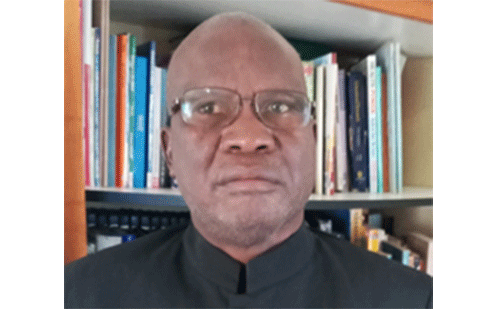
* Prof Makala Lilemba is an academician, author, diplomat, researcher and scholar.