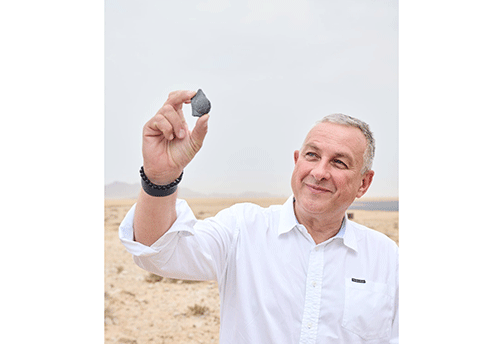

At the beginning of September, I visited the Pacific region for the first time in my life.
Like Namibia, it is a true testament to the beauty of our planet – the deep blue ocean, the greenest flora, impressive volcanoes. Yet Pacific also symbolises how fragile our world has become. Rising seas, violent storms, earthquakes or volcanic eruptions strike some islands almost every year.
The conclusion is clear: protecting our Earth is our moral imperative, but it is also the foundation of real, sustainable progress. And I believe that together with Namibia, we are doing both.
Our partnership with Namibia shows that when we align the energy and ambition of Africa’s young population with European innovation and the EU’s Global Gateway strategy, we can create something special – industries that protect the planet while creating opportunity.
I came to Namibia with high expectations. The reality exceeded them. Namibia has everything it takes to become a leader of the global clean economy. With world-class solar and wind resources, the country can produce renewable hydrogen and green steel at highly competitive costs. For Europe, this partnership secures clean energy and sustainable raw materials. For Namibians, it means jobs, skills and a modern economy that keeps more value at home.
Already now, we are seeing how concrete green hydrogen projects are creating quality jobs for Namibians. As the green industrialisation grows, the HyIron Oshivela plant has become Africa’s first zero-emissions iron facility. Once fully scaled, it will produce one million tonnes of green reduced iron each year, cutting 1.8 million tonnes of carbon dioxide emissions. Yet the human dimension is even more striking: more than 60 Namibian SMEs and hundreds of local workers were involved in the construction, (hundreds) more jobs will be created in future constructions and permanent operations.
In Walvis Bay, together with Prime Minister Elijah Ngurare, I inaugurated the Cleanergy Solutions facility. It is home to Africa’s first public hydrogen refuelling station and soon will power a hydrogen-driven port vessel. Alongside the infrastructure, a Hydrogen Academy is training Namibians for the jobs of tomorrow.
Skills development is the backbone of this transformation. Through the IGNITE GH2 programme, the EU and Namibia’s University of Science and Technology are re-skilling 700 graduates and preparing 40 new instructors for the hydrogen sector. With industry demand expected to reach between 55 000 and 130 000 skilled workers by 2040, this investment in human capital is decisive. Aligning training and skills programmes with industry needs will be key to unlocking the job creation potential.
But Global Gateway’s support goes even further. We back measures that uphold the highest levels of transparency, community engagement and environmental governance in the hydrogen sector, because new industries can only succeed if they are inclusive and accountable. We also support solar electrification for vulnerable households, because reliable energy access empowers families and opens new possibilities for communities. And we are helping transform Namport in Walvis Bay into a future regional industrialisation and global hydrogen hub, with strong links to European ports such as Antwerp, Rotterdam and Sines.
This is the essence of the 360-degree Global Gateway approach. We do not build isolated projects. We combine infrastructure with education, training, regulation, and civil society involvement to enable entire ecosystems and create local added value. This ensures that progress is sustainable, inclusive, and owned by Namibia itself.
Europe has already mobilised N$25 billion in loans and grants in Namibia, unlocking over N$400 billion in potential private investment. These projects are co-created with our Namibian public and private partners, rooted in a partnership of equals.
Global Gateway is Europe’s strategy to mobilise €300 billion worldwide for sustainable development, with half of this earmarked for Africa. Because the future of our continents is closely linked. Namibia is showing what this future can look like.
Together, we are proving that protecting the Earth and creating prosperity can go hand in hand. And I am confident that this is only the beginning of our common journey.
*Józef Sίkela is the EU Commissioner for International Partnerships.