
As a resident of Omusati region, I have a citizenry concern that I would like to reach the Office of the President (appointing authority).
These concerns are around the appointment and performance of past governors for Omusati region in relation to the pace of infrastructural development in the region since 2000.
I took note of the snail’s pace of development mainly in many sectors of the southwestern part of the region.
If one visits the region, they will notice development planning imbalances.
Yes, cattle farming is booming, but social and economic services have been neglected.
Let me highlight a few developmental challenges below.
Roads (bitumen standard and feeder roads): Only a few roads were upgraded to bitumen in the Tsandi constituency.
Moreorever, none of the village feeder roads in the Onesi constituency are tarred, both eastern and western.
The feeder roads (gravel) built in the 2000s require immediate rehabilitation every rainy season.
Development is much better if you compare both bitumen standard and feeder roads in Outapi, Okalongo and partly Anamulenge constituencies.
Schools (secondary schools): there are no new secondary schools in Onesi other than Onesi Secondary School that was built in the 1990s.
I took note of the IK Tjimuhiva Combined school, but what distance is this school from either Onesi or Tsandi?
The population in the two constituencies has increased since 2000.
In most cases, children seeking placement in grade 8 must scrabble for spaces either in Outapi surrounding schools, such as Canisianum and Onawa, or eastern schools such as Negumbo, Nuuyoma or Ruacana High schools.
A quick comparison, secondary schools in Okalongo, Oshikuku and Outapi are much closer to each other in terms of the distance, with better access to road infrastructure, including rural schools.
Health facilities: residents of outlying areas, such as Onandjandja, Omakuva, Oshikondiilongo and Okatseindhi, must hike for more than 30 kilometres to reach what is considered the closest health centre – either Tsandi Hospital or Onesi Health Centre.
Most outreach health facilities erected operate only once a week.’
They do not cater for patients with chronic illnesses – let alone transport costs to reach the health facilities.
It seems even the previous regional councillors, who supposedly lobbied for the existing government development projects, failed to perform.
I also strongly feel vetting and recommending candidates for regional council positions (councillors) by the Swapo regional executive committee, which mainly is dominated by people based in the central part of the region, is done with a different motive – to deploy those royal to the party irrespective of performance).
This contributes to the stagnant development in those areas.
I believe Her Excellency will this time around appoint an ideal governor to fast-track development in this region that is inclusive.
The region has huge potential indeed.
While drafting this noble opinion piece, these questions linger in my thoughts.
Why is it always that governors who serve in this region should be from either Outapi or the eastern part of the region?
Are there no capable comrades in the south or west of the region?
Why is development more regionally centralised but not in the western part?
My ideal regional governor should:
Be a performer, who understands the social and economic potential of the region.
Support small-scale farmers and the existing green scheme (Etunda) to maximise food production and increase employment youth uptake. I do not believe Omusati residents should rely on maize meals from the Otavi-Grootfontein-Tsumeb maize triangle for the drought relief programme. We have enough land and water, plus our green scheme.
Lobby for inclusivity in regional infrastructure development planning.
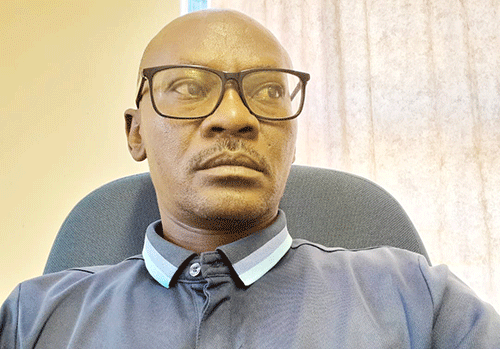
*Festus Kiiyala is a youth officer. The views expressed here are his own. He can be contacted at shalongoh@yahoo.com