
“Doing the same thing and expecting different results” is a phrase often used to describe the idea of repeating the same actions without changing your approach while hoping for a different outcome. It is insanity, according to Albert Einstein.
With the national results for Grade 11 and Advanced Subsidiary (AS) out, the most notable thing is Kunene region stubbornly maintaining its position as the worst-performing region of the 14.
In stark contrast, our neighbours in Omusati have excelled, with the //Kharas region falling from grace from 3rd position to 11th position.
The results are a mixed bag
While some regions and schools have transformed their fortunes for the better, others continue to inspire no confidence in the short-to-medium term, especially if no radical changes happen.
The results have put the Kunene education region under the microscope and heavy criticism, with teachers being the most targeted, rightfully so, to a certain extent.
This article examines the exact part of the Kunene academic machine, which makes the Kunene vehicle remain stationary in academic anguish.
To begin with, let us understand that education is a system with thousands of components (stakeholders), who must all play their various roles, no matter how minuscule – from an institutional worker, through a parent, inspector, regional director and executive director to the minister.
Because education is a system that requires all parts to be working optimally, when it fails, the finger of blame cannot rest squarely on one part.
Similarly, when all is rosy, praise cannot be given to one part either. We win and lose as a collective.
Learners
Our learners must receive their fair share of blame. You will never meet a generation of people who can just not take responsibility for their own academics like our current learners. Our learners do not understand that they are going to school for themselves.
Teachers and parents can only do so much.
The ultimate onus is on the learners themselves. Our learners frequent shebeens ,like they are going out of fashion. Our learners have lost respect for elders, including teachers, and consequently lost respect for the education system.
The parents in the region are the beginning of all our problems in the region – from their lack of involvement in their children’s learning to their struggle to keep the children disciplined and away from shebeens.
Most of the learners have temporary shelters in towns from where they attend classes, away from their parents, who live in villages.
This means that these children are without parental supervision.
They are free to do as they please. Worse is, to make ends meet, some of these learners, as young as 13, are already cohabitating with partners who do odd jobs in towns. Meanwhile, others who live with their parents do not sleep at home.
It is almost as if our parents have given up on their children.
Teacher
As teachers, the results are a collective indictment for our collective failure.
The Kunene teachers are not without blame in the performance of our region. It is almost as if our teachers have lost respect for the teaching profession.
Our teachers are not afraid to engage in activities that will bring the teaching profession into disrepute in front of learners.
Teachers freely consume alcohol in front of learners in tournaments and other educational activities, despite the circular that prohibits such behaviour. Learners copy this behaviour, and become bar-bound. Some of the teachers even go to work while inebriated.
This significantly impacts productivity.
English
English language comprehension is a big problem in Kunene. English, being the medium of instruction, means our learners are doomed to fail until a permanent solution is in place to circumvent this problem.
The point of departure is for all stakeholders in Kunene to have a shift in mentality. The Kunene community must come to realise that education is a collaborative effort, and that all our roles are equally significant in propelling Kunene to great academic levels. Since we fail as a region, we are all to blame.
When we succeed, praise will be due to each one of us.
When our learners are failing, it is because we, as education stakeholders, are failing to provide optimum ground for teaching and learning to take place.
Despite the significant improvement from the side of the regional office when it comes to recruitment and other education administration components, there is a need to empower teachers with support with trainings and workshops to keep teachers abreast of the latest trends and changes in education and instructional technology.
The region must provide opportunities for teachers to learn first-hand from those regions that are doing well, with the support of advisory teachers.
Furthermore, the crisis has deep roots, as it transcends beyond Kunene.
Policy experts, teachers, researchers and long-time observers of Namibia’s education system have consistently opined that the poor exam results indicate underlying structural issues that extend far beyond the orbit of individual learner performance.
It is not just about the classroom, desk, chair, learner, teacher, notebook, textbook and chalkboard.
From a teacher’s perspective, the education crisis stems partly from poor school infrastructure, inadequate allocation of school resources following the massification of the education system [the not-so-free, free education], the rollout of the new curriculum, lack of discipline among learners, and lack of commitment or professionalism displayed by some teachers and parents, who are nowhere to be seen in their children’s education journey. However, in this dark cloud, there is a silver lining – a glimmer of hope.
The recently-announced results perfectly fit the narrative that the best solutions are found in times of crisis.
It is in times like this that parents, learners, teachers and key stakeholders in Kunene should hold hands to fix the fundamental issues, rather than seeking to apportion blame on the next party.
This is a perfect opportunity for all stakeholders to tackle the structural problems holding the system back. Therefore, the current crisis should not turn into a wasted opportunity.
Kunene – collectively – must seize the opportunity, and deliberate on structural and systemic forces that underlie under-performance.
For as long as we continue on the same path, we will never get different results. It is about time we did things differently as a region. The longer we stay on the wrong train [education strategy], the more expensive it is to get home [improved results].
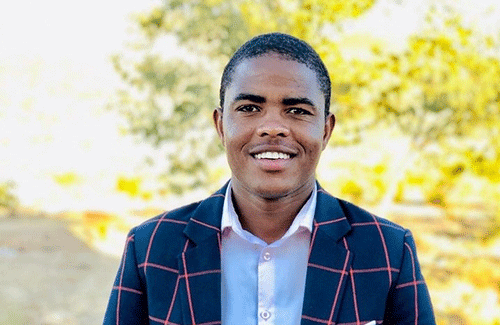
*Kaatutjiua Mbinge is a teacher and concerned parent from the Kunene region. He holds a master’s degree in education management from the University of Namibia.