

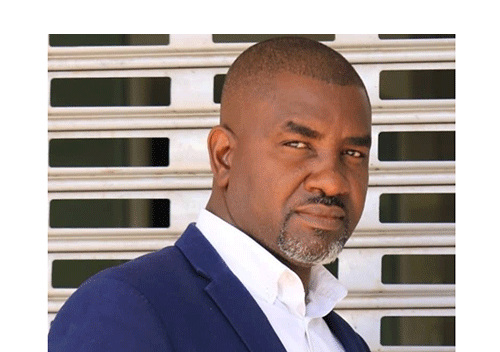

As a tradition in contemporary governance, let us take a moment to reflect on Prime Minister Tjitunga Elijah Ngurare’s time in office since he assumed duty on 21 March 2025.
Despite the brief period, his leadership has already been defined by a strong emphasis on setting a new tone for the public service, initiating administrative reforms, streamlining government operations, reducing bureaucratic hurdles, social cohesion, sports and youth empowerment.
His early efforts have further centred on strengthening leadership, building stronger relations with traditional authorities, enhancing service delivery, driving effective policy implementation, and promoting inclusive development. Others include empowering young people, responding decisively to rural development, and revitalising underperforming agricultural schemes to bolster national food security.
Leadership and administrative change:
The dynamic and forward-thinking prime minister began his term with a strategic administrative reshuffle. Ngurare implemented changes to executive directors’ positions across various ministries to enhance operational efficiency. Notably, Gladice Pickering was appointed the executive director and accounting officer in the Office of the Prime Minister, while other executive directors were either reassigned or retained in their roles.
Committed to accelerating service delivery, Ngurare has consistently advocated a shift in mindset among leadership and public servants. He is urging a transformative approach beyond complacency, emphasising the need for innovation and urgency in meeting the public’s needs.
On numerous occasions, he has underscored the importance of modernising service delivery through digitalisation and automation.
Ngurare continues to encourage executive directors to eliminate bureaucratic bottlenecks and combat nepotism in government processes, promoting a culture of meritocracy, transparency, equity and inclusivity. He has demonstrated this commitment through the establishment of a versatile and diverse team within the Prime Minister’s Bureau, embodying the national principle that “no Namibian should feel left out.”
Implementation
It is apparent the prime minister is deeply committed to translating the 8th administration’s priorities into actionable strategies, including strategic and annual plans, individual performance agreements, and key national development frameworks.
His efforts align closely with the government’s seven priority areas: youth empowerment and job creation – particularly addressing youth unemployment – value addition in natural resources, agricultural development, infrastructure expansion, education and skills enhancement, climate change adaptation and environmental resilience, as well as promoting good governance and transparency.
Employee wellness
The prime minister is a firm advocate of employee wellness, grounded in the belief that a motivated and fulfilled workforce drives higher productivity and better public service outcomes.
He often reiterates the philosophy that “happy employees are more productive than disengaged ones,” emphasising the importance of creating a positive and supportive work environment. “I want people to come to work happy and go back home to their families happy,” he frequently reminds public servants.
Central to his transformational, servanthood and democratic leadership approach is the promotion of teamwork, empathy and compassion – values he consistently demonstrates through his own conduct. He encourages ministries and agencies to prioritise the mental, emotional, and physical well-being of employees by fostering a culture of respect, open communication, and inclusivity.
The prime minister promotes employee wellness and professional development across government institutions to reduce stress, boost morale, and build a motivated public service. By fostering a supportive and inclusive work environment, the aim is to ensure public servants feel recognised, empowered, and equipped to deliver high-quality, efficient and citizen-centred services – ultimately strengthening trust in government and enhancing overall service delivery.
Upliftment
The prime minister consistently reiterates the 8th administration’s commitment to youth empowerment and the enhancement of essential services such as water, housing, roads, and food production. He encourages young people to produce and procure goods locally, with the goal of strengthening small and medium enterprises, reducing reliance on imports and stimulating the Namibian economy.
Additionally, he played an active role in the formalisation of informal settlements – a government initiative designed to transform these areas into formally recognised communities, fostering sustainable development and better service delivery.
Cultural unity and social cohesion
The prime minister has consistently urged Namibians to embrace the values of unity as the foundation for national progress and social harmony. Unity is not merely a political slogan but a practical necessity for building a cohesive, prosperous nation and a cornerstone for national development. He believes mutual respect and inclusivity are key to building a peaceful, prosperous nation. In just four months, he has actively engaged traditional leaders and communities across the country, promoting these values through dialogue and cultural events.
Aspirations
The Prime Minister Ngurare’s dream for Namibia is to build a united, inclusive, and efficient nation where every citizen – regardless of background – feels valued, empowered, and served with dignity. His vision includes a professional and responsive public service driven by happy employees, innovation, transparency and accountability.
He also envisages a prosperous and self-reliant economy, especially through rural development, agricultural revival, and youth empowerment. He also wants to see a nation grounded in cultural respect, mutual dignity and equality, as well as a government that works for the people, with modernised, citizen-centred service delivery and employee wellness at its core. He ultimately wants to see a Namibia where no one is left behind and development is both inclusive and transformative.
To sum up, the prime minister has so far laid a strong foundation for a transformative and people-centred administration. His leadership has already sparked significant shifts across public service delivery, administrative reforms, youth and rural empowerment, and the promotion of unity and cultural identity.
With a clear focus on efficiency, equity, and inclusivity, Ngurare has demonstrated a results-driven approach grounded in compassion, collaboration, and national pride. These early efforts signal a renewed commitment to responsive governance and sustainable development – one that not only raises hope but also holds the promise of meaningful progress for all Namibians.
*Rhingo Mutambo is the chief public relations officer in the Office of the Prime Minister.