


This year Namibia was downgraded to a lower-middle-income country by the world bank. This I believe was due to the fact that prosperity is not shared by everyone and pervasive inequality persists. The legacy of privileged elites endures decades after apartheid. Namibia remains among the world’s most unequal nations with roughly more than 40% of citizens in poverty and unemployment near 50%. Even President Netumbo Nandi-Ndaitwah acknowledged this reality by declaring, “We are too few to be poor.”
It is true, we are rich in resources, yet our resources largely benefit very few individuals. To put it bluntly Namibia’s socio-economic system is a “public-resource–private-profit” scheme, an economy that “borders on … theft” as ALEXACTUS KAURE once analysed. That diagnosis unveiled the truth on how Namibia’s adopted economic model, that largely remains unchanged from colonial times, has failed most of our people.
The same underlying structure that fuels economic injustice also entrenches racism. As Arun Kundnani argues in What Is Anti-Racism? And Why It Means Anti-Capitalism, “if racism is structural, it cannot be dismantled by setting out to change individual mindsets.” In other words, fighting racism requires breaking the social and economic structures that produce it. In Namibia, where apartheid entrenched racial hierarchies in property and power, this means the white capitalist ways of doing things must be challenged.
Our history, like most of history, is one of race and economic class struggle. Karl Marx and Friedrich Engels reminded us that “the history of all hitherto existing society is the history of class struggles”. They ended The Communist Manifesto with a rallying cry, “Proletarians of all countries, unite! … You have a world to win. You have nothing to lose but your chains.”
These words translate into a call to organise our majority (the working class), to overthrow the inequalities and legacies of oppression that bind us as Namibians. The fight to solve racial inequality in modern Namibia has for most become a reactive fight. It must be part of a broader anti-capitalist struggle with a leader who thinks socialist. Only then can we truly heal the wounds of apartheid and give real meaning to Namibia’s founding promise of a classless, democratic society.
New York City’s recent mayoral election where a Democratic socialist Zohran Mamdani won the New York mayoral race despite opposition from billionaires and party elites is an interesting case study. Mamdani’s grassroots campaign focused on affordable housing and ending economic injustice issues that Namibians face on a daily basis. New Yorkers, who lived in a renowned “capitalistic city” supported a socialist platform that promised to tax the rich to feed the poor. Namibia should learn from Mandani’s election win.
Even more instructive is China’s example. Under one-party, socialist rule (albeit with markets), China lifted an unprecedented number of people out of poverty. In four decades, it “lifted more than 850 million people out of World Bank-defined poverty” (by far the greatest poverty reduction in human history). China today accounts for about 18% of global GDP, and its citizens’ life expectancy has roughly doubled (from 35 in 1949 to over 78 now).
Namibia’s struggle is a microcosm of the global class conflict Marx described. We face a choice: continue down the well-trodden path where a few capture our nation’s wealth or embrace the path of radical change. For our country to succeed, it needs a leader as fearless as the “hollow” talk of socialism criticised above suggests we lack someone willing to challenge entrenched interests and remake society.
This leader must heed the lessons of Kundnani and Marx, understanding that lasting justice requires overturning the capitalist structures that breed racism and inequality. They must offer a bold vision like Mamdani’s or Xi’s promising affordable housing, land reform, and shared wealth and have the courage to implement it.
Only a fearless socialist thinker can unify Namibians behind genuine reform. Namibia’s future demands leadership that is unapologetically socialist one that will unite the working class “across Namibia and beyond, convinced you have nothing to lose but your chains.” Such leadership would finally put the promise of shared prosperity into practice, ensuring that all Namibians, not a privileged few, reap the fruits of our land and labour.
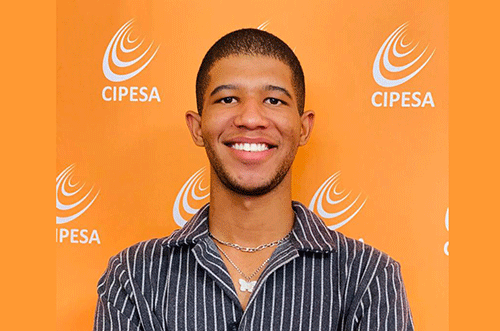
*Shonena V. Nathanael is a youth activist and EU-Namibia Youth Sounding Board Member. This article is written in his own capacity.