


About three weeks ago, I wrote an article arguing that Namibia needs a socialist leader for social and economic growth. It was published in both the New Era newspaper and the Namibian Economist. I unexpectedly stirred some controversy with that piece.
I have received lunch invitations and text messages praising my bold advocacy for socialism, while others chose to critique what they saw as a vague and unfinished piece of writing. They asked me to provide more depth and a deeper exploration of my socialist perspective. As a result, I decided to write a follow-up article.
Firstly, I acknowledge that my article was only the tip of the iceberg and I need to go beneath the surface. Socialism has, for centuries, been on a tool to break the oppressive chains upheld by white monopoly capitalists who, of course, thrive on the existence of an exploitative class society.
That class society also encourages a divided people, because a divided population is aimless, hopeless, and waits for miracles rather than finding solutions to improve themselves.
Let the truth be told, socialism has been implemented in various ways, and some versions have mirrored the very inequalities they were meant to abolish.
Take China for instance, its rapid economic growth has lifted close to 800 million people out of extreme poverty over recent decades, a reminder that state-led development can deliver large-scale social gains, but there have been issues raised of child labour, political centralisation, and the suppression of dissent.
Therefore, I do not want Namibia to simply copy and paste any foreign model. My article mainly focused on the ideological thinking of socialism and the positive outcomes it has produced, so I provided an example of one of the oldest socialist states, China.
There are also constructive lessons in the Swedish/Nordic experience, social dialogue between labour, employers, and the state, backed by progressive taxation and universal public services, helped stabilise class conflict and deliver broadly shared welfare.
The Nordic approach is not magic; it rests on strong institutions, trust, and accountable public management, elements Namibia must cultivate if we expect redistribution to be durable.
This debate should be personal. Namibia faces stark socio-economic facts of very high unemployment and extreme inequality.
These are everyday realities that demand practical, urgent responses from policy and political will.
If President Netumbo Nandi- Ndaitwah wants to turn her “business is unusual” slogan from rhetoric into action, she needs to implement concrete policy changes, such as supporting food production through land reform that includes production support, and reforming the education system so it can proactively meet Namibia’s workforce and skill needs.
Namibia is expected to see an increase in its millionaires in the coming years, while oil and gas are expected to bring billions into Namibia’s economy.
Let us examine the latter and take advantage of it by ensuring that wealth is not kept in elite circles.
Fears of institutionalised corruption and lack of political will remain at the forefront of today’s discourse. The answers to this are open budgets, independent audits, an empowered anti-corruption commission, public procurement reform, and citizen oversight (such as unions or civil society).
Investors invest where markets are stable, and people have purchasing power; basically, a well-run social compact expands those markets.
My first article provoked a conversation. This follow-up is an invitation to act. Let trade unions, youth movements, churches, civic groups, and progressive political leaders sit at one table and draft what I will now call a “Namibian Social Compact.” A clear, enforceable commitment on land, jobs, taxes, and services. If leaders will not lead, citizens must organise.
Give everyone a seat to rigorously design the policies, protect democracy and the rule of law, and make redistribution of resources a reality felt by every Namibian. Lastly, properly understood and democratically rooted, socialism is not a slogan.
It is a promise to free people not only from political oppression but also from systemic inequality and collective hopelessness. Let us now turn that promise into a real, implementable plan for Namibia.
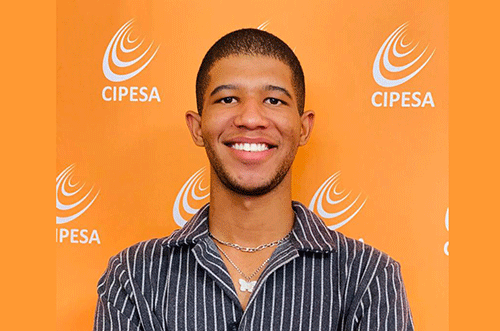
*Shonena V. Nathanael is a youth activist and EU-Namibia Youth Sounding Board Member. This article is written in his own capacity.