

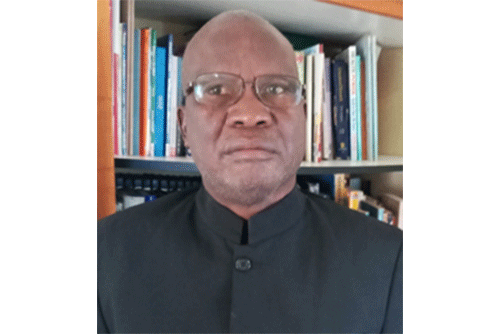

In 1992, during the peak of forming and organising constituencies for the first regional elections since Namibia gained independence in 1990, the national leadership of the Swapo Party assigned Jesaya Nyamu to carry out that task in what is now the Zambezi region.
A few days after his arrival, the team traveled to Sibbinda, where a constituency was planned to be established. Upon reaching Sibbinda village, the leader casually mentioned that there was supposed to be a shop nearby. The remark passed without much notice until I interviewed the late Bernard Sitimela Siunduma years later, after the encounter with Honourable Nyamu.
According to the late Sitimela, Nyamu and he were among the first PLAN combatants to enter the then Caprivi in 1968, with the mission of informing the population that CANU and Swapo had merged into one entity.
The former PLAN fighter further explained during the interview that on 22 June 1968, a group of combatants arrived at a small shop about two kilometres from Sibbinda Village, owned by Billy Finaughty, and helped themselves to some supplies, including food.
According to the late Sitimela, while taking some items, Nyamu accidentally stepped on a bottle and was injured. After interviewing the late Sitimela, I connected the dots. I confirmed Nyamu’s question and insistence that there was indeed a shop in that area. However, it was about two kilometres away, and that the shop had become derelict after being reconstructed in the village.
The whole narrative brings us to that day of 22 June 1968, when the PLAN combatants came to Sibbinda Shop during the night.
The fighters had previously helped themselves to food at another Finaughty Shop in Singalamwe, and certainly the Sibbinda Kapitao was on edge, waiting for his turn. The region was so rural at that time that there were no reputable shops from Singalamwe to Sibbinda.
The word “Kapitao” is actually a Portuguese term meaning boss, overseer, or captain. It was used to refer to a shop attendant, signifying a prominent position in the community.
The Kapitao at Sibbinda Finaughty Shop was then Modeus Libanda. According to the late Sitimela, the combatants had been ambushed at Nansasa Stream, about a kilometre from Sibbinda Village, during the day. When it was time to strike, in the early hours of the night, they passed close to Sibbinda Primary School, zigzagging and coming from the Sinywabuzuni village route instead of taking the direct, shorter one. It appears Kapitao Libanda anticipated such an event, as he did not flee from the PLAN combatants. When the late Moses Malamo, the group’s deputy, knocked on his door, he gladly opened it despite already being asleep.
When asked to take them to the shop and open it, the late Libanda cooperated and obeyed their instructions. Shop attendants were indeed provided firearms for use if the situation required it.
Despite this, the late Libanda never attempted to use any weapon, but instead allowed the combatants to help themselves to everything, including food. Communication was hard to come by during those years, and it was surprising that the following day, three helicopters arrived at the shop, filled with South African Security Forces, police officers, and soldiers. late Libanda stood his ground, bravely telling his interrogators about the unexpected nocturnal arrival of the combatants and that he had opened the shop for them because he had no choice, given the high risk of harm.
For days, the late Libanda was under investigation and interrogation, but did not waver or compromise his stance regarding the freedom fighters. Although he was a contemporary of Chilipeni Muyobololo, William Kabunga Masule, and Society Makumo from Makanga, who were arrested, tortured, and later sent to Pretoria to serve unspecified jail sentences for assisting freedom fighters, particularly Moses Malamo Manoah, the late Libanda was fortunate to avoid such a horrific experience.
However, the daily interrogations in front of his wife and children were extremely distressing.
To make matters worse, Libanda’s younger brother, Brendan, was working in Southern Rhodesia (now Zimbabwe), which fueled further suspicion about his involvement with liberation movements. Despite this psychological torture, the late Kapitao Libanda continued to support the liberation struggle in every possible way until he passed away on 26 September 2012, after witnessing Namibia’s independence, even though he was regarded as someone who did not contribute to the country’s freedom.
*Prof. Makala Lilemba is an academician, author, diplomat, motivational leader, researcher and scholar.