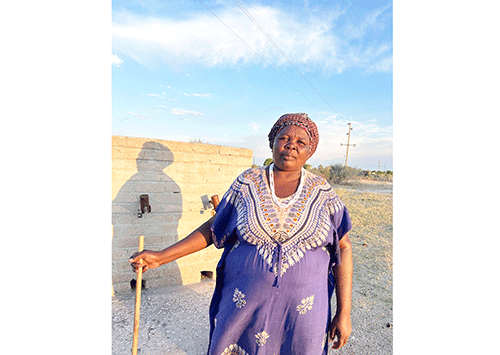

Eba Kandovazu
ONANKALI – Many families in the Oshikoto region are grappling with a lack of water, with the situation worsening as the dry season intensifies, making it a daily struggle, especially in remote areas like Onalukula village.
Local government official Stephenson Tuukondjele told Nampa the water shortage is not just limited to Onalukula village, but spans the entire region, saying the problem has worsened this year and started earlier than usual.
“Normally, we encounter the water shortage problem around October or November, but this year, some areas ran dry as early as July. The water supply from Angola through a series of pipelines, fails to meet the needs of both households and livestock due to the growing demand. Unfortunately, we are at the receiving end of a very complex system, and the water just isn’t enough to meet the demand,” he said.
A resident and member of the Onalukula water committee, Ndahafa Haimbodi, said the community has been experiencing the problem for years, and it becomes dire towards the end of the rainy season.
“This year has been worse. Since June, we haven’t had any running water. The pipeline in Eben-Ezer has become completely dry, and our taps no longer produce water,” she said.
In a desperate attempt to meet basic needs, Haimbodi and other residents are forced to buy water from neighbouring households whose pipelines remain functional. However, the high costs are taking a toll on the community, she explained.
“It’s a struggle. People charge us between N$5 and N$20 per five-litre container, and without a source of income apart from pensions, it’s hard to afford,” she explains.
Haimbodi, 50, shared that many villagers face the same challenge and find it difficult because they have to pay for water every day.
With limited mobility, Haimbodi must pay others to collect water on her behalf, often using vehicles or donkey carts, at an additional cost of between N$10 to N$20 per trip.
Haimbodi and her fellow committee members have reached out to various government offices for assistance, but she said their efforts have yielded few results.
“I’ve contacted the Rural Water Supply Office, the councillor’s office, and even the governor’s office. they used to answer, but now, no one is picking up our calls,” Haimbodi expressed, noting that the community has not received water deliveries from the government for months.
“I have receipts from last year proving I’ve paid for water at our communal tap, yet we’ve not seen any trucks come to fill our tank in months. The lack of water has affected not just our homes, but our livestock as well. Our goats and cattle are thirsty too,” she noted.
The situation has further affected the Eben-Ezer Primary School, located in the village, where parents buy water and take it to the school so their children can benefit from the school-feeding programme. “Even the toilets at the school don’t have running water. It’s shameful,” she added.
Haimbodi called on the government to urgently repair and replace the ageing pipelines in Eben-Ezer.
In response, Tuukondjele said the infrastructure is being rehabilitated, but it is a slow process due to factors such as power outages, which have interrupted the operation of purification plants and pumping stations.
The government has been dispatching water trucks to affected areas on a rotational basis, but with limited resources, they can only provide water to a few communities each day.
“We are doing our best with the resources available, but it’s a huge challenge to deliver water to over 150 villages with just a few trucks,” Tuukondjele said.
Long-term solutions, such as the Oshivelo water project and the drilling of boreholes, are underway to address the root cause of the crisis, he said. -Nampa