
Tisha Steyn
Smart agriculture can address the four main challenges in Namibia’s food production: affordability, market access, climate resilience, and long-term food stability.
This will culminate in sustainable food security, which is presently vulnerable to risk. Building a resilient future requires rethinking how Namibia produces food more efficiently and sustainably, and with stronger links from farms to the markets.
This is the view of Shange-Ndamona Mungoba, a food technologist and Agri-Projects Lead at PS Investments, who believes the country is well positioned to strengthen food security through innovation.
She highlights that, despite economic and climatic challenges, Namibia maintains strong food safety and fortification standards through institutions such as the Namibian Standards Institution (NSI) and the Ministry of Agriculture, Fisheries, Water and Land Reform(MAFWLR).
These structures, she says, form the backbone of a food system that can grow increasingly competitive at the regional level.
Mungoba emphasises persistent weaknesses in Namibia’s food system, particularly affordability, market access, and climate resilience. Smart agriculture, she argues, can address all three.
Nearly a third of food produced globally is lost before reaching consumers, and Namibia faces similar inefficiencies due to post-harvest losses, limited cold-chain capacity, and fragmented markets.
Smart agriculture solutions, such as digital monitoring, precision irrigation, and predictive planning, can dramatically reduce these losses. One model showing promise is the “farm-to-fork” or “plug-and-play” production system, built around coordinated offtake agreements.
These contracts secure markets for farmers before planting begins, protecting them from fluctuating prices and ensuring minimal waste. The result is more stable incomes for producers and a more reliable food supply for consumers.
Namibia’s climate variability, marked by frequent droughts, makes innovation essential. Remote-sensing irrigation, controlled-environment farming, and data-driven soil management can significantly boost yields while reducing risk.
According to Mungoba, these approaches not only improve productivity but also strengthen the most vulnerable pillar of food security, namely long-term stability.
Technology for food security
PS Investments, a wholly Namibian-owned agribusiness, has placed technology-driven farming at the heart of its strategy to strengthen two key pillars, namely availability and access.
The company’s work supports national goals of improving food affordability and creating jobs, particularly in rural communities.
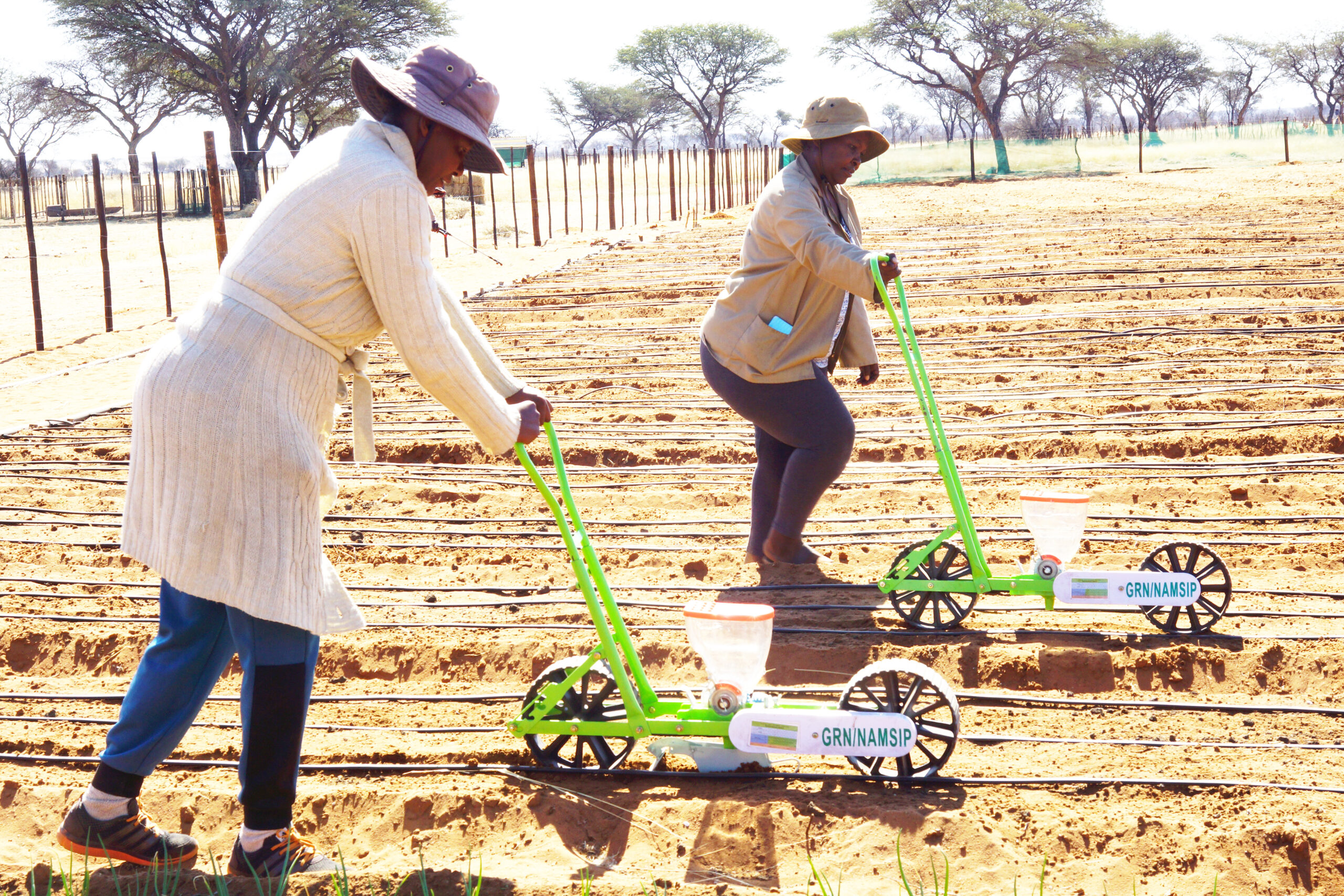
A vital component of its model is skills development. By providing training in smart farming, mechanisation, and data-based management, PS Investments equips young people and farm managers with the capabilities needed for year-round, climate-resilient production.
The company is also investing in biotechnology, particularly in tissue culture techniques, to develop climate-adaptive, pest-resistant crops suited to Namibia’s semi-arid conditions. This complements national nutrition initiatives by improving both the quantity and quality of food entering the market.
Strategic partnerships
To scale its impact, PS Investments has entered high-level partnerships aimed at expanding national food production. One major initiative is a joint venture with the Namibian Correctional Service (NCS) and Eos Capital’s Euphrates Agri Fund.
This collaboration focuses on large-scale, controlled-environment farming in Katima Mulilo in the Zambezi region.
The project will prioritise high-value crops produced through hydroponic and greenhouse systems, methods that reduce water use while ensuring consistent, year-round harvests. This regional model is designed to be replicable across Namibia.
PS Investments is also conducting feasibility studies in Nkurenkuru in the Kavango West region to establish production hubs near some of the country’s most populated areas. These hubs will reduce logistics costs, shorten supply chains, and improve access to domestic and regional markets within the Southern African Development Community (SADC).
The initiative includes compliance with standards developed by the Namibian Agronomic Board and GLOBALG.A.P., ensuring local produce can easily enter major retail markets and, ultimately, meet export requirements.
Road ahead
Namibia’s food security journey is one of resilience, innovation, and opportunity. While the country has a strong institutional framework, achieving lasting food security depends on continued investment in climate-smart, technology-led agriculture.
Mungoba believes that smart agriculture represents a shift from survival farming to sustainable, market-oriented production, thereby strengthening all four pillars of food security, namely availability, access, utilisation, and stability.
With the right technologies and partnerships, Namibia can transform its agricultural sector into a driver of inclusive growth and long-term national resilience.
– proagri.co.za