

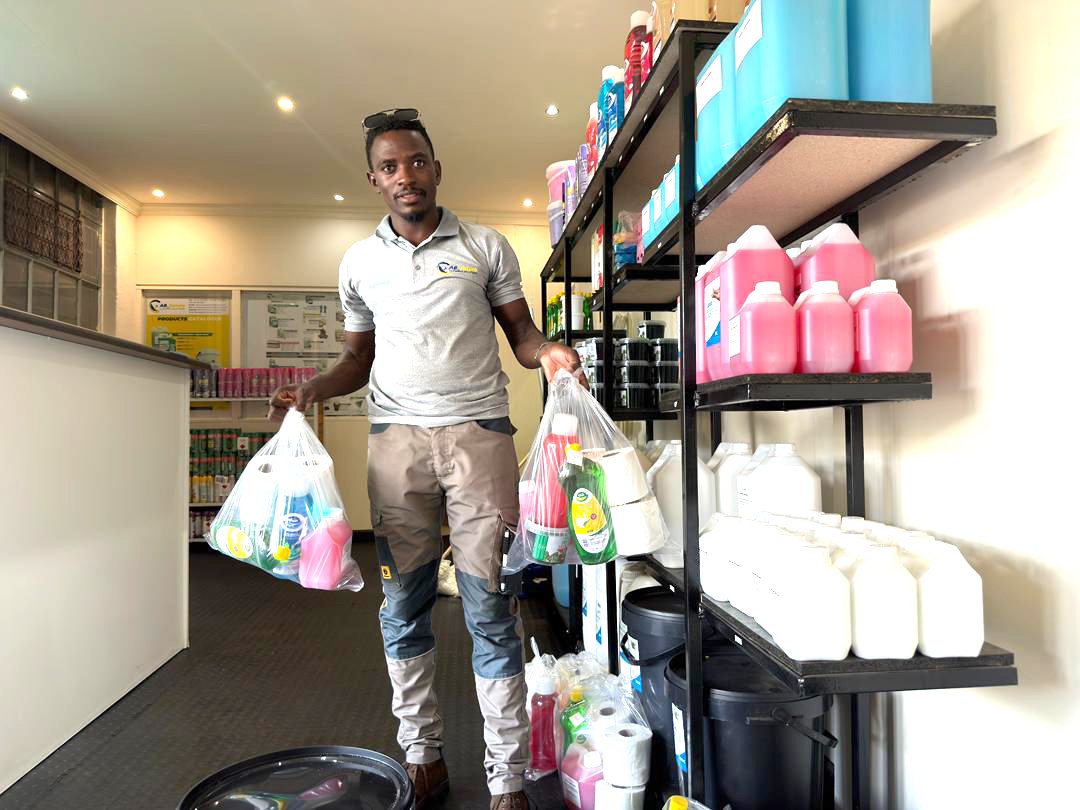

Johannes Shiwombolo started making cleaning detergents at his home in Okuryangava, he had no factory, no shop shelves and no big money behind him. What he had were buckets, raw chemicals, and a dream that refused to die.
Today, that small home operation has grown into a manufacturing business that employs four people and puts food on several tables. It is still small, but it stands tall.
“I started with dishwash only. I would move around selling it in places like Okuryangava, Ombili, Okahandja Park and Havana,” he said.
He sold door to door, street to street. Some days were good. Some days were long and quiet. But he kept going.
Shiwombolo is a trained chemist with an honours degree in Chemistry from the Namibia University of Science and Technology (NUST). After graduating, he faced the same question many young people face: what is next?
“I always wanted to be a business owner. After university, I kept asking myself what type of business can I start,” he said.
The answer was closer than he thought. Cleaning products were something people always need. And with his chemistry background, he knew how to make them properly and safely.
But the biggest push came from home.
“My mother is my biggest inspiration. Not just because she is my mother, but because of what she achieved through business. She is a businesswoman,” he said.
Starting from home was not easy. Space was limited and money was tight. But the business slowly grew. From Okuryangava, he later moved his operations to northern industry, where the business is now based.
Today, the detergent manufacturing business is his only source of income. It pays rent and salaries. It also allows him to support his family.
“This business is everything I have, It pays my employees, it pays me, and it helps me support my family here and there,” he said.
He employs four workers, all of whom are paid every month, even during difficult times. “There are tough months. When things are hard, you must sacrifice, sometimes, that sacrifice is personal,” he said.
He added that, when rent is paid and his employees are paid, then he can stay hungry for that time. That’s the most important thing in business. He has never delayed payments for his people or cut their pay because of tough months.
Like many small and medium enterprises (SMEs), money remains the biggest challenge. Large orders often come without the capital needed to produce them.
“The biggest challenge is when you get a big job, and you don’t have startup capital. It happens a lot. Also, having enough stock on the ground is a problem,” he said.
Another ongoing struggle is getting products into shops. “It has been a real fight. But it will not push us back. We keep the fire burning. We are hoping this year it will work out,” he said.
Support has been limited, but meaningful when it came. Shiwombolo remembers one moment clearly.
“I benefited from a regional grant one year when I was still operating from home. They bought raw materials for me at that time,” he said. That support helped him keep going when he needed it most.
Shiwombolo wants this business to stand strong on its own so that one day, he can build others. “For now, this is the foundation,” he said.