


GROOTFONTEIN – They say, ‘Curiosity killed the cat, but satisfaction brought it back’.
However, for Frans Katjimune (50), curiosity gave life to a business journey that continues to grow.
In a world where many people wait for the perfect opportunity or the right time, Katjimune has proved that asking the right question and taking a brave step is sometimes all it takes to succeed.
Now a successful businessman based in Grootfontein, his journey began in the humble corridors of the then-Polytechnic of Namibia, now known as the Namibia University of Science and Technology (NUST).
It was in the early 2000s, and MTC was just taking off. While others marvelled at the new mobile revolution, Katjimune asked a different question: ‘Where do people take their phones for repair?’
That curiosity pushed him to do some research and start learning how to fix phones.
Soon, he started repairing phones for students and people around him.
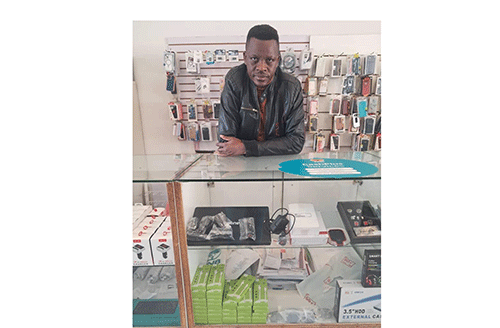
That was the beginning of his business journey. In 2003, Katjimune made a brave decision. He left his job to start a cellphone repair shop.
Like many new businesses, the beginning was not easy.
After some time in Windhoek, he moved to Otavi to grow his business, but the market was too slow there.
He then moved to Grootfontein, where he finally found the right place to grow.
Today, he owns a cellphone repair shop, a gambling house and a restaurant.
Even though Katjimune has a degree in marketing, he has never worked in that field.
“I’ve never worked in marketing, but I use my knowledge every day to grow my businesses. I’ve also created jobs for other people in Grootfontein,” he shared.
Katjimune started very small.
In his first business, he was given a corner in a salon, where he had a counter and a few cellphones.
But currently, he has a fully-fledged repair centre with about four workers.
Running three businesses is not easy, but for him, it is both a personal calling and a vital source of income for over two dozen people who depend on him.
He described his business as “challenging, but great”, saying entrepreneurship has not only sustained his lifestyle but also enabled him to support his family and staff.
“My businesses are my primary source of income. They take good care of me and my family, and allow me to maintain a lifestyle that includes travel and golfing – both costly exercises,” he said.
His businesses directly support 12 individuals, with indirect support reaching as many as 25, including employees and extended family members.
Despite the apparent success, he is candid about the challenges of doing business in Namibia, particularly when it comes to workforce culture.
“One of the biggest hurdles I face today is the relaxed attitude towards work among many young employees. There’s a lack of urgency and hunger. When I compare the service levels I receive abroad to what I get here, there’s a noticeable difference,” he said.
Still, he acknowledges that every business has its struggles.
He added that with experience, those challenges become more manageable.
“You learn to roll with the punches. The longer you stay in the game, the better you get at navigating it,” he said.
“During good times, I put money away for when things get tough. That’s how I survive the hard months. One thing business has taught me is to remain composed. Whether I’m doing well or struggling, you won’t see it on my face,” he said.
In his 22 years of business, the entrepreneur has never received any government assistance.
“Maybe it’s because I don’t know the right channels,” Katjimune said.
“I’ve heard of support systems in other countries like Pakistan and India, where entrepreneurs receive real help. If something like that exists here, it needs to be made more visible,” he added.
However, he does not blame the government.
“I’ve never knocked on their door, so I can’t say they refused me. But I do believe there’s a gap in communication,” he said.
For young people considering entrepreneurship, his advice is: “Don’t start with money in mind. Go into business looking to solve problems. Don’t expect success overnight. In fact, it often gets worse before it gets better”.
He highlighted the importance of resilience, continuous learning and humility.
“You’re entering a field where thousands of others want the same thing. You must master your craft, keep improving, and stay humble. The humble don’t stumble,” he said.