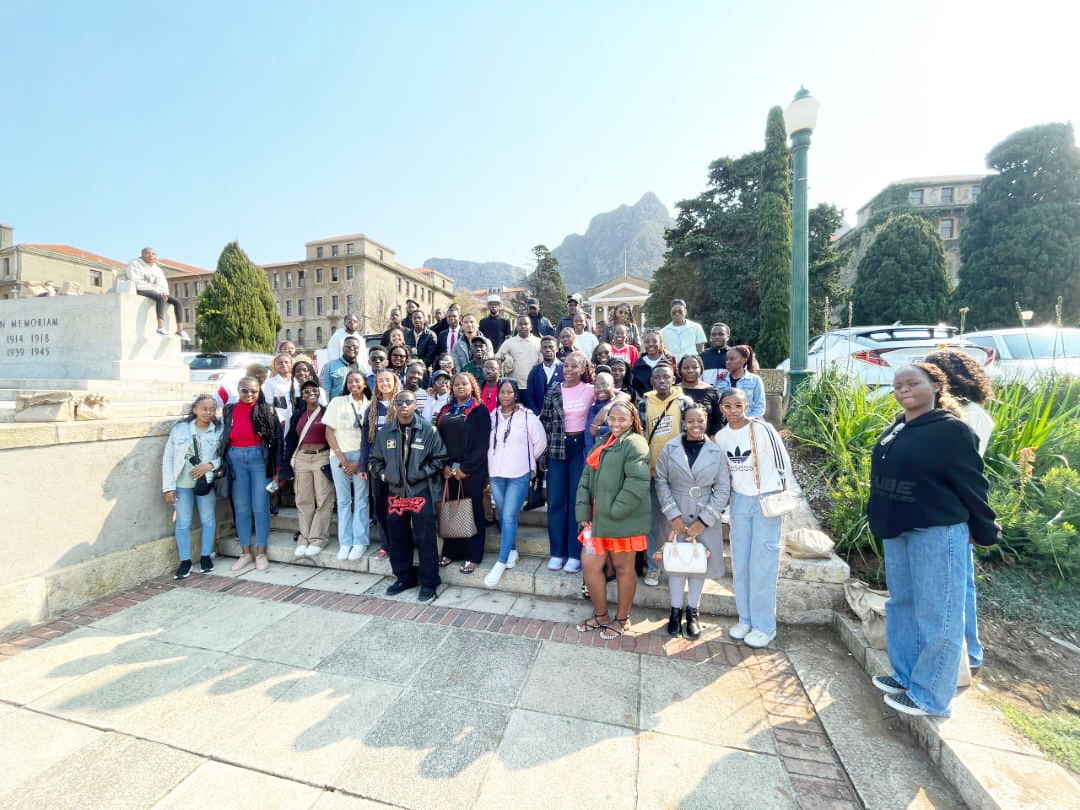

Student leadership should be holistic, courageous, and rooted in institutional pride and broader societal impact.
This is according to Felix Siyunda, the president of the University of Namibia’s Student Representative Council (SRC).
“Student leaders must not limit their focus to campus issues but also expand their influence to address national matters. This is a lesson we can learn from in Namibia, by recognising that our leadership should not only advocate for the student body but also contribute meaningfully to broader societal concerns,” reflected Siyunda on the council’s recent trip to the University of Cape Town and the University of Western Cape in South Africa.
There is a growing need for student leaders to take a more radical approach to leadership.
According to the student leader, these tours are crucial because they expand students’ horizons, introduce them to diverse practices, and promote unity across the continent. They also provide a platform for benchmarking, learning, and collaboration, giving student leaders new perspectives that can be applied to strengthen their institution, Siyunda noted.
What struck him most was the exposure to a vibrant and diverse student culture, as well as how South African universities effectively blend academics, leadership, and student life.
“One of the key cultural differences we observed is the strong sense of patriotism that students in South Africa have toward their institutions. It was common to see students proudly wearing their university merchandise on an ordinary day, which shows the pride and identity they associate with their campuses,” he stated.
Holistic leadership
According to Siyunda, when it comes to leadership, they have observed that student leaders in South Africa tend to have a holistic view of leadership.
“They do not limit their focus to campus issues only, but also extend their influence to address national matters.
This is something we can learn from in Namibia, by recognising that our leadership should not only advocate for the student body but also contribute meaningfully to broader societal concerns,” he said.
He indicated that student leaders in South Africa are more radical in their approach to student leadership. In their context, addressing matters in meetings does not always yield the same tangible results as it does for us.
“Because of that, they encouraged us to be more radical in our approach, and should the opportunity arise where our voices are not heard, we must be prepared to act in the same way,” noted Siyunda.
The youth leader noticed that their challenges are similar but not the same. The academic structures are alike, but the South African University Council and Senate have more SRC representatives, while we only have one in each.
“Another key takeaway is their emphasis on preserving institutional memory, from management to student affairs, which ensures continuity. I also took note of how student leaders were pivotal in advocating for the removal of colonial statues from campuses, such as the Rhodes Must Fall movement at UCT, with Stellenbosch SRC hoping to do the same,” he said.
What surprised him most was how openly students express themselves on campus, noting that a contributing factor is the presence of lively student centers at the universities we visited.
“It was also surprising to note that racism is still a present-day issue at some institutions, where segregation among students is still visible,” stated Siyunda.
He suggested a structured student exchange program that emphasizes leadership development and cultural exchange.
“This would allow students from both countries to experience different education systems, share best practices, and build long-term collaborations that strengthen regional student leadership,” he said.
-psiririka@nepc.com.na