


Iuze Mukube
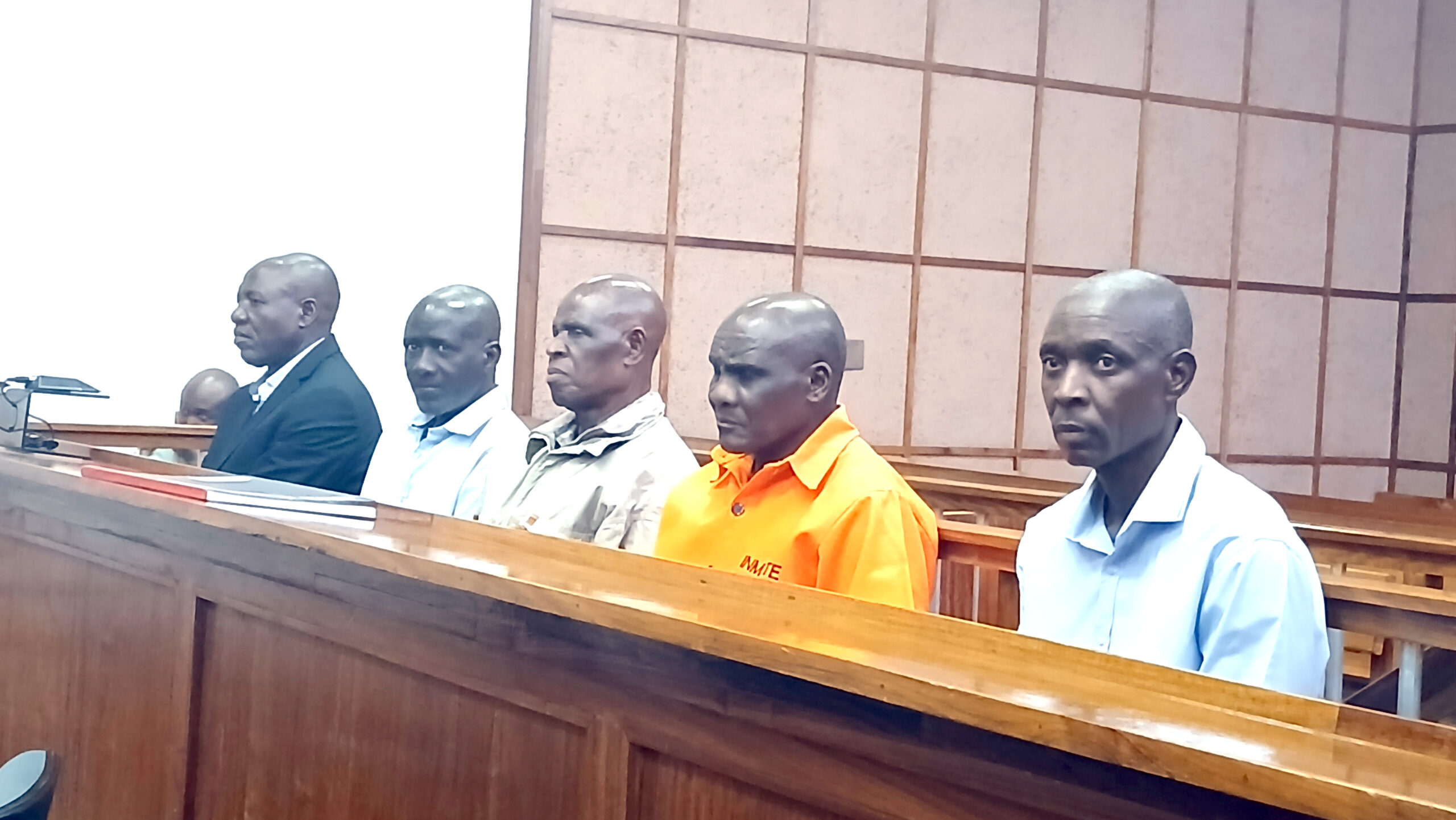
Seven men convicted and sentenced for high treason, among other charges related to the attempt of seceding the then-Caprivi region from the rest of Namibia, have asked the High Court for permission to appeal their convictions and sentences in the Supreme Court.
Windhoek High Court Acting Judge Petrus Unengu heard their arguments on Tuesday and yesterday.
The group includes Progress Kenyoka Munuma, Shine Samulandela Samulandela, Manuel Manepelo Makendano, Alex Sinjabata Mushakwa, Diamond Samunzala Salufu, Frederick Isaka Ntambilwa, Hoster Simasiku Ntombo, and John Mazila Tembwe.
Ntambilwa and Tembwe’s lawyer, Jorge Neves, said the court relied on poor, contradictory evidence, and no reasonable court would accept it as truthful.
Neves argued that the Supreme Court plea challenges the flawed foundation of a fair trial and just sentence, as the judgment was fundamentally flawed in facts and law.
Neves argued that the State failed to prove his clients were at the attack scene on 02 August 1999, as they were in Botswana then. He said that the State broadly accused them of support without proof of intent to overthrow the government. He claimed they were not leaders or organisers, but on the periphery of the events.
“The court’s conclusion that they ‘willingly participated’ in the secession attempt is a dangerous leap of logic, based on dangerously weak, uncorroborated, and compromised body of evidence,” he argued.
He argued that a state witness’s testimony should have been rejected because it was obtained through duress and intimidation. He also criticised another State witness that was relied on by the court, who contradicted himself and lacked corroboration but was accepted.
“Therefore, he argued that the court’s conviction on these grounds is a shocking neglect of its duty to scrutinise evidence with the utmost scepticism, and that the conviction was based on an evidentiary basis that is wholly unreliable and tainted by coercion,” he said.
He argued that a reasonable prospect of success exists if the application is granted a hearing in the Supreme Court.
Ilse Agenbach, representing Munuma, Samulandela, Makandano, Mushakwa, Ntombo, also shared the same sentiments.
She argued that the judge erred in convicting the applicants without proof beyond reasonable doubt that each was a Namibian citizen during September 1998 to December 2003.
She argued that the judge erred based on Eastern Namibia via a Proclamation of 1939, which was enacted during colonial times, stating that it designated that part of the country as a separate nation.
Further stating that the State failed to prove that the core element of allegiance of the common law crime of High Treason.
“There is no evidence to establish treasonable hostile intent against the legitimate government,” she said.
She argued the judge erred in convicting them under sections 18 and 17 of the Riotous Assemblies Act, when they were not charged with these. She also claimed that the judge erred in convicting for violating the Immigration Control Act, as they were political refugees in Botswana, and their return was an abduction, not voluntary unlawful entry. She suggested the Supreme Court might reach a different conclusion than the High Court considering these errors.
Munuma was sentenced to an effective jail term of 16 years, comprising 26 years, with 10 years suspended for five years on the charge of treason, five years on the arms and ammunition charge, and one year on the immigration charges.
In respect of Samulandela, Ntambilwa, Ntombo, and Tembwe, they were sentenced to 20 years on the treason count, with eight years suspended for five years, five years on the arms and ammunition charge, and one year on the immigration charges.
Makendano, who was referred to as a sympathiser, was sentenced to 10 years on the treason charge, with five years suspended for five years.
He was also sentenced to five years on the arms and ammunition charge to run concurrently.
They were convicted of attempting to secede the then-Caprivi Strip, present-day Zambezi region, from Namibia in August 1999 through violent means.
They attacked government installations, such as army bases, police stations, and the offices of the Namibian Broadcasting Corporation.
Lourens Campher, representing the State is opposing the application.
-mukubeiuze@gmail.com