

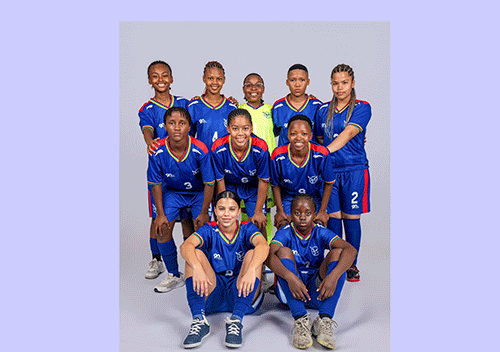

Since gaining independence in 1990, Namibia has made significant strides in promoting the participation of women in sport.
Opportunities for women and girls have steadily increased, supported by stronger national federations, more structured competitions and greater recognition of female athletes.
Policy reforms and regulatory frameworks have also played an important role in promoting gender equality in sport, creating more opportunities for women to participate both on and off the field.
Breaking barriers
Former Olympic sport shooter Gaby Ahrens says when she first started competing in sport shooting, there were very few female competitors in Namibia.
Ahrens, who initially participated in both equestrian and shooting, explains that both disciplines allow men and women to compete on equal terms, as physical strength is not necessarily the determining factor for success.
“In Namibia, equestrian sport was largely female dominated, while shooting was the opposite. When I moved into shooting, I often found myself in a male-dominated environment with very few female competitors locally,” she recalls.
At one stage, Ahrens requested to compete against male competitors at the national level because there were not enough women in the sport to provide meaningful competition. She believes the challenge pushed her to constantly improve her own performance.
“Both the Olympic Movement and the Namibian government have played an important role in promoting gender equality in sport. Today there is a strong global commitment to ensuring balanced participation between men and women at the Olympic Games, and this sends a powerful message to young girls everywhere that sport belongs to them too,” she says.
Ahrens believes Namibia is also leading by example with strong female representation in leadership across different sectors, including sport administration.
“Every time a Namibian woman competes on the international stage, it sends a powerful message to the next generation. When they succeed, it inspires even more.”
For her, representing Namibia internationally has been one of the greatest privileges of her career.
Sport gave Ahrens the opportunity to represent Namibia with pride on the world stage. Her responsibility now lies in ensuring that the next generation of Namibian girls and boys have even greater opportunities to pursue their dreams.
Participation to leadership
According to Jacqueline Gertze, a pioneer in women’s football, women’s participation in sport in Namibia has evolved significantly over the years. She says women have moved from limited roles as spectators to becoming competitive athletes, administrators and leaders within the sports sector.
“Advocacy, policy changes and organisations such as the Namibia Women in Sport Association, the Namibia Schools Sport Union and various international sports bodies have deliberately accelerated this transformation,” Gertze says.
These initiatives have helped increase the representation of women both on the field and within sports leadership structures.
However, despite the progress made, Gertze says challenges remain, particularly in terms of resources and infrastructure.
Challenges linger
Growing up as a young footballer, Gertze says she faced several personal challenges that affected her confidence and ability to compete.
She recalls struggling with a lack of proper sports clothing and equipment, as well as necessities, during her time at high school.
Gertze believes that although Namibia has made progress in gender representation in the political sphere, sport still lags.
“We need mandatory 50/50 representation on sport boards. This will have a major impact on policy implementation, funding for female-specific grassroots programmes and improved access to facilities for girls,” she says.
She also emphasises the importance of increased media visibility for women’s sport, stronger support for female coaches and safer sporting environments.
Grassroots development
Schools and grassroots sport play a crucial role in encouraging girls to participate in sport from a young age.
Over the years Namibia has recorded several milestones in women’s sport. These include international participation across various sporting codes such as netball, football, cricket, rugby, tennis and swimming, as well as medal success at major international competitions.
Women’s football has also grown significantly, with the national team, the Brave Gladiators, achieving regional success and the introduction of sponsored leagues for women.
Other developments include professional contracts for the national women’s cricket team, scholarship opportunities for female athletes and increased participation of girls in school sport, Special Olympics and para-sport. Despite these achievements, women’s sport still receives less funding, exposure and sponsorship compared to men’s sport.
Nevertheless, the progress made since independence demonstrates that women in sport continue to break barriers and create new opportunities for future generations.
– hnalupe@nepc.com.na