

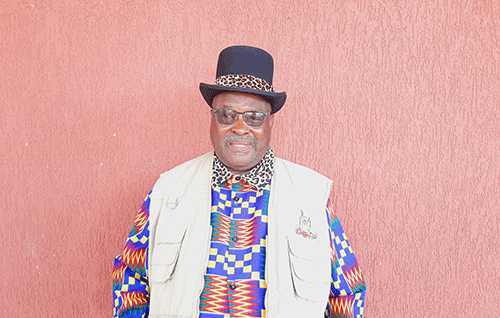

ONGWEDIVA- The reign of Uukwambi Chief Herman Ndilimani Iipumbu at the helm of the Uukwambi Traditional Authority rest on shaky grounds, following moves from within the Uukwambi Royal family to have him removed from the position.
At the centre of the controversy are allegations that Chief Iipumbu is not from the Royal family and therefore has no claim to the throne of the Uukwambi community.
This emanated from a group within the Uukwambi Royal house’s claim in a letter to the Uukwambi Traditional Authority (UTA) in which they request the authority to act on the matter and instead install someone from the royal family to lead Uukwambi.
They asked the UTA to bring back the “kinship in Uukwambi kingdom, and revert to their ancestors’ way of governance.”
Speaking to New Era, the chairperson of Uukwambi Royal family (Ovakwaniilwa) Willem Amwaama, said the leadership under the kinship system is inheritable, based on the customary laws of that community.
“In Uukwambi tradition, like in all communities of Aawambo, royal kinship is matrilineal. Succession follows a matrilineal line. The king’s nephew, born to his sister, often takes the throne. The kings appoint the councillors, referred to as ‘omalenga’ from the community,” he stressed. Amwaama said that from the 1750s up to 1932, Uukwambi was ruled by kings referred to as ‘eeshamba’ and omalenga.
“The omalenga were appointed by the king based on their character, traits and skills.
Amwaama stated that the last king in Uukwambi was lipumbu Ya Tshilongo.
In 1932, a colonial native commissioner of the former Ovamboland, Cocky Linsinger Hugo Hahn, sanctioned for Iipumbu’s palace to be bombed and lipumbu was captured, he said. “He was exiled in Kavango and never came back to reclaim his throne and he died in 1959. In 1932, after Iipumbu’s exile, the native commissioner appointed four traditional leaders to head the then-designated Uukwambi geographical area called ‘iikandjo’. None of these appointed headmen came from the bloodline of lipumbu’s Royal family, and this is the form of governance to date,” Amwaama noted.
He said in 2024, the Uukwambi Royal Family organised an event which was to take place at Okakango Ka Abed Ha Kandongo.
“The purpose of this event was to commemorate 15 August 1932 as the day on which the Palace of King lipumbu Ya Tshilongo was attacked and destroyed by the South African Colonial Forces.” Amwaama said it is important to emphasise that the commemoration was meant to be a family event and not an Aakwambi event.
At that commemoration event, the Royal family and Aakwambi community were not going to illegally appoint and install the King for Uukwambi, he said.
He said they are aware that the Traditional Authorities Act essentially prevents other organisations from presenting themselves as a traditional authority, or using its powers, functions and duties in relation to the traditional community which it leads.
“However, our event was a family affair, and as such, it was not an attempt to establish an alternate traditional authority,” he added.
Also speaking to New Era, Tangy Mike Tshilongo, who is a community member from Uukwambi kingdom, said a lawful member of the Uukwambi traditional community, has publicly denounced the unlawful and uncustomary designation of Chief Herman Ndilimani Iipumbu as Chief of Uukwambi.
He claims the process violated Uukwambi customary law and was politically influenced.
“I had a press conference on 17 August 2024 that was shut down by Oshana Police, a move he views as State repression, violating his constitutional rights. Despite formally requesting clarity from former minister Erastus Uutoni, no proper legal justification was given for Chief Iipumbu’s designation,” he indicated.
Tshilongo further quoted from the Traditional Authorities Act, noting that the community – and not the State – must designate its chief.
He emphasised that the government gazetting of Chief Iipumbu is invalid due to a flawed process.
Approached for comment, Chief Herman Ndilimani Iipumbu dismissed the narrative as false and refused to comment further.
“I will not speak on things that are not true,” he said.