


Burkina Faso is doing something powerful, something we in Namibia should have done a long time ago.
They are formally integrating traditional medicine into their public healthcare system.
Their National Health Policy now includes dedicated departments for traditional medicine in hospitals.
It is a statement of pride in their identity and a practical step toward accessible healthcare. Meanwhile, here in Namibia, we continue overlooking our indigenous healing systems – even though many Namibians still rely on them daily. What is even more puzzling is that we have welcomed Chinese medicine into clinics across the country, yet our ancestral practices remain unrecognised in the formal system.
I am not saying Chinese medicine does not have value. It certainly does.
But so do the healing traditions of our San, Aawambo, Herero, Kavango, Damara, Nama and Caprivian communities.
These practices have kept people alive for generations, long before Western clinics were built.
They are rich and rooted, deserving a seat at the healthcare table.
Healing map
In northern Namibia, the Aawambo and Kavango peoples are known for their deep herbal knowledge, passed from elder to apprentice. Remedies made from omboga, omulunga and wild roots are used to treat fevers, digestive issues and reproductive conditions.
Traditional healers are also mental health practitioners. A 2018 study by Shirungu and Cheikhyoussef revealed that Kavango healers use over 30 plant species for treating various mental health conditions, including stress, anxiety and hallucinations, often with community-based rituals and plant infusions (Shirungu & Cheikhyoussef, 2018).
Among the Caprivian communities, traditional healing blends herbalism with spiritual guidance.
Illness is viewed holistically, where emotional and ancestral imbalances must be addressed along with physical symptoms.
A 2010 ethnobotanical survey in Katima Mulilo recorded 72 plant species used by traditional healers to manage HIV/AIDS-related infections and other conditions such as herpes zoster, diarrhoea and malaria (Cheikhyoussef et al., 2010).
In the southern regions, the Nama and Damara people have long relied on plants like hoodia, devil’s claw and !Nara melon for both nourishment and medicine.
Devil’s claw, for example, is used to reduce inflammation and relieve joint pain.
This same plant is now packaged and sold abroad, yet, here at home, its healing power is still not formally recognised in our clinics.
The ovaHerero, known for its strong cultural traditions, incorporates both herbal and spiritual healing.
Healing ceremonies, particularly for cleansing, grief and conflict resolution, are widely practised and central to ovaHerero wellbeing. These collective healing spaces are vital to mental health and social cohesion.
Let us not forget the San people, Namibia’s first people and carriers of some of the oldest healing knowledge in the world.
The San rely on extensive plant knowledge, spiritual trance healing and holistic wellness practices that address body, mind and spirit. Their traditional healers, often called shamans or medicine people, are revered in their communities. Many of the plants they use, still unclassified in Western science, hold immense therapeutic potential.
A 2011 study in the Oshikoto region found that local healers use 61 different plant species to treat common ailments, ranging from wounds to snakebites, digestive problems and fevers. This showcases the cultural value and scientific promise of this knowledge (Cheikhyoussef et al., 2011).
These are not merely oral traditions. They are documented and have been studied. They have been published in reputable academic journals. So, the question is not whether the knowledge is valid. It is whether we are willing to acknowledge it and give it the institutional respect it deserves. Traditional healers remain unofficial in Namibia’s health sector.
There is no national policy, regulation or protection of their knowledge.
There are no units dedicated to traditional medicine in hospitals.
Yet, imported systems like Chinese herbal therapy and acupuncture are integrated and even marketed to the public. If we are open to foreign traditional systems, why not our own? This is not about choosing one system over the other. It is about working together. A nurse in Rundu should be able to consult a traditional healer.
A Herero herbalist should feel comfortable referring a patient to the nearest clinic.
Moreover, a San elder’s plant knowledge should be preserved and passed on with pride.
What can be done?
Namibia can and should learn from Burkina Faso. We can start by: Developing a national traditional medicine policy that recognises and protects Indigenous healing,
Establishing traditional medicine units at hospitals across all regions,
Accrediting, regulating and respectfully collaborating with traditional healers,
Supporting research, documentation and preservation of Indigenous knowledge,
Including traditional medicine in the training of nurses, doctors and community health workers, Creating legal protections for Indigenous intellectual property and sacred practices.
This must be led by traditional leaders, communities and healers themselves.
Their wisdom must shape the future – not just be archived in books.
If we can embrace Chinese medicine in Windhoek, we can surely stand behind a Nama herbalist in Keetmanshoop, a San medicine person in Tsumkwe or a Kavango healer treating mental illness with centuries-old plant knowledge.
This is our heritage and strength.
Let us stop calling our healing ways ‘alternative’. They are original and Namibian.
They deserve the dignity and recognition that our people have always known they carry.
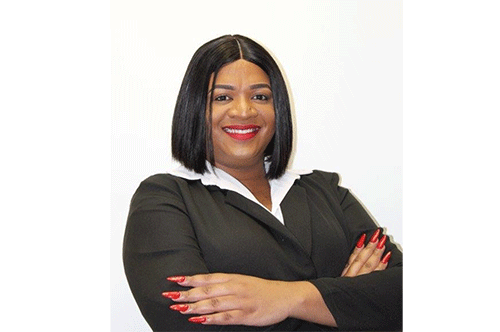
*Amy Maasdorp is a Namibian nurse, public health advocate, mental health advocate and an occupational health and safety student at the National Training Institute. She is passionate about culturally inclusive healthcare and human rights.