


One of the wisest men who ever lived, King Solomon, maintains in the Holy Book that there is time for everything.
In chapter 2 of his book, Ecclesiastes, he points out that there is a season to be born and a time to die.
In the sixth verse, he continues that there is time to seek and time to lose.
True as the dictum stands, and so it has been for many centuries, but some human beings tend to refute this dogma.
This is mostly evident in the political kaleidoscope and panorama.
Those who danced to tunes declaring them as eternal are now six metres deep under the belly of the earth.
Despite this phenomenological drama, one would have thought that the remnants and staunch followers of those political parties could learn something tangible.
In fact, it is this type of mindset that has persisted among some political leaders who refute that one day ‘they would be no more’.
As a consequence of not being missed, they decide to stick to power even when they have nothing to offer in the political realm.
This unfortunate situation breeds a situation where some leaders feel they are untouchable and bring that ‘sacred aroma’ among themselves.
It is quite incredible that some of them who failed to make it to Parliament are complaining and demanding either to be reinstated or boycotted to pay membership fees. But when they joined the party, nowhere did they attach their signatures to always be in Parliament even – when they have failed to make it to the August House.
In addition, these are the same people who were promising the electorate heaven on earth and vowed to work for the nation and its people.
Great people come and go and are automatically succeeded by the younger generation.
It is, therefore, quite strange that some seasoned politicians should be caught pants down when they do not make it to the August House.
But the game of politics resembles chess and gambling, where one either loses or wins, and there cannot be two ways about it.
As it stands, it is a game of succeeding one another politically not in a monarchical mode.
So, when one inherits the political mantle, it is always wise to know that the tenure of the office will only be five years in the Namibian context.
During these years, the political leaders in the August House should therefore be focused on their future. What is equally important is service delivery, so that one could be retained in the August House for good work carried out during the honourable member’s term of office.
But in a country like Namibia, where accessibility to funds for development is in the hands of the elite, coming back to Parliament might seem like a hurdle in the opposition regime, even though national development is an obligation of government of the day.
On a positive note, Namibia has started having its longest-serving politicians shelved aside.
Yes, it is a positive step because many of the members of Parliament were octogenarian and had become recycled.
They could not attend to service delivery.
For more than thirty years now, many politicians who were groomed and grew up in the ruling party felt comfortable and thought they could not be removed from those cosy seats of office and Parliament.
It is not the leaving of the office which must matter, but how it was used to deliver services to the nation.
The 2025/2029 Parliament should be a lesson to the incumbents that if they do not prove themselves to be worth the political salt, they should bid the house farewell and for good in 2029.
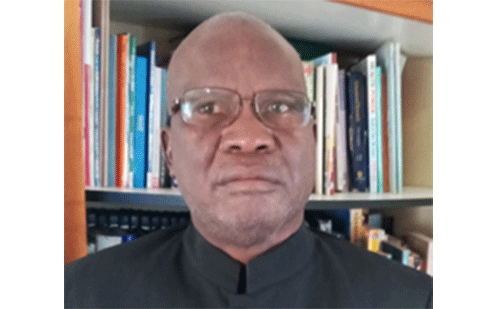
*Prof. Makala Lilemba is an academician, author, researcher and scholar.