

The recent New Era article published on 1 July 2025, titled ‘NNN pushes for construction of a dam in Kunene region,’ resonated deeply with me not only as a scholar from Kunene but also as someone whose own academic work has pointed toward the same solution. I wholeheartedly applaud Her Excellency Netumbo Nandi-Ndaitwah (NNN) for embracing this bold vision to address the recurrent droughts plaguing north-western Namibia. Communities in places like Orupembe, Onjuva, Rooidrum, Okapembei, Otjinungwa, Otomongo, Serra Cafema, Otjavaja and Otapi have, for generations, faced the devastating effects of persistent drought.
Their resilience has been remarkable, but it is unsustainable without real, structural change. The President’s support for constructing a dam offers precisely that a transformative step towards long-term water security and socio-economic resilience.
This vision aligns strikingly with findings from my Master’s degree research in Public Policy and Management titled, “An Investigation into Sustainable Management Practices for Mitigating the Recurrent Drought in the Northwestern Kunene Region.”
In my study, I highlighted how repeated droughts force indigenous communities to abandon traditional lifestyles, as local wells dry up and irrigation remains nearly impossible. During data collection, I remember praying: “God, please help our nation to have a visionary leader who will not only view this area as far away but see it through the lens of economic prosperity.” Reading the article now, I am filled with hope that this prayer has been answered.
The potential of Kunene goes far beyond subsistence: vast tracts of fertile land, rich mineral resources, and unique tourism potential all stand ready to contribute to Namibia’s broader development goals if only water security is assured. In my study, I proposed the construction of a dam in southern Kunene to capture water from the Kunene River.
This would support irrigation projects, supply potable water, reduce dependence on overused boreholes, and enable fodder production for livestock and crops to improve food security. Importantly, my research emphasised that such an intervention is not a short-term fix.
It represents a forward-looking investment that would transform livelihoods, boost rural economies, and strengthen resilience against climate shocks. This aligns seamlessly with the President’s vision of sustainable rural development and NNN’s push, as highlighted by New Era. Beyond the dam, I argued that a comprehensive drought response must include complementary measures: decentralising the National Youth Service (NYS) to equip local youth with skills in crop science and civic engagement; economic diversification beyond livestock; and harnessing mineral resources through public-private partnerships. Further, investing in tailored education for the Ovahimba and other indigenous communities, improving incentives for teachers in remote areas, and adopting green energy solutions can unlock the region’s full potential.
Looking ahead, I am embarking on a PhD in sustainable development, focusing specifically on water harvesting techniques, groundwater recharge, and surface runoff management as solutions for persistent water insecurity and recurrent floods across northern Namibia.
However, this critical research journey carries financial burdens, and I am actively seeking sponsors and partners to ensure it can be completed.
Crucially, I believe the proposed dam must be linked to regional trade policies to maximise its impact. If the government also opens key border points at Otjavaja, Otjinungwa, Onungurura/Montenegro, and Otjimuhaka, the livestock sector in Kunene could tap into Angolan markets.
Our meat could find new buyers in Otjitaazu, Tombwa, Iona, Namibe and Lubango in Angola’s Namibe Province, and potentially reach the Democratic Republic of Congo through Cabinda and other African markets less constrained by the cordon fence’s strict rules.
This would breathe new life into local farming and trade, helping to lift entire communities out of vulnerability.
In commending the President’s stance, I stress that aligning national policy with locally informed research and, most importantly, the lived experiences of affected communities, is the path to real, lasting change. “We can’t prevent drought, but with vision and targeted investments like the Kunene dam, we can ensure communities not only survive but thrive,”.
This convergence of policy and possibly grassroots scholarship will bring hope for the northwestern Kunene region: a future defined by resilience, sustainable development, and inclusive growth where drought is no longer a sentence, but a challenge that communities are equipped to overcome.
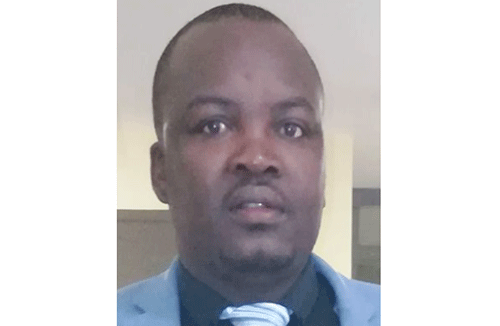
*Mawiipi M.M. Hartley holds a master’s degree in public policy and management. He writes in his capacity.