

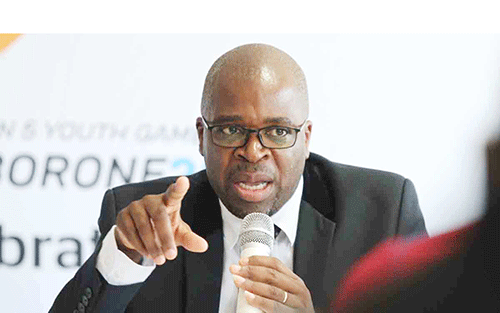

The 2024 Region 5 Youth Games hosted in Namibia have concluded, leaving behind more than just medals and records.
According to Stanley Mutoya, the Chief Executive Officer of the Region 5 Games, the recently held multi-sport event set a new standard in participation, inclusion, infrastructure and social development.
Stronger participation and competitive growth
Mutoya praised the participation levels across the 10 member countries, noting a significant increase compared to previous editions of the games.
“In 2019, we had a good number of athletes and officials, but this year was even better. Countries like Eswatini and Lesotho, which usually sent smaller contingents, brought larger teams this time. That’s a sign of growth and commitment to youth development,” he said.
Countries that traditionally field large delegations continued to do so, creating a vibrant and competitive environment.
From a competitiveness standpoint, the games also delivered. Mutoya highlighted the improvements made by countries like Malawi, which is known for its strength in netball, but has now shown prowess in basketball and volleyball.
“In athletics and swimming, we saw new contenders emerge. Eswatini, for example, showed impressive progress in swimming. We are happy with what we saw, but as always, there’s room for improvement.”
Namibia’s LOC earns high marks
Despite a short preparation window, the Namibian Local Organising Committee (LOC) rose to the challenge. Typically, the Region 5 Games require at least 36 months of planning, but Namibia was handed just six months.
“We commend the LOC for pulling all stops to ensure the success of the games. Organising an event of this magnitude in such a short time is no easy task, yet Namibia delivered,” Mutoya said.
Still, Mutoya emphasised the importance of post-event evaluations to identify areas for improvement, particularly in ceremonies, results management, transport and catering.
Pioneering inclusion through sport
One of the most groundbreaking aspects of the 2024 Region 5 Games was their inclusivity. For the first time, the games brought together athletes from the Special Olympics, Paralympic disciplines and mainstream sports under one roof.
“This was a world-first – a hybrid games model that integrated all components. Usually, Special Olympics and Paralympic events are held separately. We created a platform where all athletes competed side by side, and that is a legacy we are proud of,” Mutoya said. The ‘Making Noise’ campaign was also launched during the games to raise awareness about inclusivity. The campaign was linked to the Interministerial Forum that brought together health, education and sport ministers to discuss how inclusion can be mainstreamed into policy.
Infrastructure and environmental legacy
Beyond the competition, the games left tangible legacies in infrastructure and environmental sustainability. Facilities at the University of Namibia were upgraded, including sport courts, hostels, and the stadium. In Swakopmund, the Vineta Stadium was refurbished.
“We also trained and upgraded technical officials who can now officiate at continental and international levels. That’s a human capital legacy that will serve the region for years to come,” Mutoya explained.
Sustainability was another focus. Four air quality monitors – one in Swakopmund and three in Windhoek were installed. These will help monitor pollution levels and study health-related environmental impacts long after the games.
“We are proud that the legacy of these games goes beyond sport. It includes environmental monitoring, which is a first for us,” he said.
Planning for an inclusive future
Looking ahead, Mutoya said Region 5 is committed to expanding opportunities for athletes with disabilities. Plans are underway to introduce more adaptive sports like wheelchair basketball, wheelchair tennis, and powerlifting.
“Our long-term goal is to establish the Region 5 Disabilities Games. We are not calling them Paralympic Games because we want to include all forms of disability sport – from blind sports to Special Olympics to Deaflympics. It’s about celebrating all our athletes.”
Discussions are also ongoing in Lesotho around introducing quality physical education and adaptive physical education in schools, ensuring that inclusion starts at the grassroots level.
Sustainability beyond sponsorship
While governments continue to play a critical role in funding the games, Mutoya cautioned against over-reliance on sponsorship.
“Sponsorship is a marketing tool, and companies can change their strategies anytime. We are looking into sustainable models like broadcasting rights, merchandise production and creating sports apparel factories that can serve the region,” he explained.
Professionalising sports management
Region 5 is also leading efforts to professionalise sports management. Working with Bindura University of Science Education in Zimbabwe, the region has introduced a management development programme for sports administrators.
“We are setting minimum eligibility standards for leadership in sports federations. We want to move away from volunteer-based management to a system with codes of ethics, licensing and accreditation—just like the legal or medical professions,” said Mutoya.
Games as a talent launchpad
The Region 5 Games have historically been a stepping stone for many African sport stars. Names like Nigel Amos from Botswana, Christine Mboma from Namibia, Patson Daka from Zambia and Wayde van Niekerk from South Africa all competed at these games before rising to global fame.
“These games are a platform for transition into elite competition. We are now introducing qualifying standards to push countries to hold national youth games, which will serve as feeders for the Region 5 Games.”
Legacy beyond sport
When asked about his personal legacy, Mutoya was clear.
“I want to be remembered as a catalyst for development. These games should become an industry, creating jobs in catering, transport, apparel and media. I envision senior games, disability games, and a sustainable value chain feeding into regional sports development.”
He concluded with a vision of unity and growth.
“When I leave this position, I want people to say, ‘Here lies a man whose conscience was his master.’ That’s the legacy I aim to leave behind.” -lmupetami@nepc.com.na