


Kaviveterue Virere
Residents in the bustling Katutura township have turned cattle bones into a thriving trade for survival.
This trade has become a vital lifeline for groups of unemployed residents.
The bones have become a delicacy among customers, who frequent the business spots.
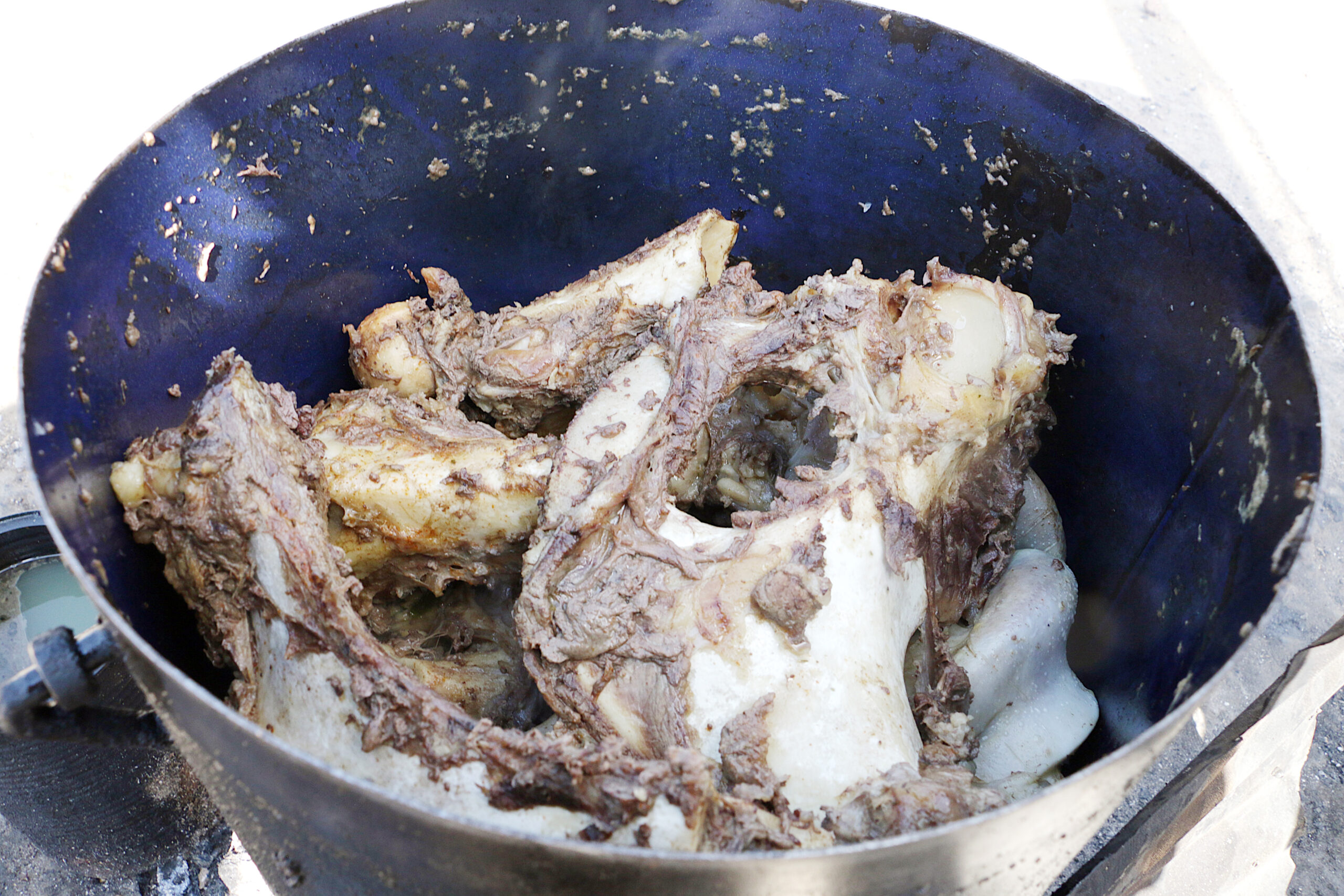
Scenes of large black pots lining up the tiny pavements, walkways and open spaces across Katutura have become a regular sight.
The cattle bones – the remnants of deboned meat – have become a vital source of income for many.
Along the August Tjaapo Street in the Katutura central constituency, small setups – each complete with huge black pots, steel benches and a makeshift shade netting – line up one side of this short street.
Each business is spaced appropriately to manage customer flow.
Ketuu Tjivau is one of the most well-known sellers.
She began selling bones in 2003 and has continued to do so ever since.
“This business is essential to my three school-going children,” she stated.
The bones are purchased from Meatco in Windhoek and Okahandja Beefcor for N$60 and N$50 per sack, respectively.
Tjivau said that, to have enough bones for a week, she purchases two or three sacks.
She stated that they all have enough customers, and their profits increase with time, especially towards the end of the month.
“We have a good customer base. We make more profit towards the end of the month, as there are more customers,” she shared.
Tjivau said they cater to customers who buy on a take-away basis.
To register the site and assign plots to each vendor, the municipality occasionally visits the area.
The vendors will begin paying a monthly fee of N$200 by the end of September 2025.
They will benefit when the municipality assigns plots to everyone, since each person will have a specific plot or booth.
This way, the mobility of random entrepreneurs will be controlled.
Belinda Kandenge is another notable vendor of this unique business.
“I have been in this business for almost 15 years now,” she said.
Before relocating to the current venue, affectionately known by locals as ‘Oruramba rwa Rodman’ (Rodman’s stream), she started selling at Herero Mall.
The area was named after Katutura Central constituency councillor Rodman Katjaimo, who popularised it by using it as a campaign base before his election.
Kandenge’s motive in the trade is to be independent.
“My husband and I, along with about eight children, are surviving from this business,” she noted.
She said, on some days, business is slow.
During such time, the remaining bones are stored and prepared to be sold the next day.
“As I was one of the first people to start selling here, I usually have more customers,” she remarked.
When she gets enough money, Kandenge plans to start selling porridge and vetkoek in addition to the bones.
Another businessman is Michael Kuhanga, who took over the family business.
His mother founded the business while he was still in school.
“My mother spent roughly nine to ten years selling meat and bones. After that, I succeeded my mother. I have now worked in the industry for roughly six years.
“Since this is a family business, it provides for my mother, sister and all of the kids living at home,” Kuhanga stated.
Mbarota Tjivikua, who began selling bones last year as a means of survival, has a message for the youth.
“Instead of grabbing people’s phones, I want to tell young boys out there in the streets to start joining us here,” he remarked.
A typical day at this popular spot and others around Katutura reveals similar scenes: customers chatting at the various stalls while stall owners move back and forth between the pots and customers.
Challenges
The shortage of restrooms is one of the main problems faced by the vendors.
Customers frequently need to use the restrooms.
This affects customers and impacts the overall business.
In addition, the vendors require water and electricity.
They currently source water from nearby homes.
The vendors said that if they had access to electricity, they would stock up on sacks of bones and store them in the refrigerators.
In addition, they need support to grow their business.
Items like tables, chairs and refrigerators would go a long way in improving their operations.
Another concern that the vendors raised is the sewage water flowing behind their stalls.
They said the stench can, at times, be unbearable.
Operations
The vendors use firewood to cook the bones.
For sustainability, they use leftover bones as cooking fuel.
Repurposing the bones also helps to reduce waste and keep the area clean.
Photo: Heather Erdmann