

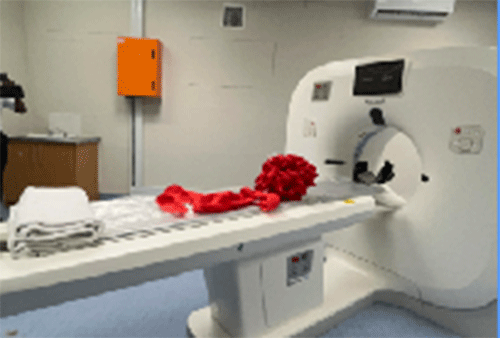

WALVIS BAY – Residents in the Erongo region will no longer have to travel hundreds of kilometres or endure long waiting periods for diagnostic scans, thanks to the donation of a state-of-the-art computed tomography (CT) scanner to the Walvis Bay State Hospital.
The scanner, valued at approximately N$5 million, was officially handed over on Friday by Lin Shengyou, vice president of the Zhejiang Provincial Hospital of Chinese Medicine. A CT scanner is used in hospitals and clinics to create detailed cross-sectional images of the body.
These images help doctors detect internal injuries, diagnose diseases, monitor treatment progress and plan surgeries. CT scans are essential for accurately diagnosing strokes, cancers, internal bleeding and trauma-related conditions.
The use of CT technology significantly improves the chances of early detection and successful treatment outcomes. The donation forms part of the China-Africa Paired Hospital Cooperation Mechanism, initiated by Chinese president Xi Jinping in 2020 to enhance healthcare collaboration between the two continents.
Speaking at the handover, Lin said the donation marked a new chapter in the longstanding partnership between the Walvis Bay State Hospital and the Zhejiang Provincial Hospital of Chinese Medicine.
“It is a great honour to represent our hospital at this important moment. Since launching the partnership in April 2023, we have achieved major milestones in skills development, equipment support and patient care,” he said.
He added that three batches of medical equipment and supplies worth more than N$6 million have already been shipped to Namibia, including the CT scanner, ventilators, monitors and consumables.
“Our aim is to build capacity. Eight healthcare professionals have already been trained in China, while six of our experts were dispatched here to share knowledge in imaging and critical care,” he added.
Lin noted that the partnership has already saved lives, including that of a nine-month-old baby with circulatory failure and a high-risk mother expecting twins.
The newly installed CT scanner will enable doctors to obtain precise internal images of the human body, aiding in the early detection and treatment of various conditions such as strokes, tumours and injuries.
Until now, such advanced diagnostic equipment was only available at central hospitals in Windhoek and Oshakati.
Executive director of the health ministry Penda Ithindi, who received the donation, said it was timely and critical. “This donation is born out of the strong and historic ties between our two nations. It reflects a shared vision of universal health coverage, where every Namibian, regardless of location, has access to high-quality healthcare,” he said.
Ithindi added that the CT scanner would significantly improve diagnostic services in the region, which has seen a rapid population increase of over 60% since 2011.
“With over 103 000 residents in Walvis Bay alone, the pressure on our healthcare system is growing. This equipment is not just a luxury but a necessity,” he remarked.
He said the equipment is aligned with the goals of Namibia’s Sixth National Development Plan (NDP6), which calls for strengthened healthcare infrastructure, skilled personnel and advanced diagnostic tools.
Also speaking at the official handover, Erongo governor Natalia /Goagoses said this is indeed a much-needed boost for the public health sector in the region.
“I am informed that this CT scan is the first of its kind in a public health facility within our region. Hence, we are grateful,” she said.
She urged healthcare workers to uphold the highest standards of professionalism and service and take care of the donated medical equipment.
“You have signed an agreement with the people of Namibia, who are represented by the government. If you do not serve to the best of your ability, you are in breach of that agreement,” /Goagoses cautioned.
She then thanked the Chinese delegation for their continued support.
“Your generous donation is a clear testament to the shared vision that every Namibian, regardless of their background, should have access to quality healthcare,” Ithindi said.