

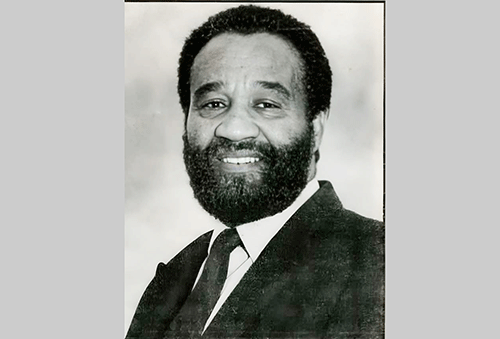

For many, Uncle Charles Kauraisa was just the easygoing friendly immaculately dressed gentleman who regularly frequented the poplar Café Schneider, his favorite eatery spot in Hepworths Arcade, holed up in the center of Namibia’s commercial hub Windhoek. Uncle Charley would be seen paging anxiously through the daily newspapers whilst clutching his favorite cup filled with Cappuccino.
However, Uncle Charley was a highly respected bookish fellow who has never hesitated to impact wisdom and share ideas with those who dared lending an ear. A true son of the soil, Uncle Charley traversed the global stage advocating for the liberation of his native land (Namibia), galvanising international support against racial oppression and the complete scrapping of apartheid laws.
Kauraisa was one of very fortunate young boys from South West Africa (Namibia), given permission to further their academic aspirations in neighbouring South Africa. He completed his secondary schooling and college education.
The boy from Namibia got involved in student politics after voluntarily joined the Cape Peninsula Students Union. Upon his return to Windhoek in 1959, residents were still reeling from the fresh wounds of the December 10th massacre that evoke an upsurge of political militancy.
Regrettably, the Bowker Boys would have none of his presence in their midst as Charles was practically exiled to the coastal town of Walvis-Bay. The football crazy young man joined Kuisebmond outfit Blue Waters Football Club and was one of the club’s shining stars.
Uncle Charley was reunited with fellow Windhoekers; Mburumba Kerina, Oscar Norich-Tjahuha, and Titus Shilongo, all finding refuge in the Birds nest. After a short period as a schoolteacher at the Town’s old location for natives, Uncle Charley developed itchy feet teamed up with his trusted buddy and fellow scholar Uatja Kaukuetu, to map out their next move.
The pair silently skipped the country en route to Sweden via Botswana in 1960. They spent time in Rhodesia (Zimbabwe), Tanzania and Zambia before finally landing in Stockholm, Sweden. Whilst abroad, Uncle Charley rubbed shoulders with great political minds; Ronald Segal, Dr Zed Ngavirue, Ben Amathila, Per Watsberg, Moses Katjiuongua, Oliver Tambo, Nana Mahomo and Advocate Fanuel Jariretundu Kozonguizi, amongst others.
IN 1978, Uncle Charley returned home from exile for a brief visit of two months before retreating to his adopted country Sweden. In his own words, his ailing old man at the time a bit long in the tooth pleaded with him not to return to exile when he came back for another visit in 1981. Uncle Charley heeded the call, albeit reluctantly and remained put. He accepted a lucrative employment offer from Rossing Uranium Mine.
As a former footballer, Uncle Charley played a pivotal role in the establishment of the Inter-Mines Chamber of Commerce multi-sport games. He was also the mastermind behind the introduction of the annual Rosssing Youth Cup for schools.
The proximity to Walvis-Bay obligated Charley to rejoin former club Blue Waters in an administrative capacity. He assumed the plum portfolio of club chairman, ploughing back the experience gained during his overseas escapades.
During his flawless tenure at the helm of the Beautiful Birds, the coastal giants enjoyed unsurpassed success winning the coveted national flagship league title, subsequently competing international at club level. Uncle Charley was duly elected president of the Namibia Football Association (NFA) ushering domestic football into the international arena.
He is accredited for having penned the constitution for Katutura glamour football club African Stars alongside fellow academics in 1952. An upright intellectual par excellence, Uncle Charley is generally regarded as one the finest advocates for self-determination to have ever come out of old location.
The dominant view is that the silky attacking midfielder could have gone very far as a noted baller had he not chosen to take up the fight against apartheid authorities in search of equal rights for the country’s marginalised inhabitants at the expense of concentrating on playing football. An extremely energetic multitalented athlete, Uncle Charley also played rugby, chasing the oval ball during his school days.
Nonetheless, the name Charles Kauraisa will be permanently etched in the golden pages of our national archives as the first duly elected president of the country’s football governing body NFA. Uncle Charley will always be remembered and held in high esteem for his undying love and honest passion towards the beautiful game of football. He likeable socialite hardly missed matches where the national team was involved.